Hello, friends! I’ve been going through some stuff recently, which limits my time for writing. But since writing is so important to me, I’ve been making time to write these short and simple blog posts on my #1 favorite facts about each planet of the Solar System. Today, it’s time for my #1 favorite fact about Saturn.
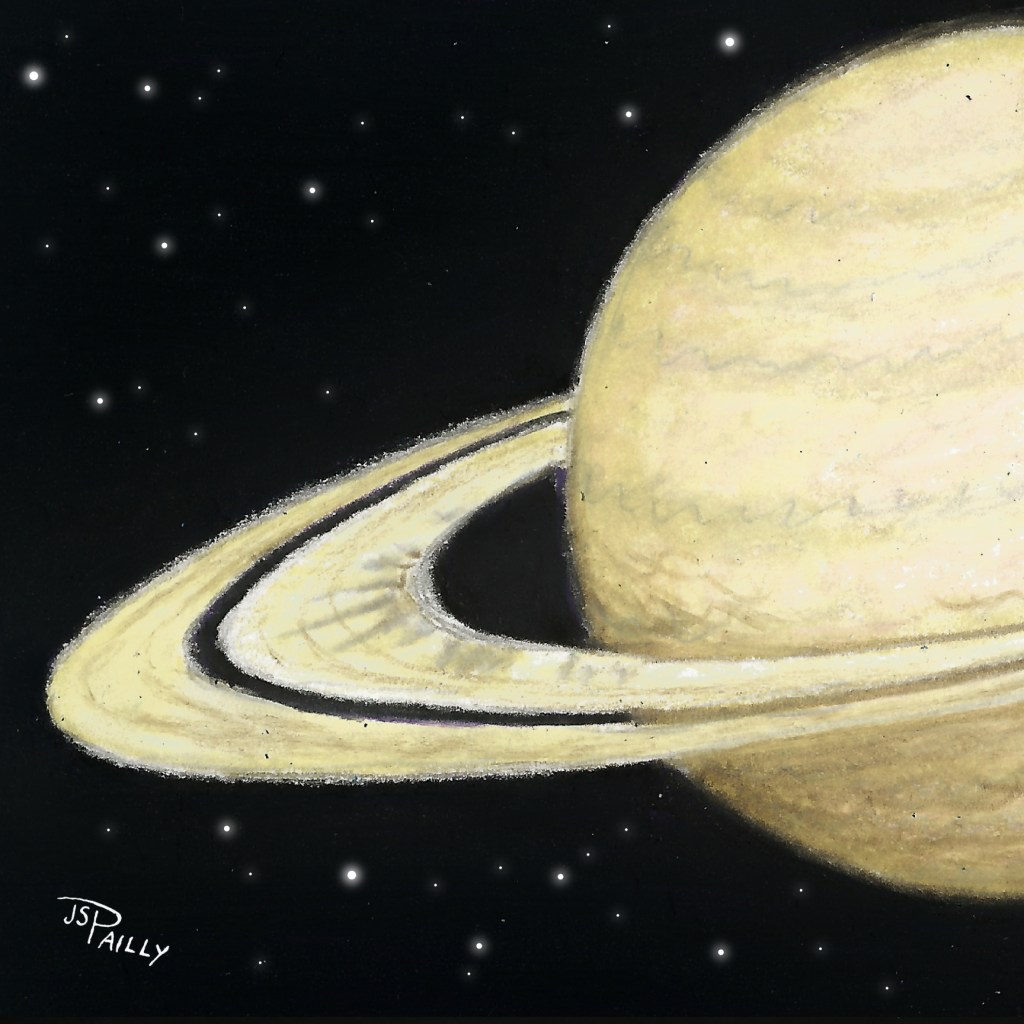
This may surprise you, but my favorite fact about Saturn has nothing to do with Saturn’s rings. It has to do with Saturn’s moons. When astrobiologists (scientists who search for and study potential signs of alien life) talk about the Solar System, not one but two Saturnian moons get mentioned over and over again. Their names are Enceladus and Titan.
Let’s talk about Titan first. Titan is covered with this weird sludge of organic chemicals. It’s important to note that in chemistry, the word organic does not necessarily have anything to do with organisms. Organic simply means carbon-based. However, when you find a world like Titan that’s just drenched in this organic chemical sludge, one can’t help but wonder….
Meanwhile, Enceladus has an ocean of liquid water hidden beneath its surface. What’s happening in that subsurface ocean? Are the conditions right for life down there? We don’t know. However, rather conveniently, there are cryovolcanoes clustered around Enceladus’s south pole. These cryovolcanoes spew water, salt, and traces of organic chemicals up from the ocean and out into space. Again, the presence of organic chemicals does not necessarily mean organisms are also present. And yet, given everything we know about Enceladus so far, one can’t help but wonder….
The search for alien life is hard, in large part because we’re not 100% sure what we’re looking for. Alien life could be wildly different from any sort of life we know here on Earth. Still, we know enough to have strong suspicions about both Titan and Enceladus, which means that exploring Saturn is a rare two-for-one deal in our ongoing search for alien life.
Thank you, friends, for reading. Next time, I’ll share my #1 favorite fact about the planet Uranus.


It’s incredible to thik that somewhere out the primordial life might have started
LikeLiked by 1 person
It is! And both Titan and Enceladus are good places to look for it.
LikeLiked by 1 person
Glad you chose the moons – esp Titan. Someone was kind enough to help me in my research of Titan, so I’m going to copy/paste the thank you from my book here: Thanks to Christopher P. McKay, NASA Ames Research Center, Space Science Division, for answering questions about Titan and for providing a copy of his concept paper, Titan as the Abode of Life, Life 2016, 6, 8.
LikeLike