My Favorite Fact About Mars

Hello, friends!  Right now, I’m going through some big changes in my life, which leaves me very little time for writing.  And yet, because I am the person I am, I must write something!  So during this time, I’ve been writing these quick and easy posts sharing my #1 favorite facts about each planet of the Solar System.  Today, it’s time for my #1 favorite fact about Mars.

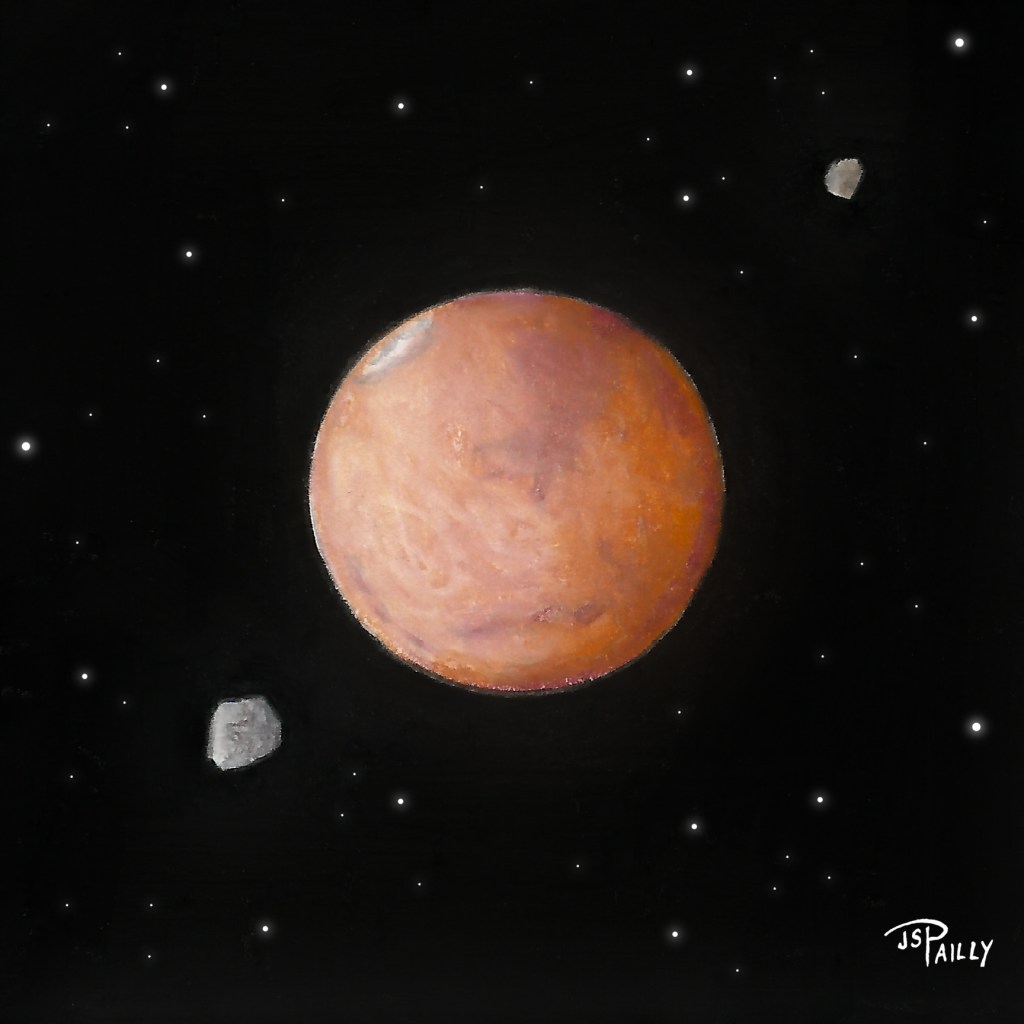
This one’s tough.  Mars is the most thoroughly explored planet in the Solar System (besides Earth, of course), which means there are tons of Mars facts to choose from.  And brand new Mars facts keep coming in all the time, thanks to the fleet of robotic spacecraft that have been continuously exploring the Red Planet for decades now.  But if I must pick just one Mars fact to share today, it would be this: Mars’s beautiful orangey-red color is only skin deep.

A little over a decade ago, the Curiosity Rover did something that had never been done before.  It drilled a tiny hole into the surface of Mars.  This hole was only two inches deep, but that was enough.  Just beneath Mars’s very red surface, the rock changed to a dull grey color.

You’ve probably heard that Mars’s red color is associated with iron oxide (a.k.a., rust).  So it may be that the grey stuff is some other iron-rich mineral, something that didn’t get oxidized (rusted) like the stuff on top of it.  Since drilling that first tiny hole, Curiosity has drilled over forty similar holes in different locations on Mars.  Sometimes, Curiosity finds grey rock, sometimes not.  That probably just means the red top layer is thin in some places and thicker in others.

What does all this tell us about the history of Mars or the modern geology of Mars?  I’m not sure.  But I do think this is a super fun fact to share at parties: beneath a relatively thin layer of red, Mars—the famously red planet—is mostly grey.

Thanks for reading, friends!  Next time I’ll be sharing my #1 favorite fact about Jupiter, which also involves the color red.

My Favorite Fact About Earth

Hello, friends!  I’m going through some life changes right now, which leaves me precious little time for writing.  But I still want to write something, so during this time I’m just writing this series on my #1 favorite facts about each planet of the Solar System.  Today, I’d like to share my #1 favorite fact about Earth.

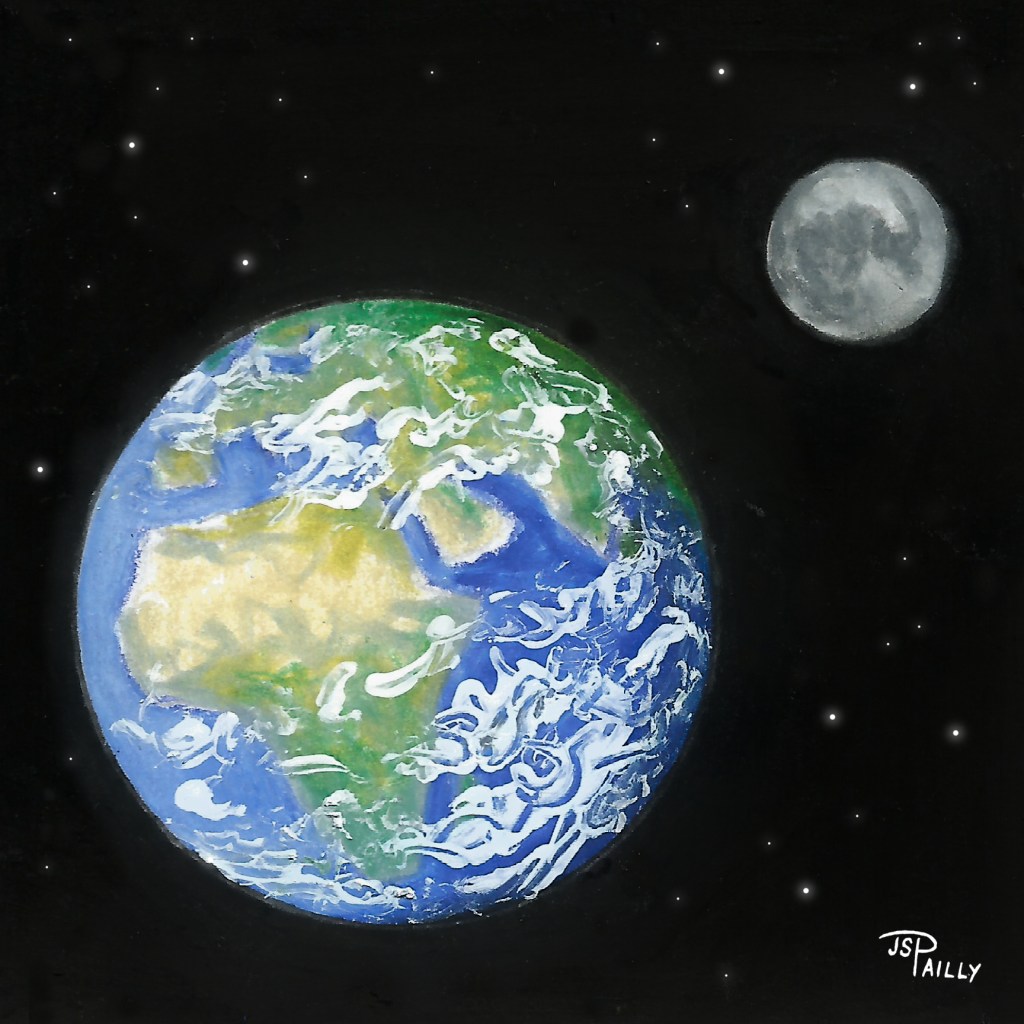
I love bringing this fact out at parties.  It’s a great conversation starter.  In 1990, NASA discovered life on Earth.

Okay, so here’s the story.  Prior to 1990, NASA sent all these missions out into space, hoping to find life.  Finding life should be easy, right?  And yet, they found nothing.  It was enough to make some scientists ask: “Are… are we doing something wrong?”  So at the suggestion of one of those scientists (Carl Sagan), NASA turned all the instruments of one of their space probes toward Earth, just to check and make sure those instruments could detect life on a planet where life was already known to exist.

And it worked!  Based solely on the data from that one space probe, NASA confirmed that there is life on Earth.  There were several compelling lines of evidence.  Here’s just one example.  NASA detected traces of methane in Earth’s atmosphere.  That, by itself, proves absolutely nothing.  NASA also detected oxygen in Earth’s atmosphere.  Atmospheric oxygen, by itself, also doesn’t mean much.  But the combination of oxygen and methane in the same planet’s atmosphere?  That’s odd.  That’s very, very strange.  It’s hard to explain how a planet ends up with an atmosphere like that, unless it’s due to biological activity.

Someday, astronomers may discover life on a distant exoplanet (a planet orbiting a star other than our Sun).  If/when that happens, one of the first signs of alien life will probably be a weird mix of chemicals in the exoplanet’s atmosphere.  It doesn’t have to be oxygen and methane.  It doesn’t have to be any of the chemicals found in Earth’s atmosphere, necessarily.  It just has to be a mix of chemicals that don’t make chemical sense together.  Searching for weird mixtures of atmospheric chemicals is one of the easiest ways to detect life on a planet.  We know, because that was one of the ways NASA detected life on Earth in 1990.

Thank you, friends, for reading.  We’ll continue this series later this week with my #1 favorite fact about Mars.

My Favorite Fact About Venus

Hello, friends!  I’m going through some major life changes right now, which leaves me very little time for writing.  And yet, because I am the person I am, I must write something!  So for the next few weeks, I’m just going to write some quick, easy posts sharing my favorite facts about each planet of the Solar System.  Today, let’s talk about my #1 favorite fact about Venus.

Venus hates you.  More than any other planet, Venus wants you dead.  If you ever try to land on Venus, she’ll kill you a dozen times over before you even touch the ground.

First, there’s the sulfuric acid.  It rains pure sulfuric acid on Venus.  Then there’s the heat.  You know how small amounts of carbon dioxide are slowly warming our planet?  With a 96% CO2 atmosphere, Venus is way beyond Earth-like global warming.  That 96% CO2 atmosphere traps enough heat to make Venus the hottest planet in the Solar System (hotter even than Mercury, despite Mercury being so much closer to the Sun).  And now let’s talk about pressure.  Venus’s atmospheric pressure is so extreme that it makes more sense to compare it to the pressure at the deepest depths of Earth’s oceans.  Remember that submarine full of billionaires that imploded near the wreckage of the Titanic?  That’s what Venus will do to your spacecraft if you try to land there.

Anyone who knows anything about space will tell you Venus is an absolute hellhole.  But that’s not my #1 favorite fact about Venus.  My #1 favorite fact is that there is a way to survive a trip to Venus.  Just don’t land.  Stay at an altitude of 55 kilometers (34 miles) above the surface.  That’ll put you safely above the sulfuric acid rainclouds.  The temperature and pressure are almost Earth-like at that altitude, too.  Conditions are surprisingly nice.  So someday, if we could build a floating city on Venus—something like Cloud City from Star Wars—Venus could end up being one of the nicest places for humans to live in the entire Solar System.

Thanks for reading, friends!  Stay tuned.  We’ll continue this next week with my #1 favorite fact about Earth, followed by my #1 favorite fact about Mars.

My Favorite Fact About Mercury

Hello, friends!  I’m going through some major life changes right now, which leaves me precious little time for writing.  And yet, me being the person that I am, I must write something!  So for the next few weeks, I’m just going to write some quick and easy posts sharing my #1 favorite facts about each planet of the Solar System.  Today, we’re starting with my #1 favorite fact about Mercury.

Finding water in space isn’t actually a big deal.  Water molecules are the simplest possible combination of hydrogen and oxygen, the first and third most common elements in the universe, respectively.  So we should expect to find water (in ice form, at least) all over the place.  And we do find it all over the place!  Many moons of the outer Solar System are covered in ice.  The rings of Saturn are mostly made of ice, and comets are famously described as “dirty snowballs” due to how much ice they contain.

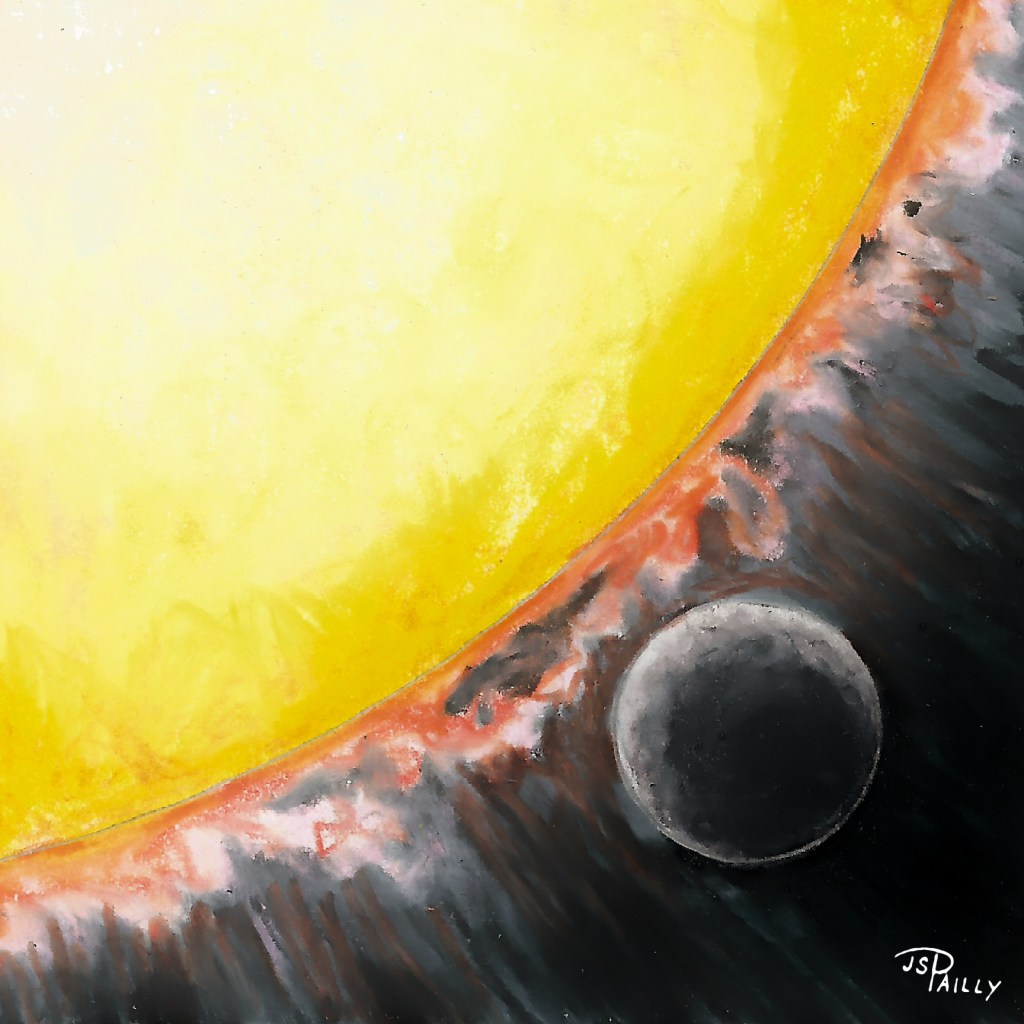
That being said, it’s still wild that we found water on Mercury, the planet closest to the Sun.  You’d think all that heat from the Sun would have vaporized any water on Mercury a long, long time ago.  But it turns out there are some very deep craters clustered around Mercury’s north and south poles.  The crater walls are tall.  The bottoms of these craters are perpetually shielded from the Sun.  And what did we find at the bottoms of these craters?  You guessed it.  Ice.  Gigantic sheets of H2O ice.

How did all that ice end up on Mercury?  Best guess is that at some point, a very large comet slammed into Mercury.  The impact scattered icy material all over the planet.  Most of this ice was then vaporized by the heat of the Sun, but any ice that happened to fall into those deep, dark craters near Mercury’s poles was protected.  And there it remains to this day.

Thanks for reading, friends!  I hope you’ll come back for my next post, when I’ll share my #1 favorite fact about Venus.

Mercury’s #1

Hello, friends!

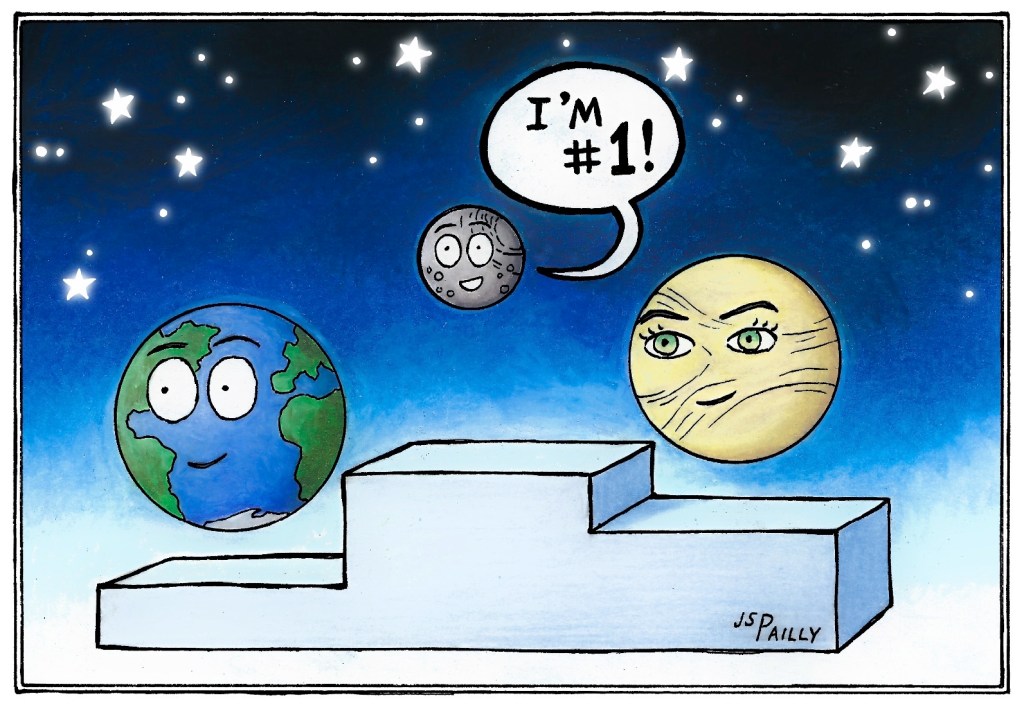
I love Mercury.  He’s the planet closest to the Sun, which makes him the first planet of our Solar System.  Sadly, that seems to be the limit of what the average person knows about Mercury, so today I’d like to share just a few other ways Mercury wins first place.

First off, if there were a footrace among all the planets of the Solar System, Mercury would win.  Easily.  Mercury is the #1 fastest moving planet in the Solar System.  This has a lot to do with Kepler’s laws of planetary motion and Netwon’s law of universal gravitation, but I think I can explain this without digging into Kepler or Newton’s math.  Imagine you’re a planet and you don’t want to fall into the Sun.  You’ll need to keep moving to maintain your orbit.  The closer you are to the Sun, the more you’ll have to fight the Sun’s gravity, and thus the faster you’ll have to move.  Mercury is the closest planet to the Sun; ergo, he’s the fastest.  (If you’d like to learn more about the math behind planetary motion, click here.)

Since Mercury is the planet closest to the Sun, you might assume Mercury is also the hottest planet.  But no, Venus is hotter than Mercury (how that happened is a story for another time).  However, Mercury does have the #1 most extreme difference between daytime and nighttime temperatures.  Daytime temperatures climb as high as 430 degrees Celsius (800 degrees Fahrenheit).  At night, the temperature rapidly drops as low as -180 degrees Celsius (-290 degrees Fahrenheit).  Why?  Because Mercury has virtually no atmosphere.  Atmospheres are like insulating blankets for planets.  Without an atmosphere, Mercury can’t retain heat at all, so all the extreme heat Mercury gets during the day is immediately lost to the vacuum of space at night.  (To learn more about Mercury’s daytime vs. nighttime temperatures, click here.)

There are plenty more ways Mercury is #1, but I’m only going to share one more with you today.  Mercury is the #1 most heavily cratered planet in the Solar System.  How did that happen?  Well, once again, Mercury has no atmosphere, which means all the smaller meteoroids that would burn up in the atmospheres of other planets make it straight through to the ground on Mercury.  Additionally, there’s very little geological activity on Mercury.  No volcanic eruptions, no major earthquakes (mercuryquakes?)… at least not in the last 3.5 billion years.  On other worlds, geologic activity helps erode and erase old impact craters, but that’s not happening on Mercury.  So Mercury gets hit more easily and has a harder time erasing old impact craters.  Those two facts add up to Mercury having more impact craters today than any other planet in our Solar System.  (To learn more about Mercury’s overabundance of craters, click here.)

In my humble opinion, Mercury doesn’t get as much love as he deserves.  I don’t know why that is, but I hope this post has piqued your curiosity and helped you appreciate Mercury a little bit more.  At the time of this writing, the BepiColombo space probe (a joint venture by the European and Japanese space agencies) has completed several flybys of Mercury.  If all goes according to plan, BepiColombo should settle into orbit around Mercury in November of this year (2026).  Here’s hoping BepiColombo will discover even more reasons to love the first planet from the Sun.

The art is today’s post is my own original work.  If you like my art, please consider visiting the I-Love-Space store on RedBubble.  Even if you don’t buy anything, just visiting and clicking the “like” button on my work helps me a lot (and obviously, if you do decide to buy something, that helps me even more).  Thank you, friends!