My Favorite Fact About Neptune

Hello, friends!  This past month brought a lot of big changes to my life, which left me very little time for writing.  And yet, because I am the person that I am, I had to write something.  So I decided to just do these short and easy blog posts sharing my #1 favorite facts about each planet of the Solar System.  Today, we’re wrapping things up with my #1 favorite fact about Neptune.
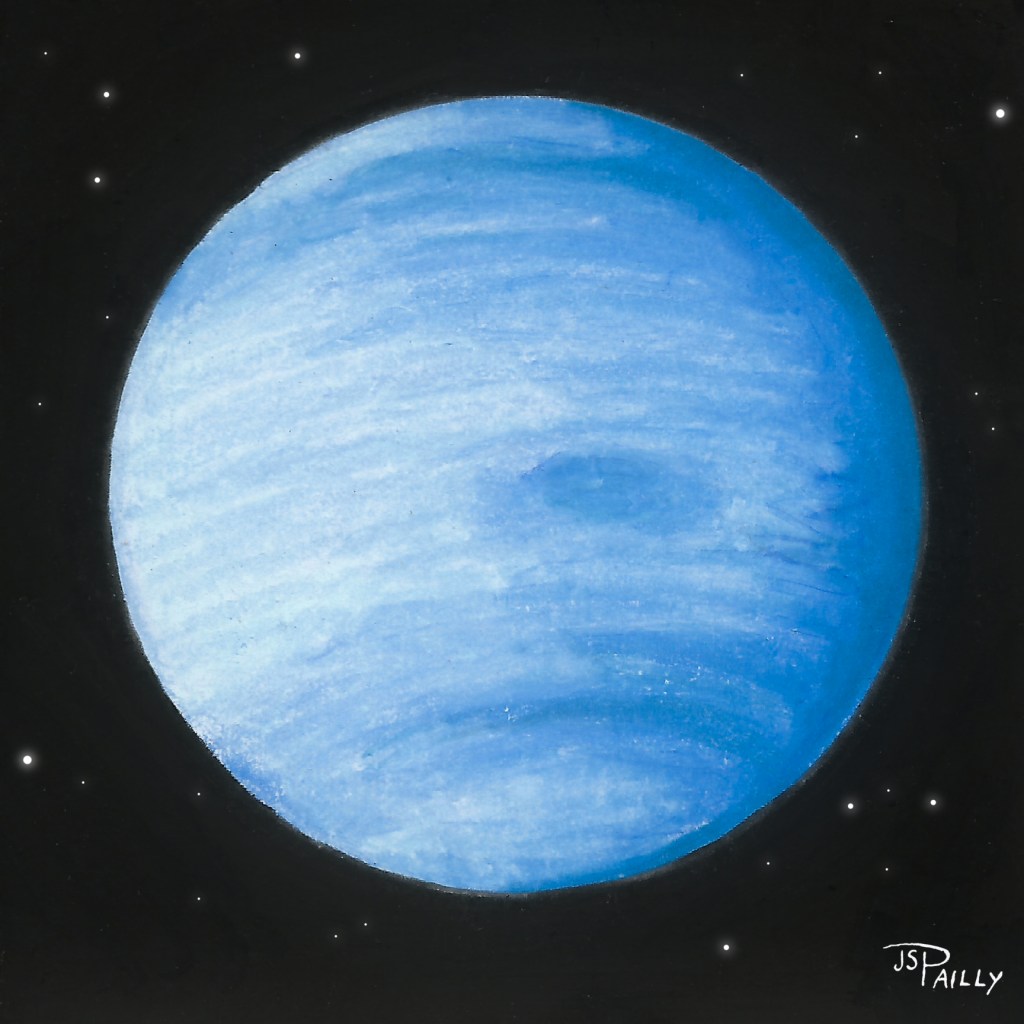
Neptune is 4.5 billion kilometers away from the Sun.  To put that in terms Americans like myself can better understand, that’s over 41 billion football fields.  Neptune is so far away that we really struggle to observe and study him.  I don’t think anything helps illustrate that point better than this: we lost one of Neptune’s moons for more than twenty years.

Naiad, Neptune’s innermost moon, was discovered in 1989 by the Voyager 2 space probe.  And then nobody could find it again until 2013.  The problem?  Well, there were multiple problems.  First, Naiad is very small and also orbits very close to Neptune, which makes spotting Naiad very difficult, even for super powerful telescopes like Hubble or J.W.S.T.  Second, Neptune has another moon, called Thalassa, which is almost the exact same shape and size as Naiad.  That may have caused one moon to be sometimes misidentified as the other.  And third, Naiad has this weirdly inclined (and possibly unstable) orbit, which confused astronomers at first and made it hard to predict where Naiad was supposed to be at any given time.

Naiad is a tricky moon.  Even if Neptune were closer, I’m sure Naiad would have confused astronomers for a while; but I doubt she would have gone missing for over two decades.  Observing and studying Neptune and his moons is hard.  Trying to see anything that’s over 41 billion football fields away is a real challenge.

Thank you, friends, for reading.  This concludes my special series on my #1 favorite facts about the planets of our Solar System, but don’t worry!  I’ll have a post about Pluto coming soon.
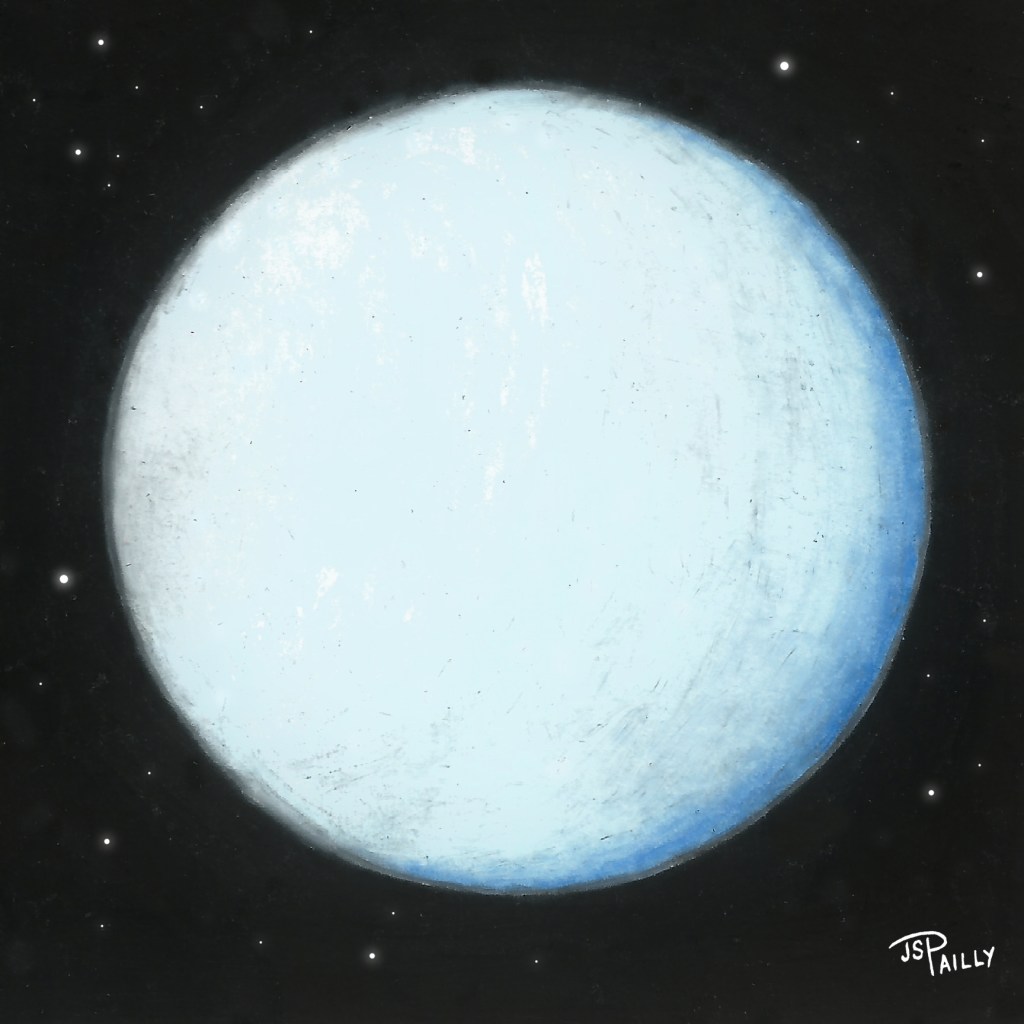
My Favorite Fact About Uranus

Hello, friends!  Life’s been slightly out of control lately, but things are finally starting to settle down.  Meanwhile, we’re nearing the end of this special series covering my #1 favorite facts about each planet of the Solar System.  Today, we’re covering my #1 favorite fact about the planet Uranus.

Everybody (or at least everybody in the English-speaking world) has something snarky to say about Uranus.  But—fun fact!—Uranus was not Uranus’s original name.  In 1781, when British astronomer William Herschel first discovered the planet we now call Uranus, he proposed naming it Georgium Sidus.

Georgium Sidus is Latin for “George’s Star.”  Who’s George?  Oh, well that would be King George III.  For fans of Hamilton, it’s that King George.  The guy who sings “You’ll Be Back.”  Being English himself, Herschel wanted to name his newly discovered planet in honor of the King of England.  Needless to say, this didn’t go over well outside the British Empire.  While the discovery of a new planet was widely celebrated, the name Georgium Sidus was roundly rejected.

German astronomer Johann Bode proposed the name Uranus, honoring the ancient Greek god of the sky, who was also the father of Saturn and the grandfather of Jupiter.  I assume Bode didn’t realize what “Uranus” would sound like in English.  Then again, I sometimes wonder if he did know.  I wonder if Bode was deliberately pranking the entire English-speaking world: “Oh, you wanted to name a planet after King George III?  How about we call it ‘Uranus’ instead?”

Thank you, friends, for reading.  Stay tuned for my final post in this series, when I’ll share my #1 favorite fact about Neptune.

My Favorite Fact About Saturn

Hello, friends!  I’ve been going through some stuff recently, which limits my time for writing.  But since writing is so important to me, I’ve been making time to write these short and simple blog posts on my #1 favorite facts about each planet of the Solar System.  Today, it’s time for my #1 favorite fact about Saturn.

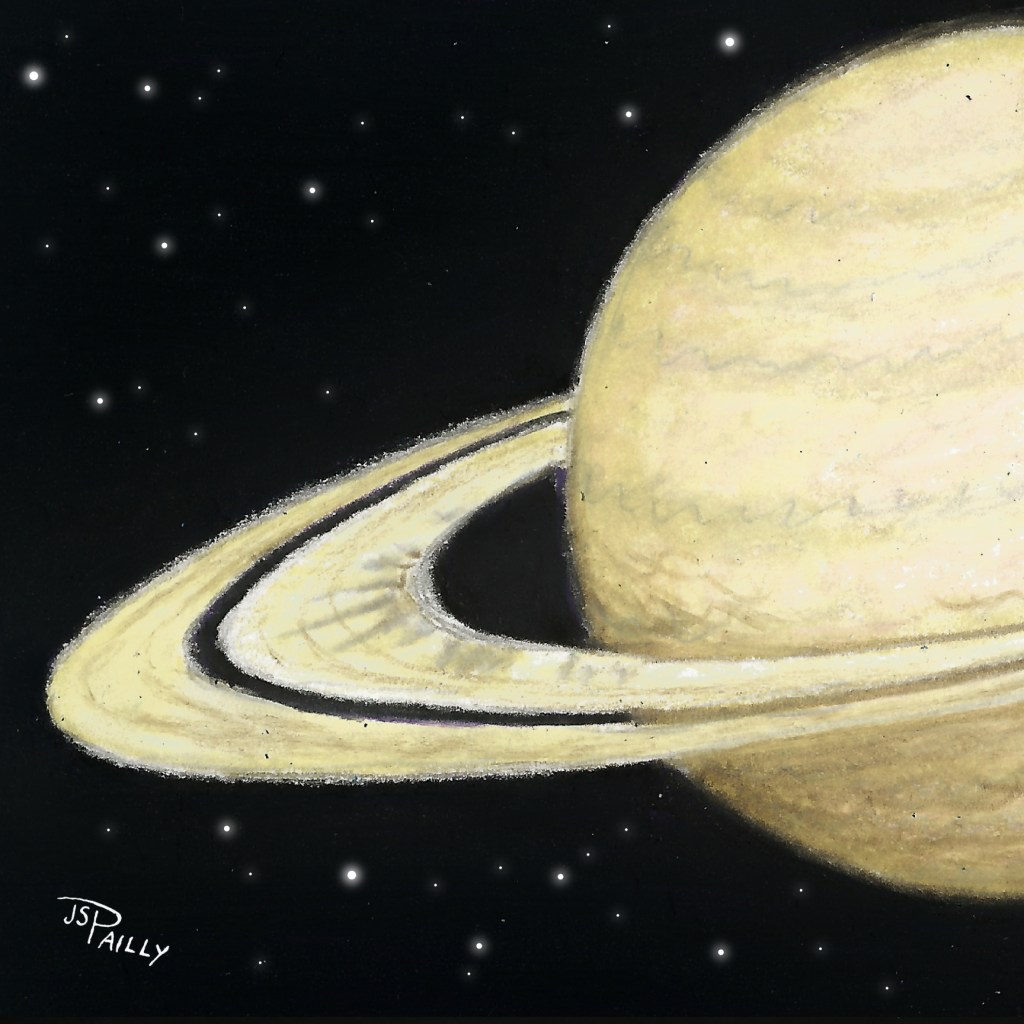
This may surprise you, but my favorite fact about Saturn has nothing to do with Saturn’s rings.  It has to do with Saturn’s moons.  When astrobiologists (scientists who search for and study potential signs of alien life) talk about the Solar System, not one but two Saturnian moons get mentioned over and over again.  Their names are Enceladus and Titan.

Let’s talk about Titan first.  Titan is covered with this weird sludge of organic chemicals.  It’s important to note that in chemistry, the word organic does not necessarily have anything to do with organisms.  Organic simply means carbon-based.  However, when you find a world like Titan that’s just drenched in this organic chemical sludge, one can’t help but wonder….

Meanwhile, Enceladus has an ocean of liquid water hidden beneath its surface.  What’s happening in that subsurface ocean?  Are the conditions right for life down there?  We don’t know.  However, rather conveniently, there are cryovolcanoes clustered around Enceladus’s south pole.  These cryovolcanoes spew water, salt, and traces of organic chemicals up from the ocean and out into space.  Again, the presence of organic chemicals does not necessarily mean organisms are also present.  And yet, given everything we know about Enceladus so far, one can’t help but wonder….

The search for alien life is hard, in large part because we’re not 100% sure what we’re looking for.  Alien life could be wildly different from any sort of life we know here on Earth.  Still, we know enough to have strong suspicions about both Titan and Enceladus, which means that exploring Saturn is a rare two-for-one deal in our ongoing search for alien life.

Thank you, friends, for reading.  Next time, I’ll share my #1 favorite fact about the planet Uranus.

My Favorite Fact About Jupiter

Hello, friends!  My life is complicated at the moment, leaving me precious little time for writing.  And yet, because I am the person I am that I am, I must write something!  So this month, I’ve just been writing these quick, easy posts sharing my favorite facts about each planet of the Solar System.  Today, we’re talking about my #1 favorite fact about Jupiter.

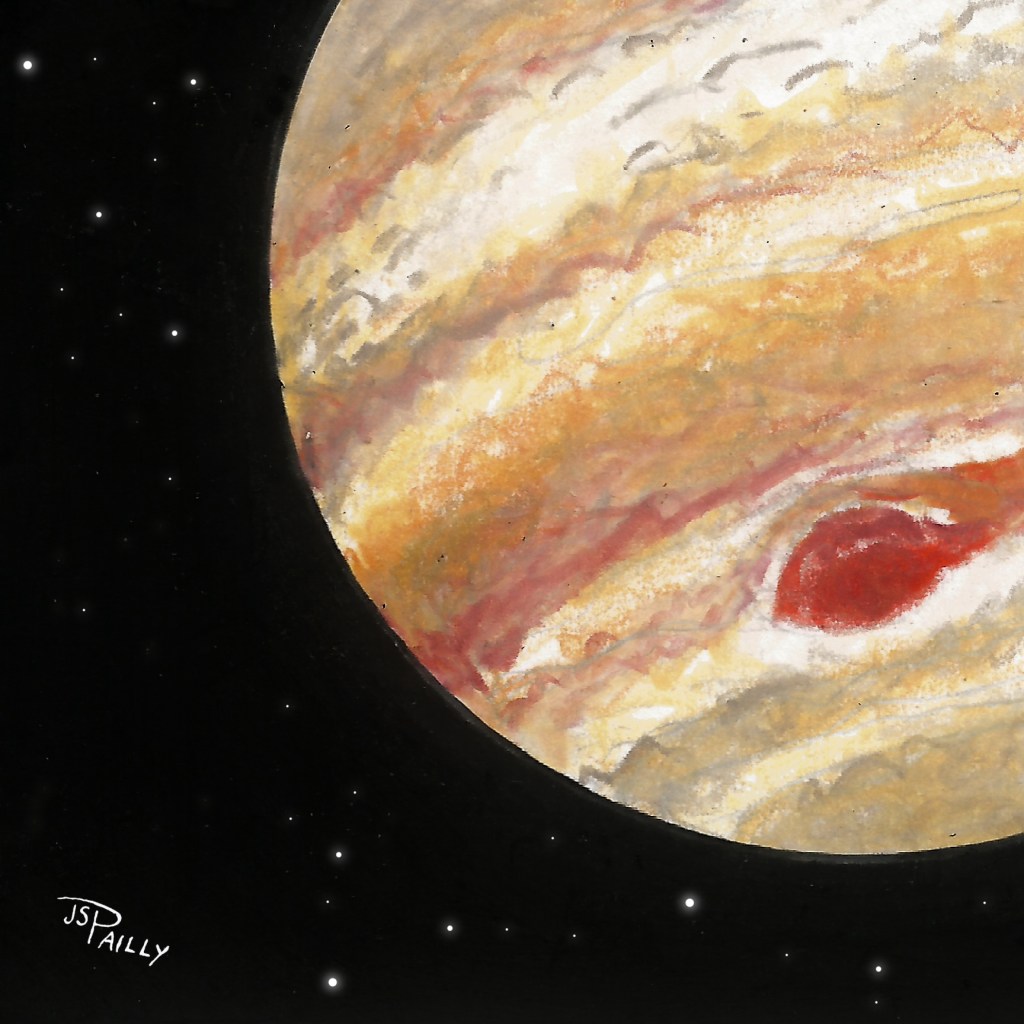
Jupiter is actually my favorite planet to look at in a telescope.  Even with a small, relatively cheap telescope, you can see the major moons, and if you check up on Jupiter from night to night you’ll see how much those moons move.  You can also see the texture of Jupiter’s clouds: the light and dark stripes contrasting against each other.  And if you’re lucky, you might even be able to see Jupiter’s Great Red Spot—but that is getting harder and harder to do.

Astronomers first started tracking the Great Red Spot in the 1830’s.  Based on notes and drawings from that time, it seems the Spot was roughly 40,000 km wide back then.  By the time NASA’s Voyager probes arrived in the 1970’s, though, the Great Red Spot was much smaller.  23,000 km wide.  And it continues to shrink to this day.  Currently, it’s about 16,000 km wide.

The ultimate fate of Jupiter’s Great Red Spot remains unknown, but there’s a real possibility that it will disappear entirely within the next few decades.  So if you ever have the chance to see Jupiter with a decently powerful telescope, do it!  Your opportunity to see the Great Red Spot for yourself may be running out.

Thank you, friends, for reading.  Stay tuned.  My #1 favorite fact about Saturn is coming soon.

Betelgeuse and Siwarha

Hello, friends!

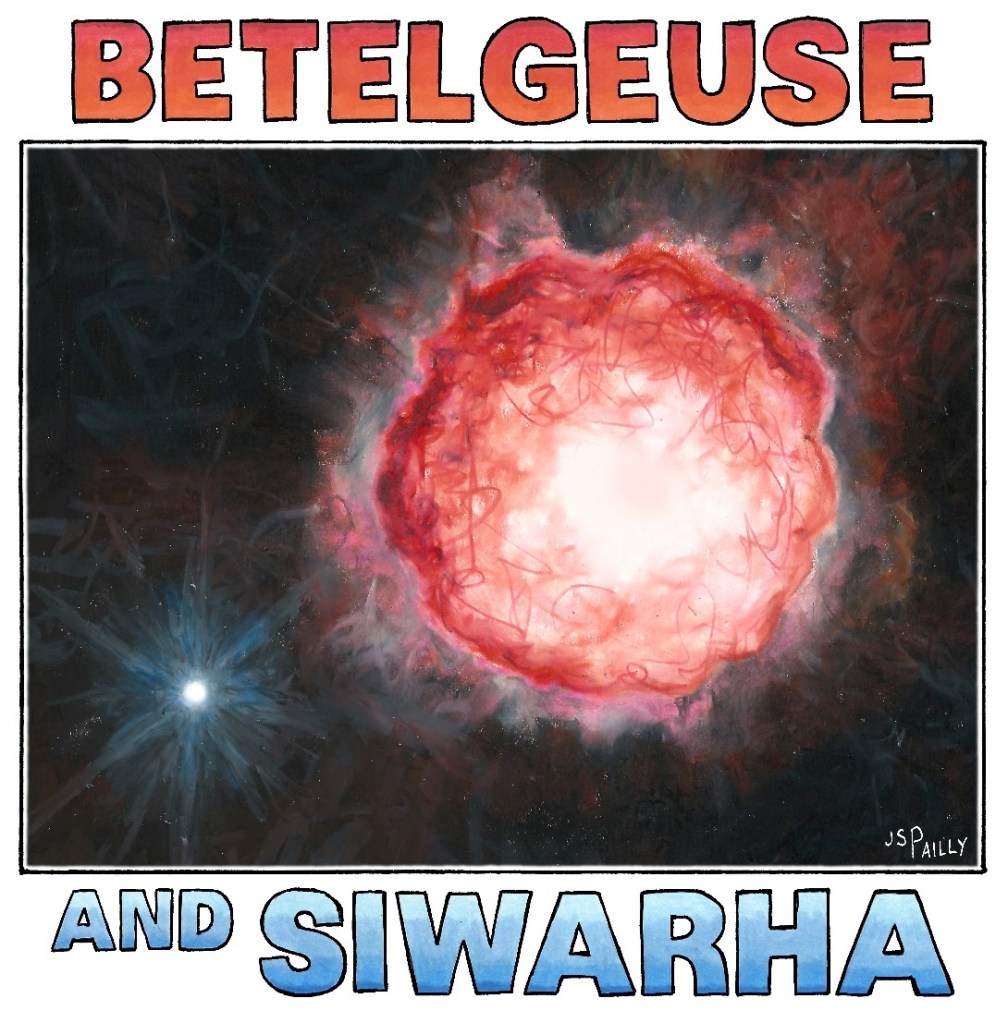
I love space, but I also love language and words and names, and I especially love it when people put thought and care into the naming of things.  Betelgeuse is a super famous supergiant star in the constellation Orion.  For as long as I can remember, it was generally assumed that Betelgeuse was a loner.  A single star, all by herself, with no binary companion.  But now it seems that Betelgeuse does have a very small, very faint companion star, which astronomers have (very aptly) named Siwarha.

Back in 2019/2020, astronomers noticed Betelgeuse start to flicker and dim.  There was a rapid 30% decrease in Betelgeuse’s brightness, leading to rampant speculation that Betelgeuse was about to go up in a supernova explosion.  That would have been an amazing sight for all of us here on Earth!  But then, nothing happened, and Betelgeuse’s brightness eventually went back to normal.

The Great Dimming of Betelgeuse, as this event is now called, was caused by something less spectacular than a supernova (less spectacular, but still interesting—check out the “want to learn more?” section below if you want to learn more).  Still, during the Great Dimming, Betelgeuse got a lot more attention from astronomers than usual, and astronomers started noticing patterns in her behavior—including a pattern that (based on reexamining historical records) seemed to repeat every 2100 days.

One possible explanation: maybe Betelgeuse has a companion star with an orbital period of 2100 days.  This hypothetical companion star was initially nicknamed “Betelbuddy.”  But then, in December of 2024, astronomers at the Gemini North Observatory in Hawaii were able to directly image “Betelbuddy” in mid-orbit.  At that point, Betelgeuse’s companion stopped being hypothetical, and somebody needed to give it a more official-sounding name.

Betelgeuse is an Arabic name (as most traditional star names are), and it means something like “the hand of the giant.”  The giant in question is, of course, Orion; however, the Arabic name for Orion is al Jawza, which is a female name from Arabian legend.  Therefore, since this newly discovered star circles round and round the hand of a lady giant, the Gemini North team proposed naming it “Siwarha,” meaning “her bracelet.”

How perfect is that?

Siwarha would have been hidden behind Betelguese during the Great Dimming, so it was not visible to Earth-based astronomers at that time, no matter how hard they looked for it.  Even after Siwarha emerged from behind Betelgeuse, spotting it stretched the limits of one of the very best telescopes in the world.  After crossing in front of Betelgeuse, Siwarha should appear again (on the opposite side of Betelgeuse) in late 2027, at which point astronomers should be able to learn much, much more about it.

WANT TO LEARN MORE?

Here’s a brief article published by NASA announcing the discovery of Siwarha.

And here’s a link to the actual research paper explaining how the Gemini North team detected Betelgeuse’s companion star.  The proposal to name it “Siwarha” is near the end of the paper.

As for the Great Dimming of Betelgeuse, it was caused by Betelgeuse burping a big, giant cloud of dust up into space, which partially obscured our view.  Click here to learn more about that.

P.S.: The art in today’s post is my own original work.  If you like my art, please consider visiting the I-Love-Space store on RedBubble.  Even if you don’t buy anything, just visiting and clicking the “like” button on some of my work helps me a lot (and if you do decide to buy something, that obviously helps me even more!).  Thank you!