How Old Are Saturn’s Rings?

Hello, friends!

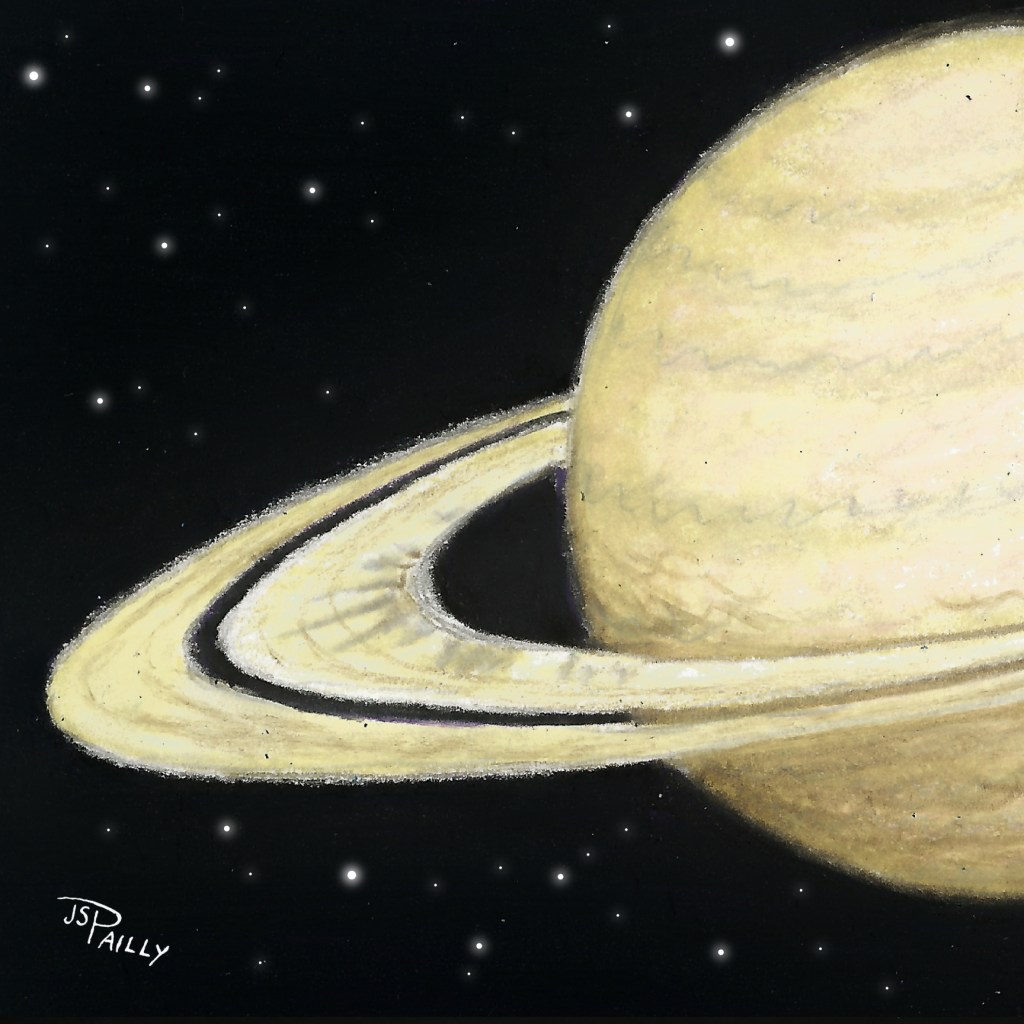
I love Saturn’s rings, you love Saturn’s rings, everybody loves Saturn’s rings!  And as you can see in the 100% real, totally legit J.W.S.T. image below, even Saturn is a little obsessed with her own rings.

Those rings are iconic!  They’re also mysterious.  Did Saturn always have rings like that, or were they created more recently (perhaps by the destruction of a Saturnian moon)?  The answer depends on which scientists you ask.

Saturn’s rings are mostly made of ice, the frozen water kind of ice (as opposed to methane ice, ammonia ice, nitrogen ice… lots of things turn into ice in space).  But the rings aren’t a pure, icy white color.  Like a pile of snow near the curb of a highway, Saturn’s rings get dirtier and dirtier over time.  Based on how dirty the rings look today, some scientists believe they can calculate how old the rings must be.  And according to those calculations, Saturn’s rings must have formed between 100 million and 400 million years ago.  That may sound like a long time ago, but in cosmic terms that makes the rings surprisingly new.

However, there’s also research suggesting that Saturn has self-cleaning rings.  Basically, here’s how that would work: when dirt and dust particles from space enter Saturn’s ring system, those particles are moving at extremely high speeds.  High speed collisions vaporize the dust particles.  The vaporized dust undergoes gaseous expansion. Most of the expanding gas then leaves the ring system due to a combination of its own momentum plus Saturn’s gravity plus Saturn’s magnetic field.  If this is true, the rings still get dirtier and dirtier over time, but at a much slower rate.  This means the rings could be up to 4.5 billion (with a b) years old.  In other words, the rings could be as old as Saturn herself.

When new scientific research comes out, I think people get the wrong idea about what that means.  I blame Hollywood, and I blame the media.  Whenever a new scientific paper is published, it’s often portrayed as the final, definitive word of science.  Until another paper comes out, contradicting the first.  Then that’s portrayed as the final, definitive word of science.  Until another paper comes out.

But science is more like an ongoing, back-and-forth conversation.  One paper comes out, making a point.  Another paper follows, making a counterpoint.  Then there’s a counterpoint to the counterpoint, and then a counterpoint to the counterpoint of that counterpoint… and so on and so forth, until eventually (hopefully) the scientific community reaches some sort of consensus.

So how old are Saturn’s rings?  Well, while researching this blog post, the most recently published paper I saw said 4.5 billion years; however, I think this is still an ongoing conversation.  New points are still being made.  New counterpoints are still being offered.  Maybe the rings are super ancient, or maybe they’re relatively young.  Science has figured out a lot of things, but on this question about Saturn’s rings, I think we’re still waiting for the scientific community to reach a consensus.

WANT TO LEARN MORE?

Maybe Saturn’s rings relatively young.  Click here to read more about that, or click here to see an actual research paper on that hypothesis.

Or maybe Saturn’s rings are super old.  Click here for an article on that, or click here to see the actual research.

Okay, I lied.  That wasn’t really a J.W.S.T. image of Saturn.  I drew that myself.  If you like my drawings, please consider visiting the I-Love-Space store on RedBubble.  Even if you don’t buy anything, just visiting and maybe clicking the like button on my art helps me a lot. Thank you, friends!

The Other Moon Race: Jupiter vs. Saturn

Hello, friends!

As you know, there’s a new moon race going on, a new race to return humans to the Moon!  But that’s not the moon race we’re talking about today.  No, today we’re talking about the race between Jupiter and Saturn to be the planet with the most moons in the Solar System.

You might expect Jupiter to win this easily.  Jupiter’s the biggest planet, and Jupiter has the most gravity.  Shouldn’t Jupiter end up with the most moons?  Well, Saturn has one not-so-obvious advantage over Jupiter: Saturn is farther away from the Sun.  That means a moon orbiting Saturn is less likely to be yanked away by the Sun’s gravity than a moon orbiting Jupiter.

This has to do with a concept in astrophysics called the Hill sphere, named after American astronomer/mathematician George William Hill.  This can get a bit technical, so if you want to learn more please check out the “What to Learn More?” section below.  This gist is this: a Hill sphere is the area around a planet where the planet’s gravity is more important than the gravity of the Sun.  The size of a Hill sphere is determined by two factors: how massive is the planet, and how far away is the Sun?

Saturn may be smaller than Jupiter, and she may have less gravity than Jupiter, but she’s so much farther away from the Sun that she ends up having the larger Hill sphere.  So which planet has the most moons?  Well, over the past few decades, as astronomers have discovered more and more moons orbiting each planet, it’s been a bit of a horserace.  Sometimes Saturn’s ahead by a couple moons, then Jupiter will catch up and take the lead, then Saturn will take the lead again for a while, and so on.

But in the last year or so, that’s changed.  Saturn has surged way ahead in the “moon race.”  At the time of this writing, Jupiter is known to have 115 moons.  Saturn, meanwhile, has 292.  We can safely assume that more moons will be discovered orbiting both planets, so the race isn’t over; however, I’m going to make a prediction now.  I don’t think Jupiter’s going to win this.

I don’t think Saturn will win, either.  There are (at least) two more planets farther away from the Sun than Saturn.  If having the biggest Hill sphere is the key to winning this moon race, Neptune’s Hill sphere is larger than Jupiter and Saturn’s Hill spheres combined (and if the Planet Nine hypothesis turns out to be correct, God only knows how large Planet Nine’s Hill sphere must be).

At the moment, Neptune is only known to have 16 moons.  I’m predicting today that as our telescopes continue to advance and as our observing techniques continue to improve, Neptune’s moon count will go up.  By a lot.  Ultimately, I’m predicting that Neptune’s total moon count will exceed Jupiter’s and Saturn’s by far.

WANT TO LEARN MORE?

Here’s an article from CosmoBC on Hill spheres, including a chart listing the radius of the Hill spheres of each planet of the Solar System (plus a few of the dwarf planets).

Here’s an article by Phil Plait on how the Moon stays in orbit by staying inside Earth’s Hill sphere.  It’s an older article, but it’s still very much worth a read if you want to understand how Hill spheres work.

Here’s an article from Earth Sky on the current totals for Jupiter’s  and Saturn’s moons.

And here’s another article from Earth Sky on the total number of moons for Uranus and Neptune, with a little information about why discovering moons orbiting Uranus and Neptune is still so difficult for us.

Lastly, I mentioned the Planet Nine hypothesis.  If you don’t know what that is, click here.

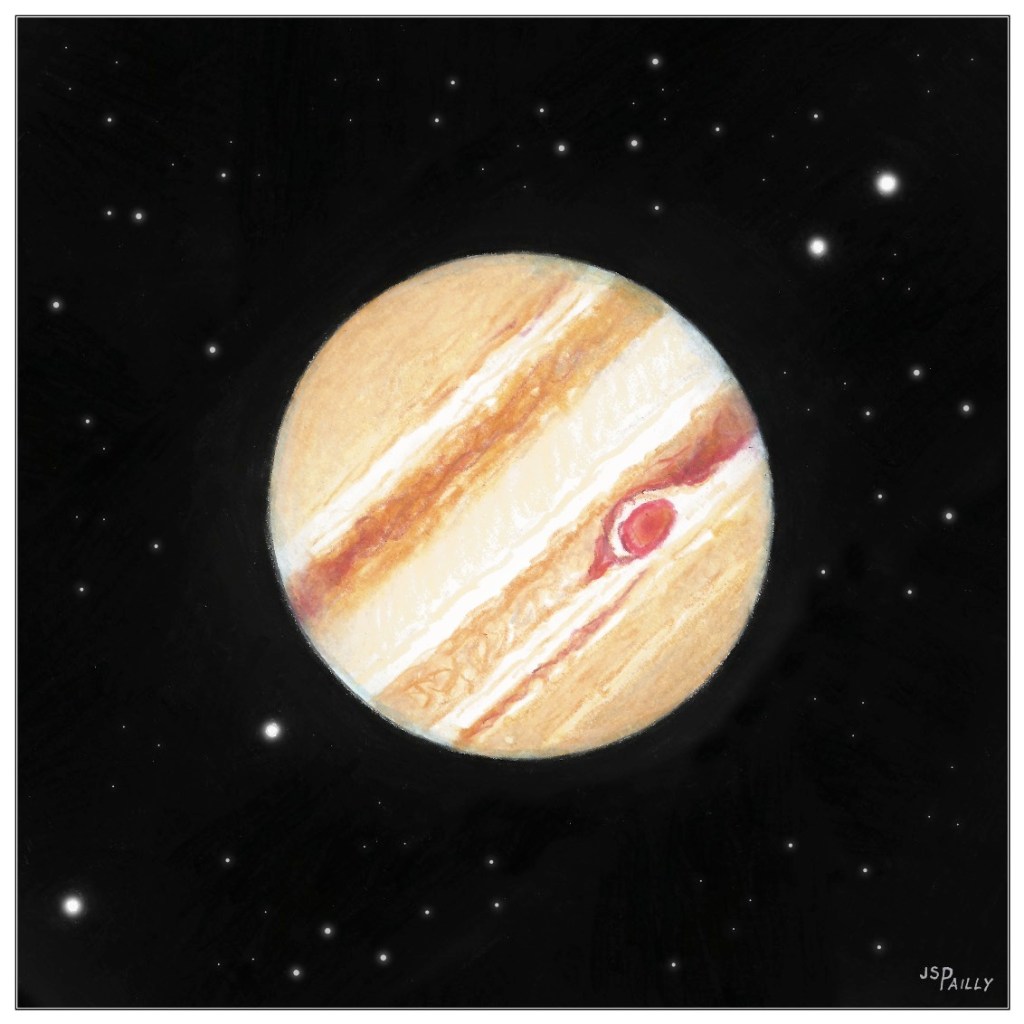
The art in today’s post is my own original work.  I don’t use A.I. for anything, ever.  If you like my art, please consider visiting the I-Love-Space store on RedBubble.  Even if you don’t buy anything, just visiting my store and clicking the like button on a few things helps me a lot.  Thank you, friends!