
Hello, friends!
It’s been a couple weeks since Artemis II went to space, looped around the Moon, and returned safely to Earth. One thing really surprised me during this mission: I didn’t hear many people whining about the cost. Whenever important NASA stuff is in the news, I always hear a ton of people whining about the cost. But this time, not so much! Which leaves me wondering: why was Artemis II different?
The most obvious explanation is that while Artemis II was up in space, there was this other major news story happening down here on the ground. Now this is not a political blog, and I don’t want to dwell on politics too long, but we can’t ignore the elephant in the room: the war. Just before Artemis II launched, the U.S. started a war with Iran. That war is wildly unpopular and also extravagantly expensive. When we keep hearing about the government spending one or two billion dollars per day on the war, NASA’s budget of $24 billion per year doesn’t sound so bad.
But I don’t think that’s the only reason. Space launches used to be rare and extraordinary events, but in the last few years, they’ve been normalized. With private companies like SpaceX and Blue Origin in the game, launches happen all the time now. There were something like 300 launches worldwide last year! Artemis II was still something new and different and very, very special; at the same time, though, it was just another rocket launch. If we’re going to have 300 launches per year, it doesn’t seem outlandish for one of them to be a Moon mission.
Do you think I’m right about this? Was your experience similar to mine, or did you hear more grumbling and griping about Artemis II’s price tag than I did? Let me know in the comments below.
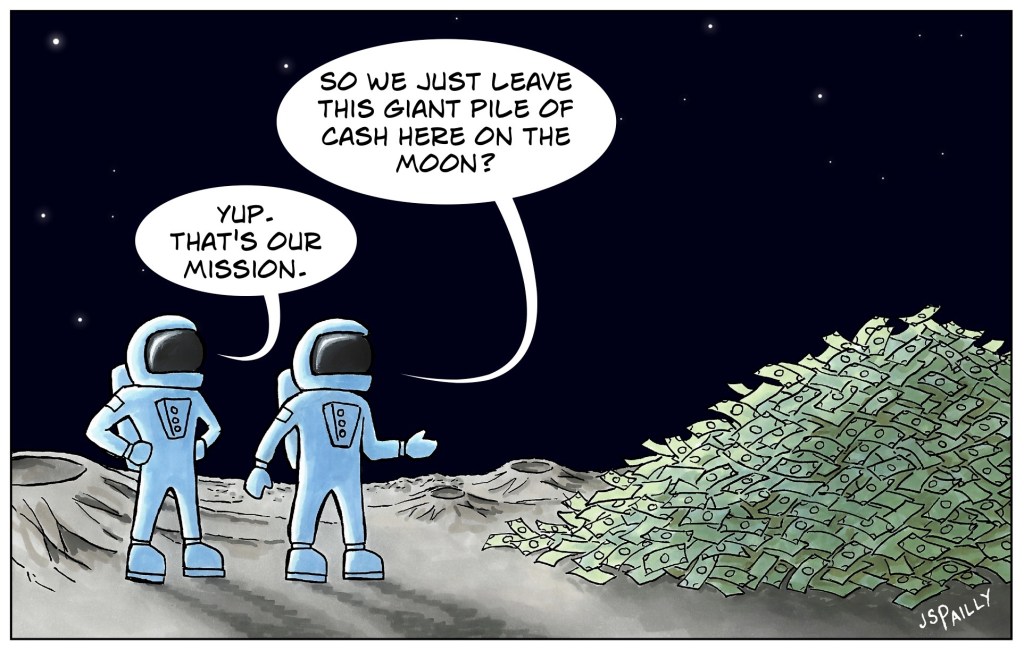
I will acknowledge that I did hear one complaint. It was some political pundit who said something like: “NASA just sent billions of taxpayer dollars to the Moon!” There’s plenty I could say in response to that, but that statement conjured such an amusing mental image in my head. So I’m just going to leave you with this:
WANT TO LEARN MORE?
It wasn’t just me who felt like Artemis II was different. According to this article from Forbes, the vast majority of Americans support the Artemis program and followed the Artemis II mission closely.
If you want to know more about NASA’s budget, check out this article from the Planetary Society. It’s a great resource, not only for understanding NASA’s budget in particular, but for understanding the U.S. federal budgeting process as a whole.
And if you’re up for some more academic literature, here’s a research paper from the journal Space Policy examining how the federal government sometimes does (and sometimes does not) listen to public opinion regarding space exploration.

 i-love-space.com
The contrast probably didn’t hurt. It helped that NASA had a live feed running for the whole mission, where we often could see the astronauts working, as well as the dialogue with mission control, all looking much more competent and professional than what’s happening in other parts of the government. And bitching about the cost overruns of the Space Launch System and Orion would have seemed churlish while actual astronauts were in the field. I think people were also reminded of just how good it feels to have a mission like this, at least when everything goes well.
LikeLiked by 1 person
That’s true. If something had gone wrong, I’m sure the conversation would have been very different.
LikeLiked by 1 person
Better rockets to the Moon…
LikeLiked by 1 person
Yup.
LikeLike
People went out farther than ever before – that intrigued us. And the media was too busy griping about the war (because it’s ‘that guy’) for people to even think about the cost of sending Artemis II past the moon.
LikeLiked by 1 person
As I said, I don’t want to dwell on the political stuff. The main thing I’m trying to say is that NASA is very expensive, but the Department of Defense is orders of magnitude more expensive. That’s always true, but it was on people’s minds in a way that it wasn’t during Artemis I, or when Europa Clipper launched, or when Perseverance landed on Mars.
I also don’t think that that was the only reason. With private companies doing so many more launches per year, I do think public perception of space is slowly changing. Maybe Artemis II was a sign of that.
And as you mentioned, there was the human element. These were actual people out there. That’s different than when we’re talking about some sort of robot being out there.
LikeLike
Something I think that you potentially overlooked is the that there was a critically and audience acclaimed movie in theaters at the same time Artemis II was undergoing its mission.
I’d be curious to see if other space-themed films like Apollo 11 and The Right Stuff had a positive impact on the average person’s agreeableness to investing in space exploration.
Project Hail Mary at least me made me more enthusiastic about Artemis II and space exploration in general.
LikeLiked by 1 person
I could see that. Project Hail Mary leaves you with such a good feeling overall. If you walk out of that movie feeling good and then find out there’s an actual mission going on, it’s easy to believe those good feelings would transfer from the movie to the mission.
LikeLike
NASA used to put out an annual publication called “NASA Spinoff,” or something like that listed the many advantages and value of space program to everyday life, and its commercial applications. This including many things from agricultural advantages through orbital surveillance to medical instruments and even procedures that have become available through research and technology developed for space flight.
LikeLiked by 1 person
If they’re not publishing that anymore, that seems like a real shame. I’d certainly read that.
LikeLike
I’m the same, I don’t dwell on the political stuff on my blog. Ever since the last elections, I’ve scaled back (a lot) on watching the news. But even without watching it, I hear about the war everywhere. So it’s the first time I’m hearing about the moon mission.
LikeLiked by 1 person
I wouldn’t have brought it up here, but the war really was the elephant in the room during Artemis II. I remember one of the astronauts made a comment (very carefully worded, of course) about how the mission proves humans can do good things, too.
LikeLiked by 1 person
❤️❤️❤️
LikeLiked by 1 person
How to make America great again: cut out the pointless unwinnable foreign wars and increase investment in more scientific space missions!
LikeLiked by 1 person
Yeah, that works for me!
LikeLike