
Artemis II: She’s Not Like Other Missions

Hello, friends!

It’s been a couple weeks since Artemis II went to space, looped around the Moon, and returned safely to Earth.  One thing really surprised me during this mission: I didn’t hear many people whining about the cost.  Whenever important NASA stuff is in the news, I always hear a ton of people whining about the cost.  But this time, not so much!  Which leaves me wondering: why was Artemis II different?

The most obvious explanation is that while Artemis II was up in space, there was this other major news story happening down here on the ground.  Now this is not a political blog, and I don’t want to dwell on politics too long, but we can’t ignore the elephant in the room: the war.  Just before Artemis II launched, the U.S. started a war with Iran.  That war is wildly unpopular and also extravagantly expensive.  When we keep hearing about the government spending one or two billion dollars per day on the war, NASA’s budget of $24 billion per year doesn’t sound so bad.

But I don’t think that’s the only reason.  Space launches used to be rare and extraordinary events, but in the last few years, they’ve been normalized.  With private companies like SpaceX and Blue Origin in the game, launches happen all the time now.  There were something like 300 launches worldwide last year!  Artemis II was still something new and different and very, very special; at the same time, though, it was just another rocket launch.  If we’re going to have 300 launches per year, it doesn’t seem outlandish for one of them to be a Moon mission.

Do you think I’m right about this?  Was your experience similar to mine, or did you hear more grumbling and griping about Artemis II’s price tag than I did?  Let me know in the comments below.

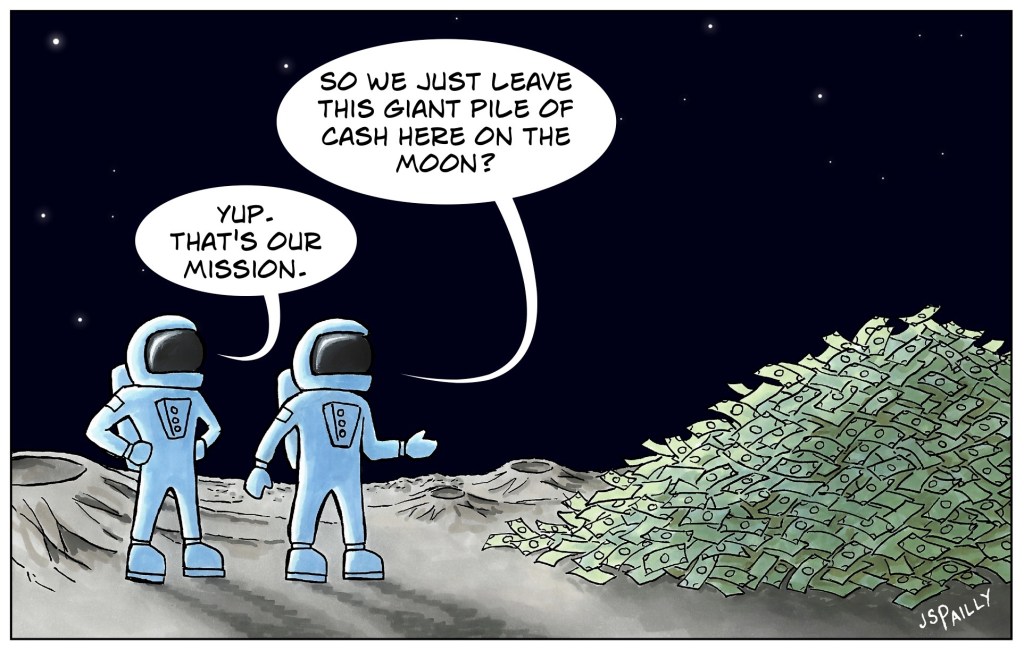
I will acknowledge that I did hear one complaint.  It was some political pundit who said something like: “NASA just sent billions of taxpayer dollars to the Moon!”  There’s plenty I could say in response to that, but that statement conjured such an amusing mental image in my head.  So I’m just going to leave you with this:
WANT TO LEARN MORE?

It wasn’t just me who felt like Artemis II was different.  According to this article from Forbes, the vast majority of Americans support the Artemis program and followed the Artemis II mission closely.

If you want to know more about NASA’s budget, check out this article from the Planetary Society.  It’s a great resource, not only for understanding NASA’s budget in particular, but for understanding the U.S. federal budgeting process as a whole.

And if you’re up for some more academic literature, here’s a research paper from the journal Space Policy examining how the federal government sometimes does (and sometimes does not) listen to public opinion regarding space exploration.

IWSG: Not Because It Is Easy, But Because It Is Hard

Welcome to this month’s meeting of the Insecure Writer’s Support Group, a blog hop created by Alex J. Cavanaugh and co-hosted this month by Melissa Maygrove, Cathrina Constantine, Kate Larkinsdale, and Rebecca Douglass.  Are you a writer?  Do you feel insecure?  Well, then this is the support group for you!  Click here to learn more and to see a list of participating blogs.

Hello, friends!

Later today, if all goes according to plan, NASA’s Artemis II Mission will launch from Kennedy Space Center, carrying four astronauts on a ten-day voyage around the Moon and back again.  Artemis II will not land on the Moon, but this will still be the farthest any human has traveled away from Earth since the 1970’s.  I bring this up for today’s IWSG post because the space program has always been my favorite metaphor for writing.

First off, we writers are always falling behind schedule, always scrambling to keep up with our deadlines, and frequently missing our deadlines despite our best efforts—much like the space program!  Artemis II, for example, was originally supposed to launch in 2024, but there were set-backs.  Unforeseen difficulties.  Stuff happened and got in the way.  It honestly doesn’t take much.  I remember a rocket launch being postponed due to something as simple as a cloud being in just the wrong place at just the wrong time.  I don’t know about you, but I’ve had plenty of writing days ruined by problems almost as simple.

Another thing we writers have in common with the space program: we can’t just do the same thing over and over again.  Every space mission has different objectives, faces exceptional challenges, and requires its own unique innovations in order to succeed.  The same can be said for each new story we writers write.  Sure, there are tried-and-true formulas we can turn to for guidance.  There may be certain methods and techniques that have been helpful before and may be helpful again.  But at some point along the way, we’re going to have to do something we’ve never done before.  That’s the scariest part of the journey.  Simultaneously, that’s the part that make the journey worth taking.

And lastly, both writers and the space program have to deal with naysayers and critics: people who don’t get it, people who don’t see the point.  Why waste so much time, effort, and money reaching for the stars when there are more pragmatic things we could be doing here on the ground?  I don’t think these people understand the difference between the cost of a thing and its value.  The space program is very expensive—I am not denying that—but its value to our species is far, far greater.  Similarly, I don’t believe the value of writing can be measured with money—not my writing, and not yours.

So, my fellow writers: keep writing, keep dreaming, keep reaching for the stars.  It won’t be easy.  Writing is never easy.  But as President Kennedy would remind us: we do these things “not because they are easy, but because they are hard.”