
Hello, friends!
Fun fact about me: Venus is my favorite planet. I just feel like, out of all the planets in the Solar System, Venus has the most personality. Granted, it’s the personality of a mad scientist, or maybe a serial killer. But still… so much personality! Anyway, today I want to share one of my favorite stories about my favorite planet. It’s the story of how Venus (the mad scientist/serial killer planet) accidentally saved all life on Earth.
In 1962, NASA’s Mariner 2 space probe became the first spacecraft to send data back from Venus (the Soviet Union’s Venera 1 probe visited Venus a year before, but due to communications issues, it couldn’t transmit any data back to Earth). In the decade that followed, more missions to Venus sent back even more data, and we learned that Venus spends all her time brewing this super deadly mix of chemicals in her atmosphere. As I said, Venus has the personality of a mad scientist/serial killer. If future astronauts ever try to land on the surface of Venus, she will straight up murder them.
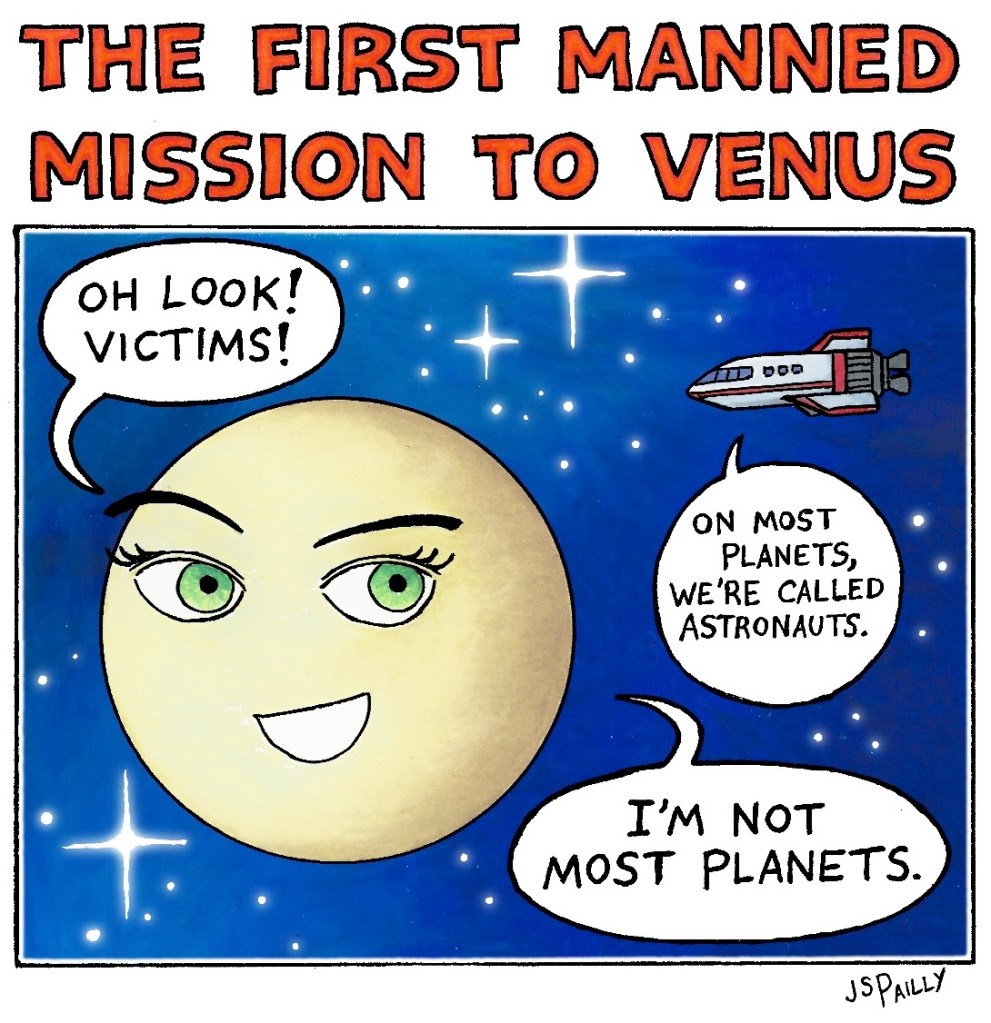
As scientists in the 1960’s and 70’s catalogued all the absolutely terrifying stuff in Venus’s atmosphere, they realized something was missing: ozone. I won’t go into all the chemistry details here, but given the kinds of chemical reactions happening on Venus, Venus should have produced something similar to Earth’s ozone layer. And yet little to no ozone was detected. So what gives?
Well, among all the other horrifying chemicals in Venus’s atmosphere, there are some chlorine-based molecules. Turns out those chlorine-based molecules were interfering with ozone production. Mystery solved! But then somebody said, “Wait, what about chlorofluorocarbons? Those are chlorine-based molecules, and we’ve been releasing them into Earth’s atmosphere for decades.” More research followed, comparing and contrasting Earth and Venus. It turned out that, yes, chlorofluorocarbons (better known as C.F.C.s) were interfering with Earth’s ozone layer just as similar chlorine-based molecules interfered with ozone production on Venus.
By the mid-1970’s, scientists were calling for action. By the end of the 1980’s, politicians were listening, and they actually did something about the problem. The Montreal Protocol is an international agreement restricting the production and use of C.F.C.s and other ozone-depleting chemicals. As a direct result, today Earth’s ozone layer is healing, and there’s hope that the ozone layer will fully recover by the end of the 21st Century. Would scientists have figured out what C.F.C.s were doing to Earth’s ozone layer without Venus’s help? Probably. But they might have figured it out too late.
A couple months ago, I did a post about solar storms and the danger they pose to our modern technological world. In that post, I cited solar storms as one of the reasons why space exploration is worthwhile, despite the notoriously high price tag. This story about Venus and the ozone layer? This is another example of why space exploration is worth the money. Comparing and contrasting Earth with another planet helped save us from disaster once before. Who knows what other valuable lessons Venus (or Mars, or any of the other planets) still have to teach us?
WANT TO LEARN MORE?
Click here for a video from Sci-Show entitled “How Studying Venus Saved Earth.”
Or click here for an article from The Conversation entitled “What Venus has taught us about protecting the ozone layer.”
If you’re wondering why the ozone layer’s so important, click here for an article from How Stuff Works entitled “What If the Ozone Layer Disappeared?”
And lastly, some of you may be thinking, “Hey, didn’t they discover an ozone layer on Venus just a few years ago?” You’re right, they did! It’s at a much higher altitude than Earth’s ozone layer, and it’s much thinner and more tenuous, too. But Venus does have just a little bit of ozone after all. Click here to learn more.
The art used in today’s post is my own original work. If you like my art, please consider visiting the I-Love-Space store on RedBubble. Shopping on RedBubble is a great way to support artists (like me) so that we can keep doing what we do. Thank you!

 i-love-space.com
This is a fascinating story, and a piece of knowledge that I hadn’t known previously! Typically, when thinking about the benefits of researching other planets (or space in general) the focus seems to be centered on innovations in technology and communications.
In this story, the research lead to a discovery that helped prevent a serious, life-threatening issue from occurring. Satellites and GPS are nice, but what is even better than that is not getting baked by the sun.
Thankfully the science and the politics hit at just the right time for appropriate action to be taken. At a different point in history, politics and corporate interests could have made an effort to bury this discovery for self-serving reasons. Science and the good of the planet don’t always prevail, but in this instance I’m sure glad they did.
LikeLiked by 1 person
There certainly was political and corporate push back at the time. And it’s worth noting that there was at least a ten year gap between scientists raising the alarm (mid-70’s) and politicians taking action (late 80’s). Which is another reason why it’s good Venus raised the alarm early.
LikeLike
Star Trek The Next Generation had an episode that was a metaphor for the vanishing ozone layer and it’s kind of fascinating that of all the problems that are resolved in the fictional future utopia, that this is the one problem we fixed in our own time.
LikeLiked by 1 person
I’m not sure if we’re thinking of the same episode, but I remember one where the Enterprise fixed a planet’s ozone layer in like 5 minutes. They probably knew how to do that because we did it first. They just improved on our techniques.
LikeLiked by 1 person
I sometimes feel wistful for the old sci-fi version of Venus, the one with steamy jungles hidden behind a cloud canopy.
Scientific space exploration, along with all scientific research, is definitely worth the investment. We can’t know ahead of time which knowledge will save us, or even just be extremely useful. I hope it’s something our society doesn’t abandon.
LikeLiked by 1 person
I do, too. There’s a hypothesis circulating right now that maybe Venus did have life a mere 700 million years ago. The planet would’ve still needed a lot of cloud cover to reflect sunlight away, and the surface would’ve still been a bit steamy. Doesn’t sound too different from retro-Sci-Fi Venus to me.
LikeLiked by 1 person