Hello, friends! Welcome to this month’s meeting of the Insecure Writer’s Support Group, a blog hop created by Alex J. Cavanaugh and co-hosted this month by Feather Stone, Kim Lajevardi, Diedre Knight, C. Lee MaKanzie, and Sarah – The Faux Fountain Pen! If you’re a writer and if you feel insecure about your writing life, click here to learn more about this awesomely supportive group.
Each month, IWSG asks us an optional question, and this month’s question taps into one of my current insecurities as both a writer and an artist.
Do you use AI in your writing and if so how? Do you use it for your posts? Incorporate it into your stories? Use it for research? Audio?
Short answer: no. No, I don’t, and I doubt that I ever will.
Longer answer: a year or two ago, when the AI craze started taking hold, I did experiment with AI a little, just to see what the hype was about. I had an AI generate some Sci-Fi art for me, and I had a different AI rewrite some of my old blog posts. My initial reaction, when I saw the work AI could produce, was “Wow, this is really impressive.” I also thought, initially, “Oh no… this is better than what I can do.”
But as I played with AI more and more, I became less and less impressed with it. Sometimes, it does shockingly good work, but more often it spits out garbage.
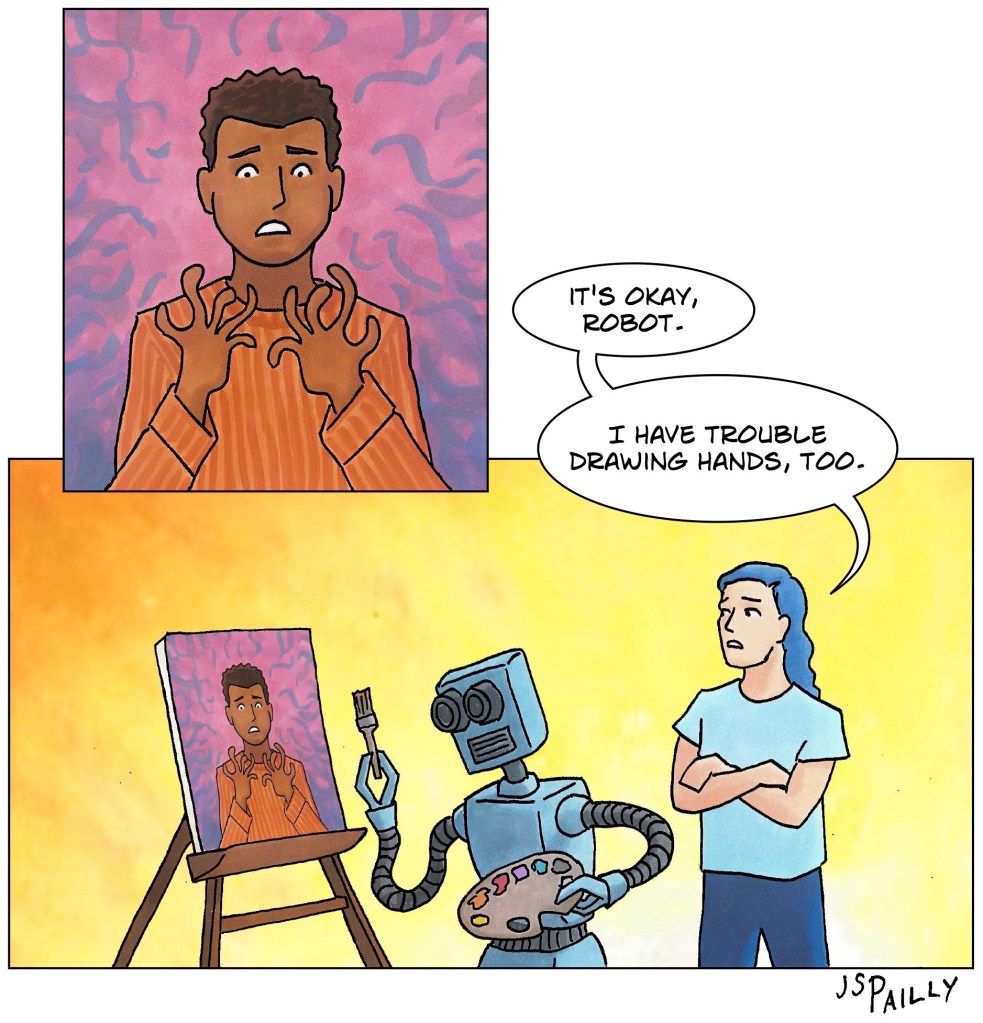
More importantly, the AI never (not even once) gave me what I actually wanted. The AI generated Sci-Fi art looked cool, but it wasn’t what I was picturing in my head. Not even close. As for the AI rewritten blog posts, I’ll admit that the AI wrote cleaner, tighter prose than I do. It had this verbally efficient style that many style guides and writing gurus try to teach you. But after a while, all that super clean, super tight writing started to sound very samey. It felt dull and soulless to me.
Also, when I write blog posts about space and science, I’m really trying to express two things: first, my sense of awe and wonder about the cosmos, and second, my hope for humanity’s future out there among the stars. When I let the AI rewrite my blog posts, it repackaged all the space and science facts reasonably well, but any themes of wonder or hope for the future got lost in translation.
I’m still deeply concerned about AI intruding into the domains of art and literature, mainly because so many big players in the tech industry keep insisting that AI can and should be used for these things. But for my own creative process, AI offers me very little. Basically nothing. I do my art and I do my writing because there’s something inside me that I desperately want to express, that I desperately need to express. This thing inside me that I’m trying to express through my art and my writing—no one else can express it for me, not even an AI.
P.S.: Sorry for not being active on the blog this past month. I haven’t been feeling well, but I’m recovering, and I should have more space and science stuff for you in the month to come.
 i-love-space.com