IWSG: Just Keep Learning

Hello, friends!  Welcome to this month’s meeting of the Insecure Writers’ Support Group, a blog hop created by Alex J. Cavanaugh and co-hosted this month by Rebecca Douglass, Natalie Aguirre, Cathrina Constantine, and Louise Barbour.  Are you a writer?  Do you feel insecure?  Well, then this is the support group for you!  Click here to learn more!

A long time ago, I was talking to some friends about space.  I don’t remember what space thing I was talking about, specifically; I just remember it was something I didn’t understand at the time, and I was trying to learn more about it.  Anyway, I was telling my friends about all the work I was doing, trying to learn about this one specific space thing, and I guess my enthusiasm was showing, which prompted one of my friends to say: “You make me want to go learn stuff.”

To this day, I still consider that to be the single nicest thing anyone has ever said to me.  I love space, obviously, but even more than that, I love learning.  That’s what drives me to be a writer.  On a superficial level, I write because I want to share my love of space with others, and I want to show off some of the cool space facts I’ve learned over the years.  But on a deeper, more fundamental level, I write because I want to show people that learning is fun, that learning creates joy.  Yes, learning can be hard sometimes, but the struggle of learning a difficult or complicated thing increases the joy when you finally do understand that thing.

Writing is not always easy for me.  Sometimes I get discouraged.  Sometimes I get frustrated.  Sometimes I wonder: “Why am I doing this?”  But that thing my friend said to me, all those years ago, is a good reminder: “You make me want to go learn stuff.”

I realize not everybody loves space as much as I do, and I realize not everybody wants to learn everything there is to know about space the way I do.  But if you read any of my stuff, and if you still don’t care much about space, then I hope I can at least inspire you to go learn stuff about the things you do care about, the things that do interest you, the things that you do love.

The art in today’s post—that drawing of a brain hovering over an open book—is my own original work.  If you like my art, please consider checking out the I-Love-Space store on RedBubble.  Shopping on RedBubble is a great way to support artists (like me!) so that we can keep doing what we do.  Thank you!

IWSG: 42

Hello, friends!  Welcome to this month’s meeting of the Insecure Writer’s Support Group, a blog hop created by Alex J. Cavanaugh and co-hosted this month by PJ Colando, Pat Garcia, Kim Lajevardi, Melisa Maygrove, and Jean Davis.  Are you a writer?  Do you feel insecure?  Well, then this is the support group for you!  Click here to learn more.

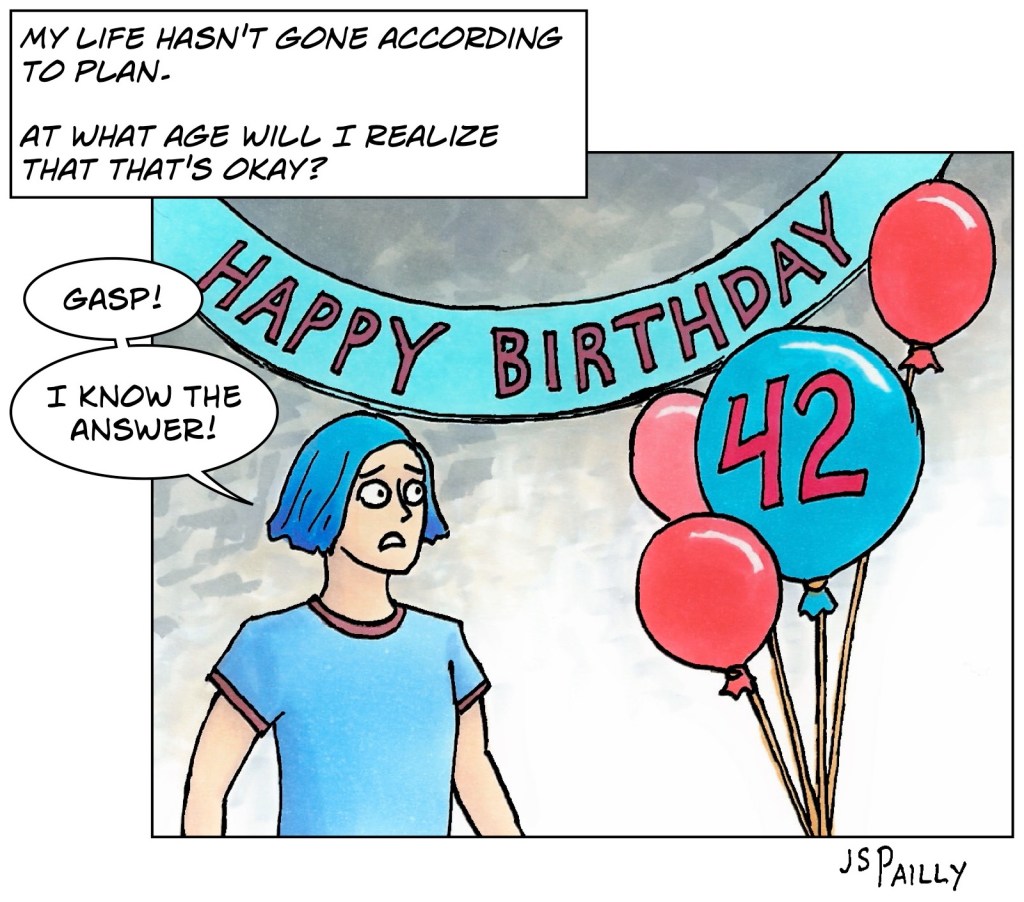
I’m turning 42 this month, a truly momentous age in the life of any geeky person.  For much of my life, I’ve been a collector of inspiring quotes, so I thought this would be a good time to share a quote that’s come to be one of my favorites:

I may not have gone where I intended to go, but I think I have ended up where I needed to be.

– Douglas Adams

I have to admit, the first time I heard this quote, I did not like it much.  I was very young at the time, and I was very ambitious.  I had a very clear vision of what I intended to do with my life.  I had what I called my “master plan,” and I believed that so long as I followed my master plan I would become a rich and successful author.  The notion that Douglas Adams, one of the authors young me admired most, could end up where he ended up in life by accident didn’t make any sense to me.

I managed to stick to my master plan fairly well for a while, up until the 2008 financial crisis.  Master plans don’t hold up well in the face of global financial crises of that magnitude.  Anyway, very little in my life has gone according to plan since then.  Young me would have been distressed to hear that.  Young me would have assumed that meant I’d given up on writing by now.  Writing careers are hard.  How could anyone pursue a writing career without a plan?

Well, it turns out my love of writing is more resilient than that.  No matter what happens, I keep writing.  Even on days when I hate my own writing, I still feel that urge to write.  And I’ve come to appreciate how all the unplanned events in my life and in the world around me help make me a better writer.

How about you, friends?  Whatever age you are, whatever place you’re at in life, are there any inspiring quotes that have helped you along the way?

IWSG: What Are Books For?

Hello, friends!  Welcome to this month’s meeting of the Insecure Writer’s Support Group, a blog hop created by Alex J. Cavanaugh and co-hosted this month by Feather Stone, Janet Alcorn, Rebecca Douglass, Jemima Pett, and Pat Garcia.  Are you a writer?  Do you feel insecure?  Well, then this is the support group for you!  Click here to learn more and to see a list of participating blogs.
What are books for?  When I was young, the answer seemed self-evident.  You read a book, and the ideas and information on the page get absorbed into your brain, like uploading data into a computer.  But over the years, I’ve come to realize that books can do something far more magical than that.

You see, there are a handful of books that I’ve read and re-read over and over again.  The Lord of the Rings, The War of the Worlds, and Dune are probably my top three most re-read books.  I’ve read each of them half a dozen times at least over the course of my life.  Weirdly enough, each time, the reading experience feels different.  Some characters seem more relatable, or less relatable.  Little details seem to gain or lose significance, and the overall meaning or moral of the story seems to keep changing.

How can this be?  I haven’t bought new, updated editions of these books.  The text on the page is the same as it’s always been.  Even the typos (for some reason, my copy of Dune has a lot of typos).  So what’s happening?  If my reading experience keeps changing, but the books themselves always stay the same, then the only other factor in this equation is… me, the reader.  I’m the one who’s changed.  And every time I re-read one of my favorite books, I get a glimpse of who I am now compared to who I was five, or ten, or twenty years ago.  In the case of The Lord of the Rings, it’s been almost thirty years since the first time I read that book.

Books can impart ideas and information from the author to the reader.  That is one of their functions.  But there’s a deeper magic at work, too.  Books can also serve as psychological mirrors for their readers.  When you read a book that you love, what does that tell you about yourself?  What is the book reflecting back at you that makes you so happy?  Or, if you hate a book, what is that book reflecting back at you that makes you so mad?

As writers, our job is not merely to put words down on the page.  Our job is not merely to inform and/or entertain our readers.  Our job is also to make good mirrors.  To offer people a chance to see themselves a little more clearly.  To help them catch a glimpse of their own hearts, their own souls.  What an awesome and helpful service we writers provide!

P.S.: Oh!  Maybe that’s why they talk about “polishing” your manuscript!

IWSG: I Believe in Fairies

Hello, friends!  Welcome to this month’s meeting of the Insecure Writer’s Support Group, a blog hop created by Alex J. Cavanaugh and co-hosted this month by Jennifer Lane, L Diane Wolfe, Jenni Enzor, and Natalie Aguirre.  Are you a writer?  Do you feel insecure?  Well then good news!  This is the support group for you!  Click here to learn more and to see a list of participating blogs.

As you can probably tell from the name of my blog, I love space.  I also love science and science fiction.  I’ve been loving space, science, and science fiction for such a long time now that I’ve developed a highly scientific, highly evidence-based view of the world.  I don’t pay attention to astrology.  I don’t take tarot cards or Ouija boards seriously.  I don’t knock on wood or worry about black cats crossing my path.  I don’t believe in any superstitions except one: I do believe in fairies.

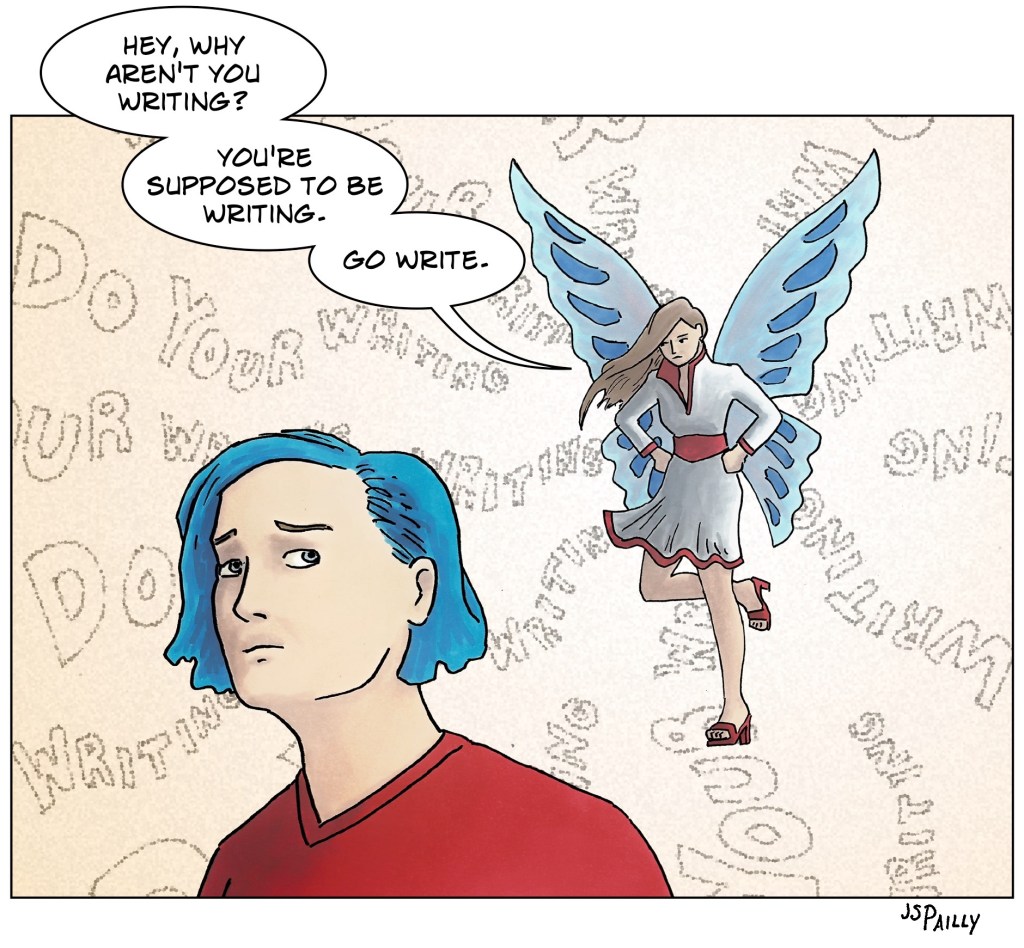
That’s because I happen to know a fairy.  I call her my muse, and she can be super annoying sometimes, always pestering me with new ideas and nagging me about writing whenever I take even the shortest possible break from writing.

It’s hard to deny the existence of fairies when there’s this one fairy who just will not leave you alone, not even for one goddamn minute!

Anyway, the real point I’m trying to make is that there is a highly scientific, highly evidence-based approach you could take to writing.  You could learn all about the craft of writing.  You could study plot and characterization.  You could memorize all the heroic archetypes and all twelve steps of the monomythic journey.  You could find out what words like synecdoche and antimetabole mean and then apply those concepts to your writing.

And… okay, sure, you should spend some time learning about those things.  But don’t get too technical about writing.  Don’t take too scientific of an approach.  Leave room for sudden inspiration.  Be prepared for things to suddenly make sense, and you can’t explain why.  That’s probably your muse sprinkling fairy dust on your head, causing the magical side of writing to happen.

P.S.: Of course, the great science communicator Carl Sagan once said exactly what I’m trying to say, except much more succinctly: “A book is proof that humans are capable of working magic.”

IWSG: I Wish I Were…

Hello, friends!  Welcome to this month’s meeting of the Insecure Writer’s Support Group, a blog hop created by Alex J. Cavanaugh and cohosted this month by Ronel Janse Van Vuuren, Pat Garcia, and Liza @ Middle Passages.  Are you a writer?  Do you feel insecure?  Well, then this is the support group for you!  Click here to learn more and to see a list of participating blogs.

Each month, IWSG asks its members a question, and this month’s question is kind of a strange one:

If for one day you could be anyone or *thing* in the world, what would it be?  Describe, tell why, and any themes, goals, or values they/it inspire in you.

I wasn’t sure how to respond to this question at first, and I was considering skipping it and talking about something else.  But then I got thinking….

I’m pretty unhappy at the moment: unhappy with the state of my personal life, the state of my art/writing progress, the state of my financial situation, the state of my country and of the world at large….  Given all that, there are plenty of other people I’d rather be right now.  Transforming into an inanimate object doesn’t sound so bad at the moment, either.

But despite all of the problems I’m facing, there are a few things I wouldn’t want to give up.  Chief among them: my stories.  The weird, Sc-Fi worlds I’ve created inside my own head.  All the characters (humans, aliens, robots, etc.) who inhabit those worlds.  No matter what, I wouldn’t want to give any of that up.  I especially do not want to give up the two or three new story ideas that popped into my head within that last few months.

And the thing is all of the story worlds I’ve created are the product of my experiences.  My good experiences, my bad experiences.  My hopes and dreams, my successes and triumphs, and also my failures.  My disappointments.  My mistakes.  Swap my life with the life of somebody else, replace my experiences with the experiences of another person, and those stories wouldn’t be the same.  And the two (or maybe three) new story ideas that I’m currently working on… the ones that I am most excited about right now… they wouldn’t exist at all if not for the particular blend of fears and anxieties that I’m dealing with right now.

So despite everything, the only person (or thing) that I want to be right now is myself, because I am the only person who can tell the stories currently sitting in my head.

P.S.: Okay, after writing this whole post, I reread the initial question and realized that I’d misunderstood it.  I missed the “for one day” part.  If I could become someone else for just one day, I’d want to be an astronaut on the International Space Station.  I think my writing would benefit from me knowing, first hand, what it’s like to be in space (provided I got to go back to being myself the next day).

IWSG: How Writing Changes You

Hello, friends!  Welcome to this month’s meeting of the Insecure Writer’s Support Group, a blog hop created by Alex J. Cavanaugh and co-hosted this month by Joylene Nowell Butler, Louise Barbour, and Tyrean Martinson.  Are you a writer?  Do you feel insecure?  Well, then this is the support group for you!  Click here to learn more and to see a list of participating blogs.

I am not the same person I was 20 years ago.  In some respects, I’m sickened to think of the person I was 20 years ago.  My outlook on life and on the world has completely changed.  I left my church, I switched political parties, I came out of the closet, I lost a lot of friends, I went no contact with my family… it’s been a rough 20 years.  It was also about 20 years ago that I began my writing journey.

Which ties in nicely with this month’s question.  Each month, IWSG asks us an optional question, and this month’s question is:

Is there a story or book you’ve written you want to/wish you could go back and change?

Oh yes.  Very much yes.  When I think about my writing from 20 years ago, I’m sickened by some of the things I wrote.  Fortunately for me, very little of that old writing was published, and even less of it is still out there on the Internet today.

But while I’m glad that those old stories aren’t out there to be seen, I do not regret writing them.  You see, one of the magical things about writing is that it reveals to you who you really are and what you really believe.  I was raised to believe certain things.  I thought I knew who I was and what my place in the world was supposed to be.  But whenever I tried to express those beliefs in a story, the story felt… disingenuous.  Halfhearted.  Unconvincing, even to me.

Writing can reveal deep, personal truths to you.  Sometimes it will reveal truths that you’re not prepared to deal with just yet.  And you don’t have to be super introspective or meditative about your writing process for this to happen.  It could be as simple as thinking “Huh, my protagonist seems like a hypocrite,” or “Huh, my antagonist raises some really good points.”  (Or maybe—I don’t know, purely hypothetical example—that Sci-Fi utopia you’re working on keeps sounding like a dystopia, no matter what you do).  That could be the first sign that your own writing is trying to teach you something about yourself.

I suspect a lot of older, more seasoned writers already know what I’m talking about in this post.  As for any new, younger writers who might be reading this, keep an open mind.  Pay attention to what your own writing is trying to tell you.  If you do, the act of writing may change you.

IWSG: Hope for the Future

Hello, friends!  Welcome to this month’s meeting of the Insecure Writer’s Support Group, a blog hop created by Alex J. Cavanaugh and co-hosted this month by Rebecca Douglass, Beth Camp, Liza @ Middle Passages, and Natalie @ Literary Rambles.  Are you a writer?  Do you feel insecure?  Then this is the support group for you!  Click here to learn more and to see a list of participating blogs.

Each month, the Insecure Writer’s Support Group asks us a question.  The question is totally optional!  IWSG member can answer it if they like, or they can talk about something else if that’s what they want (or need) to do this month.  No pressure, no judgment.  This month’s optional question is:

Describe someone you admired when you were a kid.  Did your opinion of that person change when you grew up?

Oh boy… so I had an assignment in school once.  I had to pick an American historical figure I admired and give an oral presentation on that person to the class.  The teacher said we could pick anybody, so I picked Gene Roddenberry.  Then the teacher said to take this seriously and made me pick somebody else.  I’ve been bitter about that ever since, but now—finally!—I can satisfy little kid me’s dream and tell you why I admired Gene Roddenberry so much.

Truth be told, though, little kid me didn’t know much about Roddenberry.  All I knew was that he created Star Trek, and I absolutely adored Star Trek.  When I was happy, Star Trek was the most fun and exciting thing on television.  And when I was no so happy, Star Trek offered hope and the promise that the future would be better than today.  No matter who was bullying me at school, and no matter what I was dealing with at home, Star Trek reassured me that the future would be better.

It’s also one of the main reasons I started writing.  Some of the first “books” I wrote as a kid were just Star Trek fan fiction.  I then branched out into writing Jurassic Park fan ficiton, Aliens fan fiction, Star Wars fan fiction, Battlestar Galactica fan fiction, Doctor Who fan fiction….  Later, I created my own original characters and sent them off adventuring in my own original Sci-Fi universe.  Meanwhile, I started reading Scientific American, Sky and Telescope, Universe Today… I tried reading more challenging, more technical sources of science info, too.  I didn’t understand everything I read, but the more I learned about space and science, the more convinced I became that Star Trek got it right: the future will be better than today.  Or at least, the future can be better, if we don’t lose faith in ourselves.

This isn’t a message unique to Star Trek.  All Sci-Fi, regardless of how realistic or unrealistic the science may be, offers us hope for the future.  Even darker, more dystopian visions of the future still offer hope, in their own way: hope that we may yet choose a different path forward.

As an adult, I’ve come to learn that Gene Roddenberry was kind of a jerk.  He cheated Alexander Courage (the guy who wrote the Star Trek theme song) out of half of the royalties he was owed.  He was wildly unfaithful to his wife.  He had a notoriously short temper and created a toxic work environment on set.  In short, Roddenberry was not the hero little kid me might have thought.

Still, Roddenberry had some good ideas, and (with the help of many other talented people) he made something that made a real difference in my life.  Now more than ever, here on this blog and in all my other creative work, I hope I can pass on some of that Star Trek-ian optimism to others.

IWSG: I Don’t Actually Like Writing

Hello, friends!  Welcome to this month’s meeting of the Insecure Writer’s Support Group, a blog hop created by Alex J. Cavanaugh and co-hosted this month by Ronel, Deniz, Pat Garcia, Olga Godim, and Cathrina Constantine.  Are you a writer?  Do you feel insecure?  Well, then this is the support group for you!  Click here to learn more and to see a list of participating blogs.

For most of my life, I’ve been telling people that I love writing.  But (confession time) that’s not entirely true.  I don’t love writing.  Most days, I don’t even like writing.  Writing is a tedious, time-consuming process that requires me to think really hard about words when I’d rather be watching Netflix.  I mean, have you seen Arcane?  That show is so good!!!  Wait, no… I need to stay on topic.  What was I talking about?  Oh yeah: writing sucks.  I hate it.  So why do I keep doing it?

Whenever I go around claiming (erroneously, as you now know) that I love to write, people will inevitably start suggesting things that I ought to write about.  I’ve been told that I ought to write smut, because that’s how you make the easy money (I’ve met writers who write erotica, and I know it’s not such an easy way to make money).  I’ve been told I ought to write a book about Abraham Lincoln, because it’s about time the truth came out about Lincoln (the person who suggested this… I do not know what he was talking about, and I don’t want to know).  I’ve been told I ought to write about what it was like to live through a global pandemic, because that’s an interesting experience that I’ve had (and other people haven’t, I guess???).

As a writer, it takes a lot to get me to sit down and do my writing.  All those suggestions from random people in my life—I’m sure somebody could write a good book about those things, but I cannot muster up enough enthusiasm to write about them myself.  I’d much rather curl up in bed and rewatch Three Body Problem on my laptop.  That scene in the Panama Canal gives me chills every time.  So upsetting.  Anyway… sorry, we were talking about writing.

For some strange reason, those same people who keep telling me what I ought to write about also keep telling me what not to write about.  They don’t think I should spend so much time writing about space.  They say I’ll never get rich, like E.L. James, by writing about space.  And maybe that’s true.  But here’s the thing: I love space.  I hecking LOVE outer space.  I mean, outer space is so cool!  Unless you wander too close to a star, in which case outer space gets face-meltingly hot.  Gravity’s weird up there.  There might be aliens.  All the planets (besides Earth, of course) are straight-up death traps, but we’re going to try to live on some of them anyway.  Remember to bring your own oxygen, and remember to hold on to your oxygen tank like your life depends on it (because it does).

Space is just so exciting to me!  It’s exciting enough that I’m willing to spend hours upon hours of my own free time writing about it.  That’s time I could’ve spent watching… I don’t know, Stranger Things, or something?  Doesn’t matter.  The point is I love space so much that I’m willing and eager to write about it, despite the fact that I don’t actually like writing all that much.

So going forward, I may still tell people, from time to time, that I love writing.  But between you and me, dear reader, you’ll know what I really mean.  You’re in on my secret now.  To me, writing is merely a means to an end.  It’s a tool I use to express a more important thought.  Namely, that I love space.

So friends, what do you love?  What do you love so much that you’re willing to write about it?

IWSG: Let’s Talk About Politics

Hello, friends!  Welcome to this month’s meeting of the Insecure Writer’s Support Group, a blog hop created by Alex J. Cavanaugh and co-hosted this month by Diedre Knight, Lisa Buie Collard, Kim Lajevardi, and JQ Rose.  Are you a writer?  Do you feel insecure?  Then this is the support group for you!  Click here to learn more!

So this blog post is scheduled to come out the day after the U.S. Presidential Election; however, I am writing this a few days before the election.  Therefore, the me who is writing this post does not yet know what the outcome of the election will be.  Perhaps, when this post comes out, we still won’t know what the election results will be.  It’s hard for me to guess what might happen, here in the past.

But I do know one thing.  I know that, whatever the outcome of the election happens to be, a whole lot of people will be real happy about it, and a whole lot of other people will be real mad.  I know I personally will be either really happy or really mad, depending on who wins this one.  But it’s important to remember that elections are not the only things that matter in a democratic society.  There are other ways to express your beliefs and advocate for causes you care about.

Which brings me, finally, to the real topic of today’s blog post: writing.  I’m a science communicator and science fiction writer.  I write about space, science, and the future of humanity.  I believe in a future where we don’t destroy ourselves through nuclear war or climate change.  I believe in a future where we come together as a species and where we go on to become explorers of the cosmos.  In other words, I believe in the Star Trek future.

Sometimes, my writing gets a little preachy.  Sometimes I want to get preachy in my writing.  And sometimes I don’t.  But even when I’m not deliberately trying to make some sort of moral or political statement, my beliefs and values still come through in everything I write.  You can’t be a writer and not have your beliefs and values creep into your work somehow.

So if you’re a writer and if you have strong feelings (positive or negative) about whatever just happened in the U.S. Presidential election, my advice to you is this: go write.  It doesn’t have to be overtly political writing.  Write whatever makes you happy.  Write whatever you’re passionate about writing.  Just write.  Your words matter more than you know.  Your words can help people understand your point of view.  Your words may change somebody’s mind.  Your words can make the world a better place.  So go write, keep writing, and make a difference.

P.S.: Oh no, I just wrote a blog post about politics and scheduled it for the day after a Presidential election.  Okay, everybody, please try to be kind in the comments below.  At the very least, try to be respectful.  If you want to get into a fight with somebody about politics, there are plenty of other places on the Internet where you can go do that.

IWSG: I Love Lovecraftian Horror

Hello, friends!  Welcome to this month’s meeting of the Insecure Writer’s Support Group, a blog hop created by Alex J. Cavanaugh and co-hosted this month by Nancy Gideon, Jennifer Lane, Jacqui Murray, and Natalie Aguirre.  Are you a writer?  Do you feel insecure?  If so, then this is the support group for you!  Click here to learn more.

Each month, the Insecure Writer’s Support Group asks us an optional question.  IWSG members can answer the question if they want, or they can skip it if there’s something else they want/need to talk about instead.  This month’s optional question is:

Ghost stories fit right in during this month.  What’s your favorite classic ghostly tale?  Tell us about it and why it sends chills up your spine.

I almost skipped this month’s question.  Ghost stories don’t do much for me.  I have a very sciency worldview, unfortunately, so stories about the occult or the paranormal don’t give me much of a thrill or a fright.  But there is an author who bridged the gap between science and the supernatural well enough to freak me the f*** out.  That authors’ name is H.P. Lovecraft.

Lovecraft did most of his writing in the 1920’s and 30’s.  He died young, unfortunately, in 1937.  As I understand his biography, Lovecraft was a huge fan of Edgar Allan Poe and was inspired by Poe’s work; however, Lovecraft believed that the traditional ghost story needed to be updated for modern times and modern, scientific sensibilities.  So rather than leaning on ghosts and devils, Lovecraft filled his stories with theoretical physics, extraterrestrial intelligences, and occasional references to a certain newly discovered planet (Pluto).

My favorite Lovecraft story is called “The Colour Out of Space.”  In that story, a meteor crashes on Earth, introducing an extraterrestrial something to the local environment.  The local environment begins to change as a result.  Plants and animals become weirdly mutated, and the humans living on a nearby farm gradually lose their sanity.  No one can explain what’s happening.  No one can explain what that thing from outer space is or even describe what it looks like.  The best anyone can say is that it’s a color unlike any color seen before by human eyes (hence the title of the story).

I can’t think of many stories where alien life forms are presented as truly unknowable beings.  There are the alien monoliths from 2001: A Space Odyssey.  There are the replicas from Solaris, or the sphere from Michael Crichton’s Sphere.  But that thing from “The Colour Out of Space”… whatever that thing was, it was the most incomprehensible of all incomprehensible aliens in science fiction.  And that truly scares me.

I love space and I love science fiction.  One of my dearest hopes for the future is that we will one day make contact with aliens—aliens like E.T. or Mr. Spock.  You know: the kind of aliens we can be friends with.  But that may not be what happens.  If/when we discover alien life, the aliens may be something totally and completely beyond human comprehension (and we humans may seem equally incomprehensible to whatever alien intelligence happens to discover us).  That’s a scenario that terrifies me, and it should terrify anyone who lives on this rather small and extremely vulnerable planet.