Hello, friends!
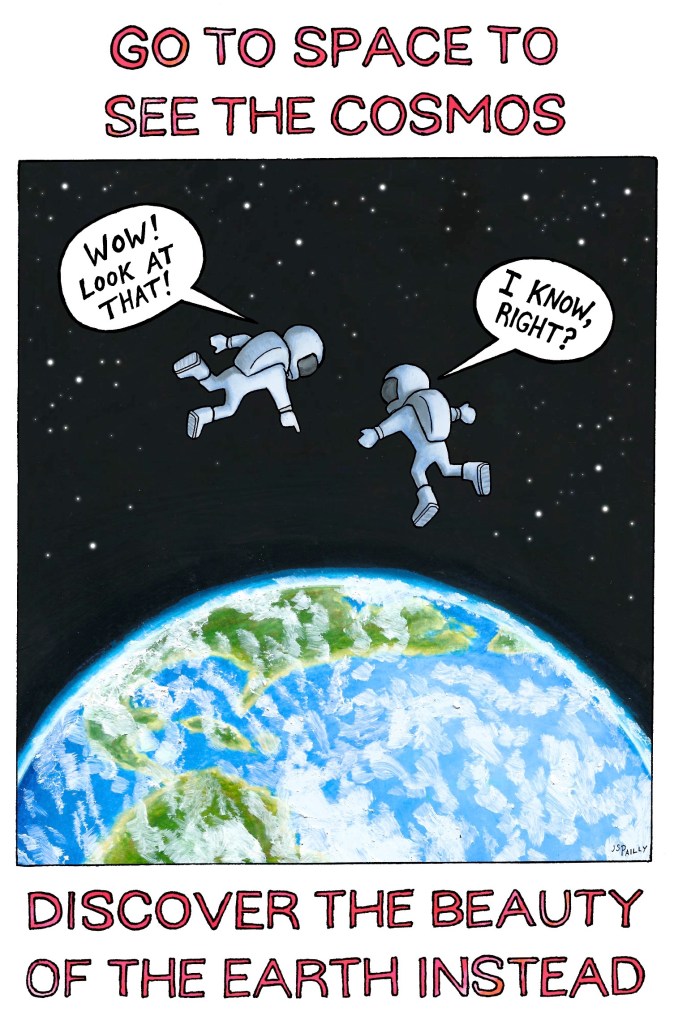
I don’t know about you, but whenever I stop and look up at the nighttime sky, I feel… something. It’s hard to explain. And if I take out my telescope to look more closely at the planets and nebulae and galaxies up there, I feel that same indescribable something even more. Whatever it is I feel, it’s a powerful, almost spiritual thing. But as powerful as that experience is, I’m told it’s nothing compared to the feeling you get when you’re up in space, looking not farther out into the cosmos but rather looking back at the Earth.
In 1987, American author and space exploration advocate Frank White coined the term “overview effect” to describe the experience so many astronauts report having when they first see the Earth from space. These astronauts don’t just look at Earth and think, “Huh, neat view.” They describe this as a life changing experience, a dramatic shift in belief and perspective, a sudden realization that our world is precious and fragile and that we all must set aside our differences and work toward the common good.
If only more people could have an experience like that, maybe the world would be in a better state than it is currently in. That would be great, wouldn’t it? Well, there are individuals and organizations working to make this an experience more people can have. One option is, of course, to make commercial spaceflight more affordable. Another is to try to simulate the overview effect in virtual reality. But if more people could see our planet for what it truly is—not as a globe crisscrossed by national borders but rather as a singular world that we all must share—that might bring about some real change. It might, right?
Now obviously there’s been some criticism of this idea, and I do think some of the criticism is valid. Even among those who’ve been to space, who’ve experienced the overview effect for themselves, and who’ve come back eager to do good things for our planet and our species… even among those people, some of them still say some troubling things. For example, during the Cold War, Soviet cosmonauts would sometimes remark that seeing the Earth laid out before them reinforced their belief that communism must be spread all across the world. American astronauts occasionally say similar things about spreading freedom and democracy. Even if we all want to do good things for our planet, we’ll still disagree about what good things our planet needs us to do.
Frank White has acknowledged this issue in some of his writings. If you’re one of the people lucky enough to see the Earth from space, cultural and political biases, religious beliefs, personal history… all sorts of factors may influence how you describe the overview effect to others, or how you interpret the experience for yourself. But it does seem that no matter who you are or where you come from, seeing the Earth from space is a powerful and humbling experience. Maybe White and others in the overview effect movement are right. Maybe it would do some good if more people could have this experience for themselves.
WANT TO LEARN MORE?
A few years ago, William Shatner (a.k.a. Captain Kirk from Star Trek) went to space aboard a Blue Origin rocket. What he saw moved him to tears. Regardless of how you might feel about Blue Origin or its owner, Jeff Bezos, I think what Shatner had to say about the experience is worth hearing. Click here.
Friend of the blog Matt Williams had the chance to interview Frank White a few years back, and I’m super jealous about it. Click here to listen to that interview on Matt’s podcast, Stories from Space.
Jordan Bimm is one of the most noteworthy critics of the overview effect and the overview effect movement. Click here to read his paper “Rethinking the Overview Effect,” which lays out his main points.
I’d also recommend reading Frank White’s response, entitled “Rethinking ‘Rethinking the Overview Effect.’” Click here for that.
The art used in today’s post is my own original work. If you like my art, please consider visiting the I-Love-Space store on RedBubble. Shopping on RedBubble is a great way to support artists (like me) so that we can keep doing what we do. Thank you!

 i-love-space.com
I would imagine that seeing Earth from space would be a profound experience, and I would love to be able to have it someday. But I’d be surprised if much changed from everyone being able to do it. This isn’t because I’m jaded and cynical. Just the opposite. I think the reasons people clash aren’t trivial, a condition that exists only because they’re blinkered. (Some are, but most people are just caught up in constraints not of their making.) Not that having the experience can hurt!
LikeLiked by 1 person
That’s a good perspective. Have you read “City on Mars” by Kelly and Zach Weinersmith? They make a similar point in that book: that some of the conflicts we have are worth having, that both sides have an equally valid claim that they’re fighting for the common good.
LikeLiked by 1 person
I own City on Mars but haven’t read it yet. I really need to. (Just one of many books in my Kindle like that.) Sounds like they make a good point.
But it seems to me that even when people’s interests aren’t necessarily in alignment with the common good, those interests often aren’t ones they can easily set aside. I think of eminent domain and someone being forced to sell a home that’s been in their family for generations. Or people losing their job to automation. Maybe people in these scenarios should lose for the common good, but their reasons for resisting seem deep and visceral.
LikeLiked by 1 person
Also a good point. And in some cases, just because someone in a position of authority says “this is for the common good,” that doesn’t mean it’s true. For example: losing your family home to eminent domain so the city can sell the land to a developer who wants to build a golf course.
LikeLiked by 1 person
Of course I have never been to space, but I have been at least 43,000 feet in a Lear Jet, and millions of other people who have been that high or higher. At that height the darkening of the sky is obvious and I believe that it is just barely possible to detect the curvature of the Earth, if you get a view from the cockpit. Views from passenger windows are too restrictive. I think that you can get a sense of the Overview Effect at this altitude.
But more than that, for me at least there can be a slight Overview Effect at the very top of a mountain. It’s doesn’t even have to be that high, but it’s best that the mountain be solitary, with no other nearby peaks in view. Even from a high ridge, overlooking plains below, can give a sense of this effect, which is of course more subjective than anything else.
A similar feeling can be had from viewing the night sky (for me at least) from a very clear, dark sight, especially with the Milky Way. (I remember such an experience many years ago on an experimental pig farm in Nebraska — no lights around because no one wanted to be near a pig farm!)
LikeLiked by 1 person
I wasn’t thinking about this when I wrote this post, but the first time I saw the Milky Way was a really powerful experience for me as well. I was at a campsite somewhere in Indiana. Trees blocked most of the sky, but then we came out into a clearing and the Milky Way was there overhead. My traveling companion proceeded to set up our tent without me while I just stood there gawking at the view. How much is that like the overview effect? I don’t know, but I’m sure it must be similar.
LikeLiked by 1 person