Hello, friends!
I don’t remember when or where I first heard about astrobiology (the scientific study of alien life), but I do remember my initial gut reaction: “If we haven’t discovered alien life yet, what the heck do astrobiologists study?” Then I learned more. I learned that astrobiologists are concerned, first and foremost, with studying the only life we currently know of in this universe: life on Earth. That provoked another instant, incredulous question in my mind: “How is that different from regular biology?”
But there is a difference! Yes, astrobiologists and regular biologists both study life on Earth. There’s some overlap between these two scientific fields. However, astrobiologists and regular biologists are working to understand life on very different scales. How do plants do photosynthesis? Why do cows need so many stomachs? What’s the purpose of that giant claw on the fiddler crab? Those are biology questions. Astrobiology is less interested in individual organisms or individual species and more interested in life as a “planetary phenomenon.”
So here’s this planet. We call it Earth, and we know for a fact that there’s life on it (NASA checked).
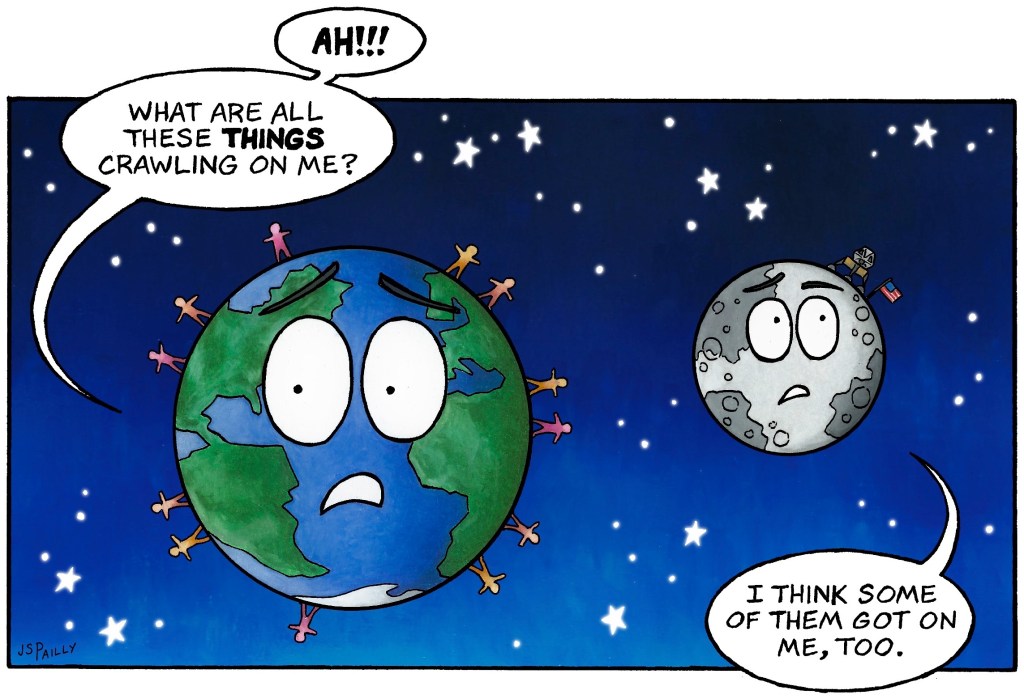
What’s more, life from Earth has already started spreading to neighboring celestial bodies. A bunch of astronauts left their footprints on the Moon, and there’s a possibility that our robotic landers and rovers may have contaminated Mars with our Earth germs. So how did life as a planetary (and now interplanetary) phenomenon happen here on Earth? And more importantly, what does the example of life on Earth tell us about what might be happening elsewhere in the cosmos?
In 1950, nuclear physicist Enrico Fermi famously asked “Where is everybody?” Funny story: Fermi actually blurted this out at lunch, as a total non sequitur. It was a weird and awkward moment. Fortunately, Fermi was having lunch with some physicist friends, and they quickly got the gist of what he was trying to say. The universe is vast. Mindbogglingly huge. It does not make sense for life to exist on one and only one planet. So where is everybody?
That pretty much sums up the work astrobiologists do. They’re trying to figure out where everybody is. Their research begins, first and foremost, with life on Earth. How did life begin here on Earth? Which environmental factors mattered most? As life evolved and spread across this planet, how did the planet change as a result?
Obviously Earth is a special planet. If astrobiologists can figure out which qualities make Earth so special (special enough for life), then perhaps they’ll know what qualities to look for on other planets out there among the stars.
WANT TO LEARN MORE?
That story about Enrico Fermi, where he blurts out “Where is everybody?” at lunch, is true. It’s the origin of what we now call the Fermi Paradox. Click here to read some first hand accounts of people who were having lunch with Fermi that day.
Contaminating Mars with our Earth germs is a real concern. Unfortunately, it may have already happened. As a result, if we ever do discover microorganisms on Mars, it may be hard to tell whether or not those microbes are actually native to Mars. Click here to learn more.
And lastly, in 1990 NASA “discovered” life on Earth, but it turned out that detecting life from space-based observations alone was really difficult. More difficult that you might expect. The astrobiological implications are obvious. Click here to learn more.

 i-love-space.com
The first time I recall understanding what the word “astrobiology” meant was when reading one of Carl Sagan’s books. He called himself an astrobiologist, which threw me because I’d always thought of him more as an astronomer. He went on to describe its cross-disciplinary nature, which at the time meant getting credentials in several fields. I suspect it still does.
LikeLiked by 1 person
It still does, absolutely. I wanted to say something in this post about schools that offer doctorates in astrobiology, but it turns out there aren’t any. You can minor in astrobiology while studying one of the fields that contributes to astrobiology, but you can’t get a degree in astrobiology itself.
LikeLiked by 1 person