IWSG: Sci-Fi Writers Don’t Need Research… Really?

Hello, friends!  Welcome to this month’s meeting of the Insecure Writers’ Support Group, a blog hop created by Alex J. Cavanaugh and cohosted this month by Ronel Janse van Vuuren, Natalie Aguirre, Sarah – The Faux Fountain Pen, and Olga Godim.  Are you a writer?  Do you feel insecure?  Well, good news!  This is the support group for you!  Click here to learn more and to see a list of participating blogs.
Today, I’d like to tell you a story.  This story is half true, half not true, but I think it’s a good story nonetheless, and maybe some of you will find it relatable.

A long time ago, I was at a party for writers—one of those networking events they say you have to go to if you want to get published.  I ended up sitting at a table with some dude who wrote historical fiction.  He was apparently a big shot in the historical fiction genre, or at least he talked about himself as if he were a big shot in the historical fiction genre.

As the evening wore on, the conversation turned to research.  Mr. Historical Fiction knew a lot about doing research, obviously.  He and his wife had just returned from a trip to Europe, where they’d toured some castle that was going to feature prominently in his next magnum opus.  Anyway, this guy went on and on about how important research is for every writer.  Not just historical fiction writers but every writer, in ever genre.

“Unless you write science fiction,” this guy said, with a gracious nod toward me.  “Sci-Fi and fantasy writers do ‘world building’ where the rest of us do research.”

At this point, I’d run out of patience.  “Well, yeah,” I said.  “Fantasy writers have no need for research.  What would they even do research about?  Horses?  Livestock?  Agriculture?  Blacksmithing?  Swords and armor?  Military strategy?  Medieval architecture?  None of that ever comes up in fantasy.

“And as for Sci-Fi, well… my need for research is even less.  Outer space is a mysterious void that we can fill with pure imagination.  Biology?  Geology?  Chemistry?  Don’t need them.  Newton’s laws?  Not important—not when you’re writing about spaceflight.  As a Sci-Fi author, I will never need to know the difference between an asteroid and a meteor, or between dark matter and dark energy, or between special and general relativity.  It’s a good thing, too, because that relativity stuff is complicated.  Have you seen how much math Einstein put into special and general relativity?

“Nope, I have it easy.  I get to just make stuff up.  Maybe I’ll throw the word ‘quantum’ in there so that I sound smart, but don’t worry!  I don’t need to know what the word quantum actually means.  And when I get my stories published, I can rest easy in the knowledge that my audience—i.e., the nerdy people who read science fiction on a regular basis—will not notice my laziness and will not call me out for my ignorance.”

The room was dead silent now.  I carefully set down my drink.  “My point is,” I said, “we Sci-Fi and fantasy writers do world building on top of our research.  Not instead of research.”

Okay, I lied.  I didn’t say all those things.  That whole rant is the part of this story that’s not true.  But I really wanted to say that stuff.  I really, really wanted to.

IWSG: Just Keep Learning

Hello, friends!  Welcome to this month’s meeting of the Insecure Writers’ Support Group, a blog hop created by Alex J. Cavanaugh and co-hosted this month by Rebecca Douglass, Natalie Aguirre, Cathrina Constantine, and Louise Barbour.  Are you a writer?  Do you feel insecure?  Well, then this is the support group for you!  Click here to learn more!

A long time ago, I was talking to some friends about space.  I don’t remember what space thing I was talking about, specifically; I just remember it was something I didn’t understand at the time, and I was trying to learn more about it.  Anyway, I was telling my friends about all the work I was doing, trying to learn about this one specific space thing, and I guess my enthusiasm was showing, which prompted one of my friends to say: “You make me want to go learn stuff.”

To this day, I still consider that to be the single nicest thing anyone has ever said to me.  I love space, obviously, but even more than that, I love learning.  That’s what drives me to be a writer.  On a superficial level, I write because I want to share my love of space with others, and I want to show off some of the cool space facts I’ve learned over the years.  But on a deeper, more fundamental level, I write because I want to show people that learning is fun, that learning creates joy.  Yes, learning can be hard sometimes, but the struggle of learning a difficult or complicated thing increases the joy when you finally do understand that thing.

Writing is not always easy for me.  Sometimes I get discouraged.  Sometimes I get frustrated.  Sometimes I wonder: “Why am I doing this?”  But that thing my friend said to me, all those years ago, is a good reminder: “You make me want to go learn stuff.”

I realize not everybody loves space as much as I do, and I realize not everybody wants to learn everything there is to know about space the way I do.  But if you read any of my stuff, and if you still don’t care much about space, then I hope I can at least inspire you to go learn stuff about the things you do care about, the things that do interest you, the things that you do love.

The art in today’s post—that drawing of a brain hovering over an open book—is my own original work.  If you like my art, please consider checking out the I-Love-Space store on RedBubble.  Shopping on RedBubble is a great way to support artists (like me!) so that we can keep doing what we do.  Thank you!

IWSG: 42

Hello, friends!  Welcome to this month’s meeting of the Insecure Writer’s Support Group, a blog hop created by Alex J. Cavanaugh and co-hosted this month by PJ Colando, Pat Garcia, Kim Lajevardi, Melisa Maygrove, and Jean Davis.  Are you a writer?  Do you feel insecure?  Well, then this is the support group for you!  Click here to learn more.

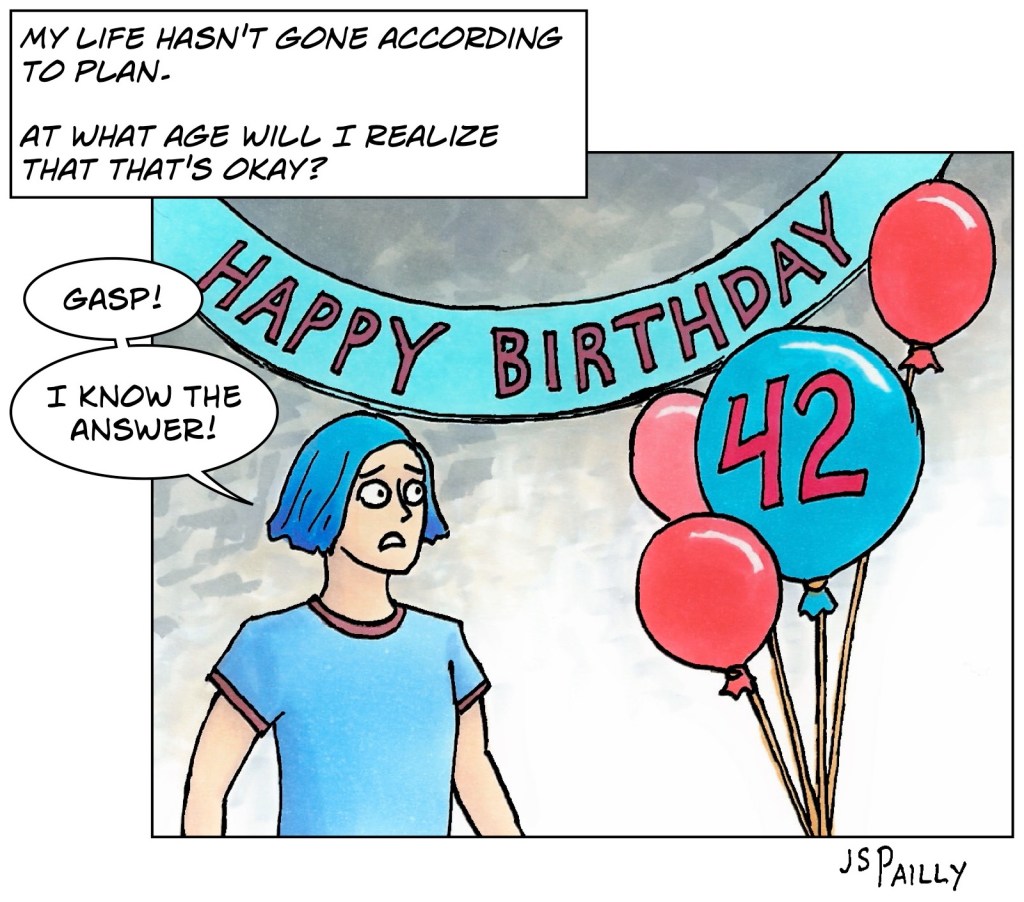
I’m turning 42 this month, a truly momentous age in the life of any geeky person.  For much of my life, I’ve been a collector of inspiring quotes, so I thought this would be a good time to share a quote that’s come to be one of my favorites:

I may not have gone where I intended to go, but I think I have ended up where I needed to be.

– Douglas Adams

I have to admit, the first time I heard this quote, I did not like it much.  I was very young at the time, and I was very ambitious.  I had a very clear vision of what I intended to do with my life.  I had what I called my “master plan,” and I believed that so long as I followed my master plan I would become a rich and successful author.  The notion that Douglas Adams, one of the authors young me admired most, could end up where he ended up in life by accident didn’t make any sense to me.

I managed to stick to my master plan fairly well for a while, up until the 2008 financial crisis.  Master plans don’t hold up well in the face of global financial crises of that magnitude.  Anyway, very little in my life has gone according to plan since then.  Young me would have been distressed to hear that.  Young me would have assumed that meant I’d given up on writing by now.  Writing careers are hard.  How could anyone pursue a writing career without a plan?

Well, it turns out my love of writing is more resilient than that.  No matter what happens, I keep writing.  Even on days when I hate my own writing, I still feel that urge to write.  And I’ve come to appreciate how all the unplanned events in my life and in the world around me help make me a better writer.

How about you, friends?  Whatever age you are, whatever place you’re at in life, are there any inspiring quotes that have helped you along the way?

IWSG: What Are Books For?

Hello, friends!  Welcome to this month’s meeting of the Insecure Writer’s Support Group, a blog hop created by Alex J. Cavanaugh and co-hosted this month by Feather Stone, Janet Alcorn, Rebecca Douglass, Jemima Pett, and Pat Garcia.  Are you a writer?  Do you feel insecure?  Well, then this is the support group for you!  Click here to learn more and to see a list of participating blogs.

What are books for?  When I was young, the answer seemed self-evident.  You read a book, and the ideas and information on the page get absorbed into your brain, like uploading data into a computer.  But over the years, I’ve come to realize that books can do something far more magical than that.

You see, there are a handful of books that I’ve read and re-read over and over again.  The Lord of the Rings, The War of the Worlds, and Dune are probably my top three most re-read books.  I’ve read each of them half a dozen times at least over the course of my life.  Weirdly enough, each time, the reading experience feels different.  Some characters seem more relatable, or less relatable.  Little details seem to gain or lose significance, and the overall meaning or moral of the story seems to keep changing.

How can this be?  I haven’t bought new, updated editions of these books.  The text on the page is the same as it’s always been.  Even the typos (for some reason, my copy of Dune has a lot of typos).  So what’s happening?  If my reading experience keeps changing, but the books themselves always stay the same, then the only other factor in this equation is… me, the reader.  I’m the one who’s changed.  And every time I re-read one of my favorite books, I get a glimpse of who I am now compared to who I was five, or ten, or twenty years ago.  In the case of The Lord of the Rings, it’s been almost thirty years since the first time I read that book.

Books can impart ideas and information from the author to the reader.  That is one of their functions.  But there’s a deeper magic at work, too.  Books can also serve as psychological mirrors for their readers.  When you read a book that you love, what does that tell you about yourself?  What is the book reflecting back at you that makes you so happy?  Or, if you hate a book, what is that book reflecting back at you that makes you so mad?

As writers, our job is not merely to put words down on the page.  Our job is not merely to inform and/or entertain our readers.  Our job is also to make good mirrors.  To offer people a chance to see themselves a little more clearly.  To help them catch a glimpse of their own hearts, their own souls.  What an awesome and helpful service we writers provide!

P.S.: Oh!  Maybe that’s why they talk about “polishing” your manuscript!

IWSG: I Believe in Fairies

Hello, friends!  Welcome to this month’s meeting of the Insecure Writer’s Support Group, a blog hop created by Alex J. Cavanaugh and co-hosted this month by Jennifer Lane, L Diane Wolfe, Jenni Enzor, and Natalie Aguirre.  Are you a writer?  Do you feel insecure?  Well then good news!  This is the support group for you!  Click here to learn more and to see a list of participating blogs.

As you can probably tell from the name of my blog, I love space.  I also love science and science fiction.  I’ve been loving space, science, and science fiction for such a long time now that I’ve developed a highly scientific, highly evidence-based view of the world.  I don’t pay attention to astrology.  I don’t take tarot cards or Ouija boards seriously.  I don’t knock on wood or worry about black cats crossing my path.  I don’t believe in any superstitions except one: I do believe in fairies.

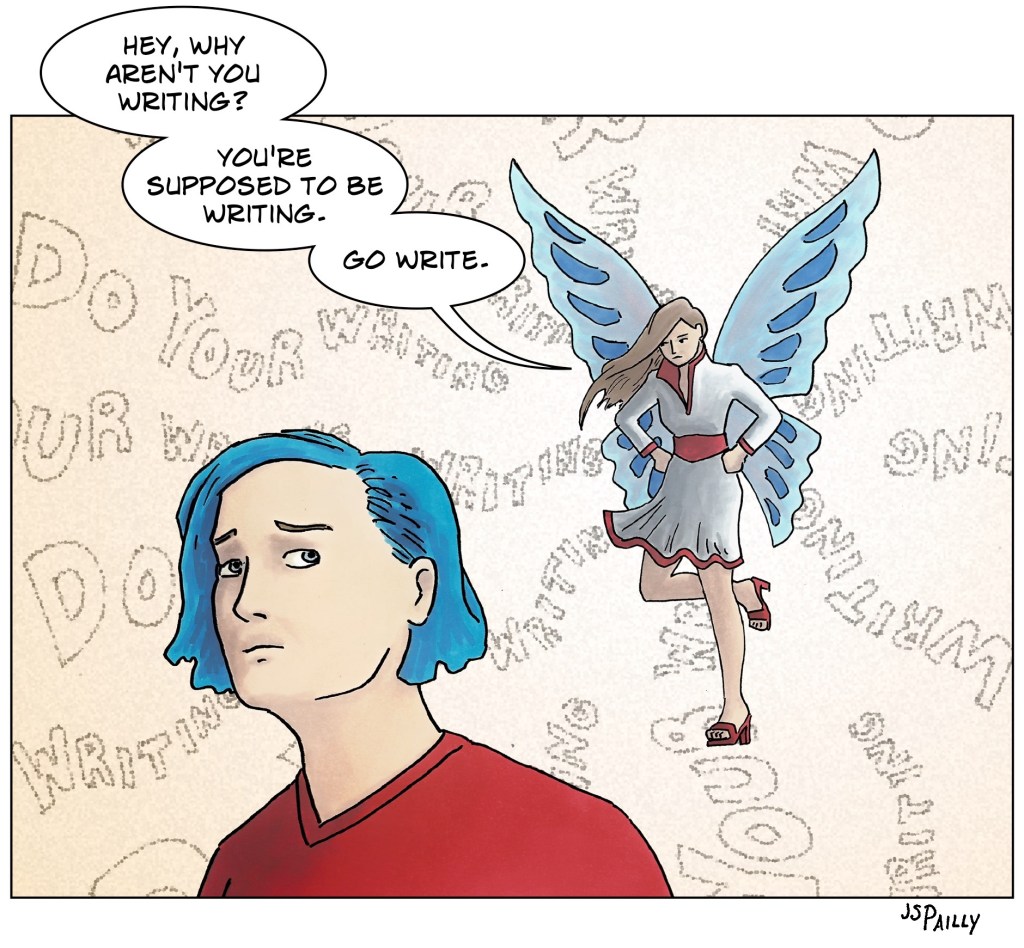
That’s because I happen to know a fairy.  I call her my muse, and she can be super annoying sometimes, always pestering me with new ideas and nagging me about writing whenever I take even the shortest possible break from writing.

It’s hard to deny the existence of fairies when there’s this one fairy who just will not leave you alone, not even for one goddamn minute!

Anyway, the real point I’m trying to make is that there is a highly scientific, highly evidence-based approach you could take to writing.  You could learn all about the craft of writing.  You could study plot and characterization.  You could memorize all the heroic archetypes and all twelve steps of the monomythic journey.  You could find out what words like synecdoche and antimetabole mean and then apply those concepts to your writing.

And… okay, sure, you should spend some time learning about those things.  But don’t get too technical about writing.  Don’t take too scientific of an approach.  Leave room for sudden inspiration.  Be prepared for things to suddenly make sense, and you can’t explain why.  That’s probably your muse sprinkling fairy dust on your head, causing the magical side of writing to happen.

P.S.: Of course, the great science communicator Carl Sagan once said exactly what I’m trying to say, except much more succinctly: “A book is proof that humans are capable of working magic.”

Who Is J.S. Pailly?

Hello, friends!  Every once in a while, I think it’s good for bloggers to reintroduce themselves.  My name is James Serain Pailly, and I love space.

I love other things too, of course.  I love good food.  I love a glass of fine wine.  I love taking naps in the middle of the afternoon.  I collect books.  I have a few really nice leather-bound classics that I’m really, really proud of.  I also collect Lego, and I have several Lego sets on display in my house that I’m really proud of, too.  I love making art.  I love… well, sometimes I have mixed feelings about writing, but when the  muse is with me, I do love to write.  Oh, and I have a few close friends whom I love very much (you know who you are!).

But on this blog, I mainly talk about my love for space.  And on that note, dear reader, there is something I want to make sure you understand about me: I am not a scientist.  I’m not an aerospace engineer.  I don’t have any professional experience with space exploration whatsoever.  I’m just really enthusiastic about this stuff.  I read a lot about space, and I’m always trying to learn more.  Thanks to all that learning and all that reading, plus all that enthusiasm, the way I talk about space sometimes makes people think I must work at NASA, or something.  So I just want to clarify, for anybody who might get the wrong impression, that I don’t work at NASA.  I don’t work in the aerospace industry.  I’m just a big, big fan of space.

I also want to clarify (because this is another assumption people sometimes make about me) that my obsession with space and space exploration does not extend to U.F.O.s.  I used to be more openminded about U.F.O.s (or U.A.P.s, which seems to be the more politically correct term for them these days), but time and again the evidence never seems to hold up to scrutiny.  So no, I don’t take U.F.O.s seriously.  Or alien abductions, or conspiracy theories about reptilians running the government, or anything else along those lines.

I’m also not into astrology, though I do enjoy the astrology aesthetic.

One last thing I feel I should tell you: I’m in the LGBT community.  To be more specific, I’m a genderqueer bisexual.  That’s not super relevant to anything we talk about on this blog, but I also don’t want anyone to think I have something to hide or that I’m ashamed of who I am.  In other words: I’m here, I’m queer, now let’s get back to talking about space.

I haven’t been blogging much these last few months.  That’s due primarily to work-related stress.  You may be wondering: “So James, if you don’t work at NASA, where do you work?”  Well, dear reader, I work in news.  News is a depressing line of work, even at the best of times, and these are not exactly the best of times.  All the stress and all the anxiety of my day job has kept me from blogging, which is a real shame because blogging about space (i.e. blogging about a thing I love!) is one of the best ways I know to manage my stress and reduce my anxiety.

But I’m hoping to turn that around.  Today, I’m recommitting myself to writing this blog and posting on a more regular basis, because despite everything, I still love space.  If you also love space, then I hope you’ll join me on this adventure.

Thanks for reading, friends.  I’ll talk to you again soon.

IWSG: How Writing Changes You

Hello, friends!  Welcome to this month’s meeting of the Insecure Writer’s Support Group, a blog hop created by Alex J. Cavanaugh and co-hosted this month by Joylene Nowell Butler, Louise Barbour, and Tyrean Martinson.  Are you a writer?  Do you feel insecure?  Well, then this is the support group for you!  Click here to learn more and to see a list of participating blogs.

I am not the same person I was 20 years ago.  In some respects, I’m sickened to think of the person I was 20 years ago.  My outlook on life and on the world has completely changed.  I left my church, I switched political parties, I came out of the closet, I lost a lot of friends, I went no contact with my family… it’s been a rough 20 years.  It was also about 20 years ago that I began my writing journey.

Which ties in nicely with this month’s question.  Each month, IWSG asks us an optional question, and this month’s question is:

Is there a story or book you’ve written you want to/wish you could go back and change?

Oh yes.  Very much yes.  When I think about my writing from 20 years ago, I’m sickened by some of the things I wrote.  Fortunately for me, very little of that old writing was published, and even less of it is still out there on the Internet today.

But while I’m glad that those old stories aren’t out there to be seen, I do not regret writing them.  You see, one of the magical things about writing is that it reveals to you who you really are and what you really believe.  I was raised to believe certain things.  I thought I knew who I was and what my place in the world was supposed to be.  But whenever I tried to express those beliefs in a story, the story felt… disingenuous.  Halfhearted.  Unconvincing, even to me.

Writing can reveal deep, personal truths to you.  Sometimes it will reveal truths that you’re not prepared to deal with just yet.  And you don’t have to be super introspective or meditative about your writing process for this to happen.  It could be as simple as thinking “Huh, my protagonist seems like a hypocrite,” or “Huh, my antagonist raises some really good points.”  (Or maybe—I don’t know, purely hypothetical example—that Sci-Fi utopia you’re working on keeps sounding like a dystopia, no matter what you do).  That could be the first sign that your own writing is trying to teach you something about yourself.

I suspect a lot of older, more seasoned writers already know what I’m talking about in this post.  As for any new, younger writers who might be reading this, keep an open mind.  Pay attention to what your own writing is trying to tell you.  If you do, the act of writing may change you.

IWSG: I Don’t Actually Like Writing

Hello, friends!  Welcome to this month’s meeting of the Insecure Writer’s Support Group, a blog hop created by Alex J. Cavanaugh and co-hosted this month by Ronel, Deniz, Pat Garcia, Olga Godim, and Cathrina Constantine.  Are you a writer?  Do you feel insecure?  Well, then this is the support group for you!  Click here to learn more and to see a list of participating blogs.

For most of my life, I’ve been telling people that I love writing.  But (confession time) that’s not entirely true.  I don’t love writing.  Most days, I don’t even like writing.  Writing is a tedious, time-consuming process that requires me to think really hard about words when I’d rather be watching Netflix.  I mean, have you seen Arcane?  That show is so good!!!  Wait, no… I need to stay on topic.  What was I talking about?  Oh yeah: writing sucks.  I hate it.  So why do I keep doing it?

Whenever I go around claiming (erroneously, as you now know) that I love to write, people will inevitably start suggesting things that I ought to write about.  I’ve been told that I ought to write smut, because that’s how you make the easy money (I’ve met writers who write erotica, and I know it’s not such an easy way to make money).  I’ve been told I ought to write a book about Abraham Lincoln, because it’s about time the truth came out about Lincoln (the person who suggested this… I do not know what he was talking about, and I don’t want to know).  I’ve been told I ought to write about what it was like to live through a global pandemic, because that’s an interesting experience that I’ve had (and other people haven’t, I guess???).

As a writer, it takes a lot to get me to sit down and do my writing.  All those suggestions from random people in my life—I’m sure somebody could write a good book about those things, but I cannot muster up enough enthusiasm to write about them myself.  I’d much rather curl up in bed and rewatch Three Body Problem on my laptop.  That scene in the Panama Canal gives me chills every time.  So upsetting.  Anyway… sorry, we were talking about writing.

For some strange reason, those same people who keep telling me what I ought to write about also keep telling me what not to write about.  They don’t think I should spend so much time writing about space.  They say I’ll never get rich, like E.L. James, by writing about space.  And maybe that’s true.  But here’s the thing: I love space.  I hecking LOVE outer space.  I mean, outer space is so cool!  Unless you wander too close to a star, in which case outer space gets face-meltingly hot.  Gravity’s weird up there.  There might be aliens.  All the planets (besides Earth, of course) are straight-up death traps, but we’re going to try to live on some of them anyway.  Remember to bring your own oxygen, and remember to hold on to your oxygen tank like your life depends on it (because it does).

Space is just so exciting to me!  It’s exciting enough that I’m willing to spend hours upon hours of my own free time writing about it.  That’s time I could’ve spent watching… I don’t know, Stranger Things, or something?  Doesn’t matter.  The point is I love space so much that I’m willing and eager to write about it, despite the fact that I don’t actually like writing all that much.

So going forward, I may still tell people, from time to time, that I love writing.  But between you and me, dear reader, you’ll know what I really mean.  You’re in on my secret now.  To me, writing is merely a means to an end.  It’s a tool I use to express a more important thought.  Namely, that I love space.

So friends, what do you love?  What do you love so much that you’re willing to write about it?

IWSG: Let’s Talk About Politics

Hello, friends!  Welcome to this month’s meeting of the Insecure Writer’s Support Group, a blog hop created by Alex J. Cavanaugh and co-hosted this month by Diedre Knight, Lisa Buie Collard, Kim Lajevardi, and JQ Rose.  Are you a writer?  Do you feel insecure?  Then this is the support group for you!  Click here to learn more!

So this blog post is scheduled to come out the day after the U.S. Presidential Election; however, I am writing this a few days before the election.  Therefore, the me who is writing this post does not yet know what the outcome of the election will be.  Perhaps, when this post comes out, we still won’t know what the election results will be.  It’s hard for me to guess what might happen, here in the past.

But I do know one thing.  I know that, whatever the outcome of the election happens to be, a whole lot of people will be real happy about it, and a whole lot of other people will be real mad.  I know I personally will be either really happy or really mad, depending on who wins this one.  But it’s important to remember that elections are not the only things that matter in a democratic society.  There are other ways to express your beliefs and advocate for causes you care about.

Which brings me, finally, to the real topic of today’s blog post: writing.  I’m a science communicator and science fiction writer.  I write about space, science, and the future of humanity.  I believe in a future where we don’t destroy ourselves through nuclear war or climate change.  I believe in a future where we come together as a species and where we go on to become explorers of the cosmos.  In other words, I believe in the Star Trek future.

Sometimes, my writing gets a little preachy.  Sometimes I want to get preachy in my writing.  And sometimes I don’t.  But even when I’m not deliberately trying to make some sort of moral or political statement, my beliefs and values still come through in everything I write.  You can’t be a writer and not have your beliefs and values creep into your work somehow.

So if you’re a writer and if you have strong feelings (positive or negative) about whatever just happened in the U.S. Presidential election, my advice to you is this: go write.  It doesn’t have to be overtly political writing.  Write whatever makes you happy.  Write whatever you’re passionate about writing.  Just write.  Your words matter more than you know.  Your words can help people understand your point of view.  Your words may change somebody’s mind.  Your words can make the world a better place.  So go write, keep writing, and make a difference.

P.S.: Oh no, I just wrote a blog post about politics and scheduled it for the day after a Presidential election.  Okay, everybody, please try to be kind in the comments below.  At the very least, try to be respectful.  If you want to get into a fight with somebody about politics, there are plenty of other places on the Internet where you can go do that.

IWSG: The Ultimate Writing Machine

Hello, friends!  Welcome to this month’s meeting of the Insecure Writer’s Support Group, a blog hop created by Alex J. Cavanaugh and cohosted this month by Rebecca Douglass, Pat Garcia, Louise-Fundy Blue, Natalie Aguirre, and J.S. Pailly (hey wait a minute, that’s me!!!).  If you’re a writer and if you feel insecure about your writing life, click here to learn more about this amazingly supportive group, or click here to check out the IWSG Facebook page.

Each month, IWSG asks us an optional question.  It is totally optional!  IWSG members do not have to answer the question if they don’t want to, or if there’s something else they need to talk about instead.  This month’s optional question is:

What are your favorite writing processing (e.g. Word, Scrivner, yWriter, Dabble), writing apps, software, and tools?  Why do you recommend them?  And which one is your all time favorite that you cannot live without and use daily or at least whenever you write?

As you know, I love space, and I love science.  Based on those two statements, you might expect that I’d also love technology, or that I’d at least feel somewhat comfortable using technology.  But no.  There’s something about sitting in front of a computer screen that makes the creative side of my brain switch off.  Ergo, I don’t use writing software or writing apps much.  I do almost all of my writing the old fashioned way, with pen and paper.

Now I’m not trying to be a hipster about this.  I don’t want to wax poetic about the magical sound of a pen scratching on crisp, white paper.  Writing by hand is not—absolutely not—a better, more sophisticated, more intellectually proper way to write.  It is simply that I cannot “good words do” (as Patrick Rothfuss once described writing) when I’m staring at a computer screen, so writing by hand is my only option.

I do use a computer (obviously!), but only at the very end of my writing process.  Once I have a fully finished draft written out by hand, I take it to my computer, go into a fugue state, and mindlessly transcribe whatever I wrote into a word processor.  Which word processor?  It doesn’t matter.  I don’t have strong feelings about these things.  But I do have strong feelings about pens.  So let me tell you about the Pilot Precise V5 Rolling Ball Pen.

Pilot Precise Rolling Ball pens are marketed as “the ultimate writing machine.”  They’re ballpoint pens with super fine, almost needle-like tips.  According to the marketing copy, these pens use a “unique ink formula” and an “advanced ink feed system for smooth, skip free writing.”  That sounds like marketing B.S., but this is one of the rare cases where the marketing B.S. is actually true.

When I’m in the zone, deep in the flow state of writing, totally lost in my own imaginary world, I don’t want to worry about having any sort of trouble with my pen.  And with Pilot Precise pens, I never do.  Just as words flow from my mind, ink flows smoothly and consistently from my pen onto the page.  It’s such a satisfying writing experience.  And given how incredible these pens are, they’re surprisingly affordable.  Depending on where you shop for office supplies, you can usually get a pack of twelve pens for under $20.

The pens come in two sizes: the V7 and the V5.  I prefer the V5.  The V7 makes a slightly thicker, slightly heavier line.  Nothing wrong with that, but the V5’s slightly thinner, slightly finer line feels more elegant and graceful.  The pens also come in a wide variety of colors, which helps me color code different projects, or keep track of different drafts of the same project.  The first draft of this blog post was written in green.  The second draft was pink, and the third draft was purple.  This made it easy for me to see, at a glance, which pages needed to be transcribed into the computer and which ones didn’t.

So I can’t offer any recommendations for writing apps or writing software.  I barely use a computer at all in my writing process.  But for those of you who write using pen and paper, I can recommend the Pilot Precise V5 Rolling Ball Pen.  And try out the multicolor variety packs, if you see them in stores!  These are the only pens I use for writing.  They really are the ultimate writing machines (and nobody’s paying me to say that).

P.S.: This is my first time cohosting IWSG.  I’m super excited to be doing this today, and (fingers crossed) I hope I do a good job.