Hello, friends!
I love space, you love space—lots and lots of people love space. It’s easy to get large numbers of people hyped up about outer space! But as soon as you start talking about funding space exploration, the mood shifts. Folks get uncomfortable, and it turns out that space can be a controversial topic after all. So today, I want to talk about one of the reasons (just one of the reasons) why space exploration is worth the high price tag. It has to do with the Sun.
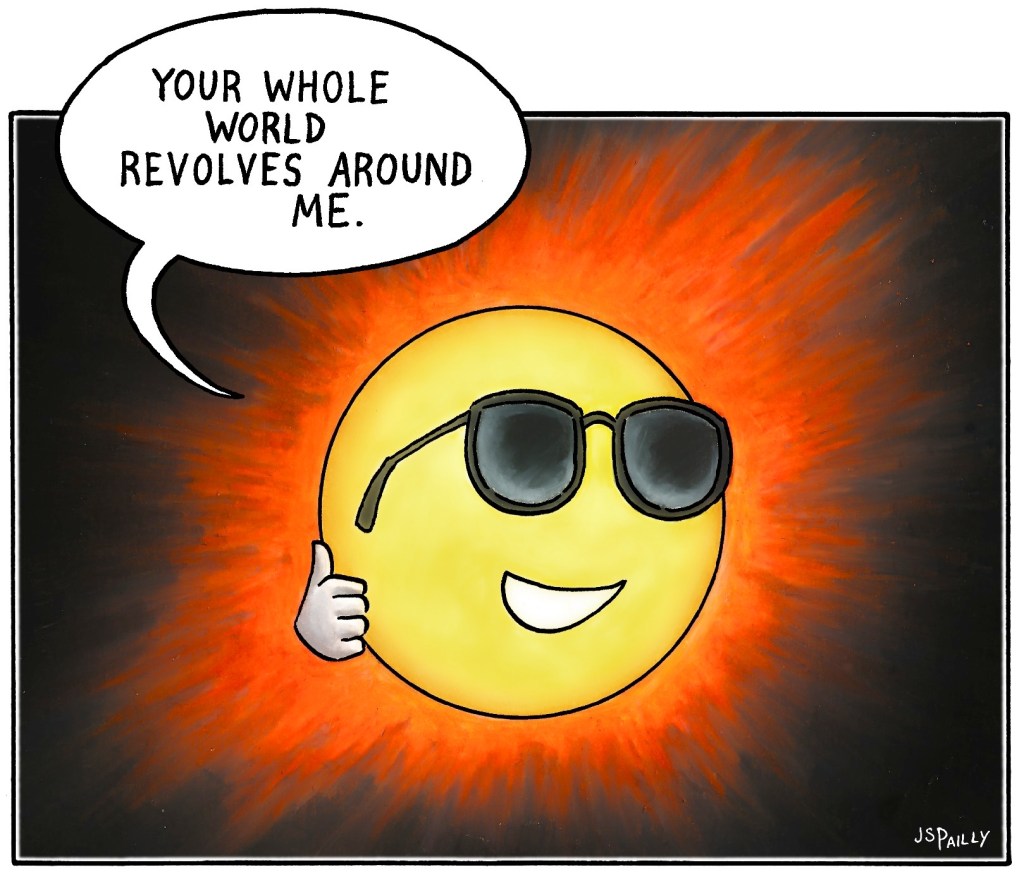
Earth has a complicated relationship with the Sun. Sure, the Sun gives Earth something to orbit. It also provides Earth with light and heat and generally makes this planet livable. However, the Sun also throws spectacular temper tantrums, flinging all sorts of high energy radiation and electrically charged particles out into space. Sometimes, when the Sun throws a temper tantrum, it flings all those charged particles and all that super scary radiation directly at Earth.
Fortunately, Earth’s magnetic field protects us, deflecting the danger away or redirecting it toward Earth’s poles (this is what causes auroras). And so, for the vast majority of human history, the Sun could throw all the temper tantrums she liked, and we haven’t had to worry about it much down here on the ground. That changed on September 1st, 1859.
On that day, English astronomer Richard Carrington was studying sunspots on the Sun (using the proper safety filters on his telescope, I presume) when he observed an absolutely stupendous flash of light. Most likely, Carrington witnessed what we now call a coronal mass ejection, or C.M.E. Seventeen hours later, that C.M.E. hit Earth. It’s said that the resulting auroras stretched from the poles to the tropics and were bright enough to turn night into day. I’ve read some versions of this story that claim auroras were even visible at Earth’s equator.
The Carrington Event, as we now call it, in Richard Carrington’s honor, must have been a beautiful sight. However, this was also the first time a C.M.E. of that magnitude hit Earth while Earth was wired up with telegraph lines. As Earth’s magnetic field reacted to the impact of the C.M.E., induced electric currents wreaked havoc up and down the world’s telegraph network. Telegraph operators received electric shocks. Telegraph equipment started shooting sparks. In some instances, those sparks started fires.
The world today is even more wired up with technology than it was in 1859, so how bad would it be if something like the Carrington Event happened again? No one really knows, but the Sun doesn’t need to produce another Carrington Event to mess with our technology. Much weaker solar events have damaged or disabled our satellites in orbit, triggered power outages here on the ground, and caused radio communications blackouts. Solar storms pose radiation hazards for astronauts, obviously, but they can also put the passengers and crew of aircraft at risk, especially if those aircraft are flying anywhere near Earth’s north or south poles. Solar storms are enough of a problem that insurance companies are paying attention, and they get nervous whenever the Sun stars acting up (see the “want to learn more?” section below if you want to learn more).
So in the early 2000’s, NASA created the Living With a Star program, or L.W.S. Because, for better or worse, the Sun is right there, and we have to live with it. As of this writing, there are three active L.W.S. missions in space, plus a few other solar science missions that operate outside the L.W.S. program. They’re all monitoring the Sun, gathering new data about solar physics, doing their best to give us a least a little warning whenever the Sun decides to hurl a giant, radioactive fireball our way. In time, perhaps these missions will teach us why the Sun’s temper tantrums happen in the first place, so that we can better predict when they’ll happen next.
I heard something on a podcast recently: there is a difference between knowing the cost of a thing and understanding the value of that thing. Space exploration costs an enormous amount of money. There’s no denying that. But for a society like ours, on an increasingly technological world like ours, the value of something like the International Living With a Star program far exceeds the cost. This is just one example of why space exploration is worthwhile, despite the high price tag, and in upcoming posts I’m planning to offer other examples, too.
Thank you for reading, friends. I hope to talk to you again soon.
WANT TO LEARN MORE?
Click here to read “The Carrington Event: History’s greatest solar storm” from Space.com
Click here to visit NASA’s website for the Living With a Star Program.
I mentioned that solar storms can make insurance companies nervous. Click here for an article on how much money the insurance industry could potentially lose due to an “extreme space weather event.”
And lastly, here’s a link to the podcast I mentioned near the end of my post. The podcast is called Stories from Space, and the episode is titled “WTF is Happening at NASA?”
The art used in today’s post is my own original work. If you like my art, please consider visiting the I-Love-Space store on RedBubble. Shopping on RedBubble is a great way to support artists (like me) so that we can keep doing what we do. Thank you!




 i-love-space.com