
My Favorite Fact About Neptune

Hello, friends!  This past month brought a lot of big changes to my life, which left me very little time for writing.  And yet, because I am the person that I am, I had to write something.  So I decided to just do these short and easy blog posts sharing my #1 favorite facts about each planet of the Solar System.  Today, we’re wrapping things up with my #1 favorite fact about Neptune.
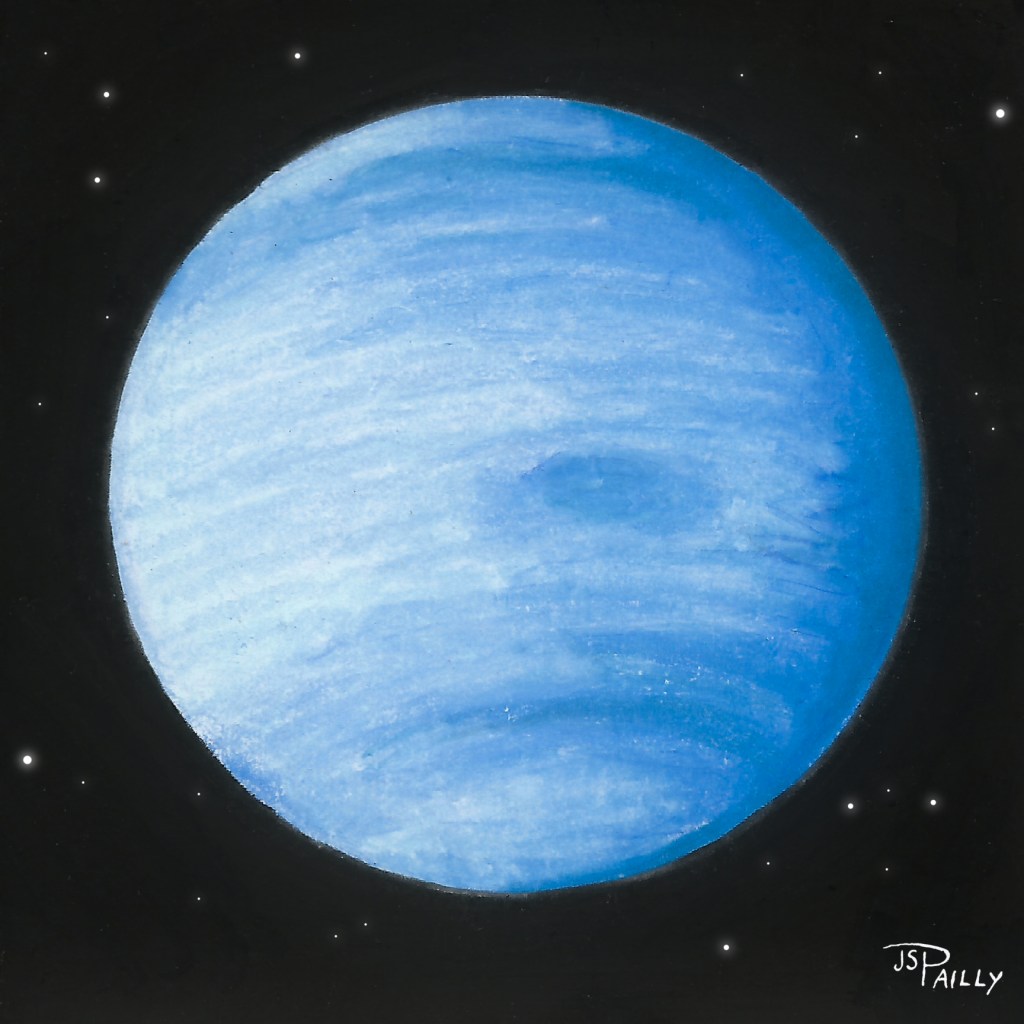
Neptune is 4.5 billion kilometers away from the Sun.  To put that in terms Americans like myself can better understand, that’s over 41 billion football fields.  Neptune is so far away that we really struggle to observe and study him.  I don’t think anything helps illustrate that point better than this: we lost one of Neptune’s moons for more than twenty years.

Naiad, Neptune’s innermost moon, was discovered in 1989 by the Voyager 2 space probe.  And then nobody could find it again until 2013.  The problem?  Well, there were multiple problems.  First, Naiad is very small and also orbits very close to Neptune, which makes spotting Naiad very difficult, even for super powerful telescopes like Hubble or J.W.S.T.  Second, Neptune has another moon, called Thalassa, which is almost the exact same shape and size as Naiad.  That may have caused one moon to be sometimes misidentified as the other.  And third, Naiad has this weirdly inclined (and possibly unstable) orbit, which confused astronomers at first and made it hard to predict where Naiad was supposed to be at any given time.

Naiad is a tricky moon.  Even if Neptune were closer, I’m sure Naiad would have confused astronomers for a while; but I doubt she would have gone missing for over two decades.  Observing and studying Neptune and his moons is hard.  Trying to see anything that’s over 41 billion football fields away is a real challenge.

Thank you, friends, for reading.  This concludes my special series on my #1 favorite facts about the planets of our Solar System, but don’t worry!  I’ll have a post about Pluto coming soon.
The Other Moon Race: Jupiter vs. Saturn

Hello, friends!

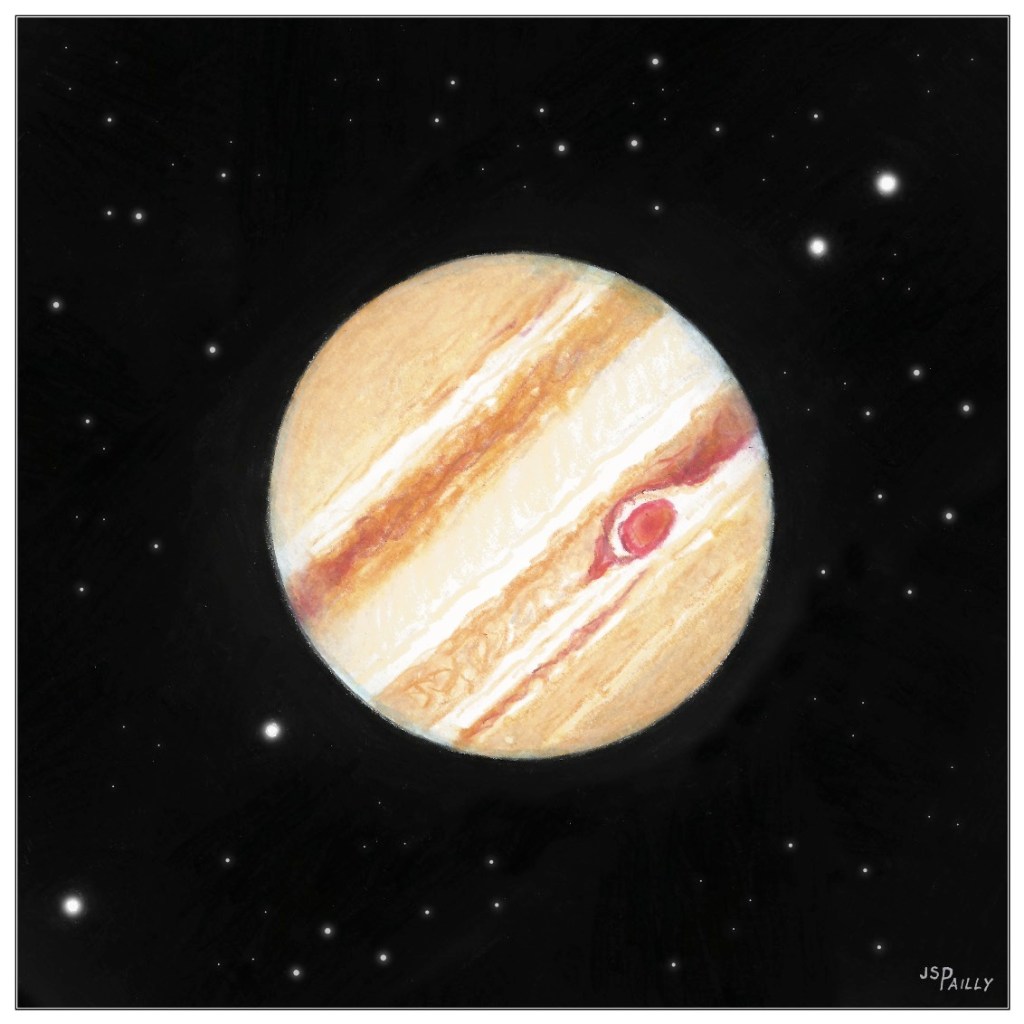
As you know, there’s a new moon race going on, a new race to return humans to the Moon!  But that’s not the moon race we’re talking about today.  No, today we’re talking about the race between Jupiter and Saturn to be the planet with the most moons in the Solar System.

You might expect Jupiter to win this easily.  Jupiter’s the biggest planet, and Jupiter has the most gravity.  Shouldn’t Jupiter end up with the most moons?  Well, Saturn has one not-so-obvious advantage over Jupiter: Saturn is farther away from the Sun.  That means a moon orbiting Saturn is less likely to be yanked away by the Sun’s gravity than a moon orbiting Jupiter.

This has to do with a concept in astrophysics called the Hill sphere, named after American astronomer/mathematician George William Hill.  This can get a bit technical, so if you want to learn more please check out the “What to Learn More?” section below.  This gist is this: a Hill sphere is the area around a planet where the planet’s gravity is more important than the gravity of the Sun.  The size of a Hill sphere is determined by two factors: how massive is the planet, and how far away is the Sun?

Saturn may be smaller than Jupiter, and she may have less gravity than Jupiter, but she’s so much farther away from the Sun that she ends up having the larger Hill sphere.  So which planet has the most moons?  Well, over the past few decades, as astronomers have discovered more and more moons orbiting each planet, it’s been a bit of a horserace.  Sometimes Saturn’s ahead by a couple moons, then Jupiter will catch up and take the lead, then Saturn will take the lead again for a while, and so on.

But in the last year or so, that’s changed.  Saturn has surged way ahead in the “moon race.”  At the time of this writing, Jupiter is known to have 115 moons.  Saturn, meanwhile, has 292.  We can safely assume that more moons will be discovered orbiting both planets, so the race isn’t over; however, I’m going to make a prediction now.  I don’t think Jupiter’s going to win this.

I don’t think Saturn will win, either.  There are (at least) two more planets farther away from the Sun than Saturn.  If having the biggest Hill sphere is the key to winning this moon race, Neptune’s Hill sphere is larger than Jupiter and Saturn’s Hill spheres combined (and if the Planet Nine hypothesis turns out to be correct, God only knows how large Planet Nine’s Hill sphere must be).

At the moment, Neptune is only known to have 16 moons.  I’m predicting today that as our telescopes continue to advance and as our observing techniques continue to improve, Neptune’s moon count will go up.  By a lot.  Ultimately, I’m predicting that Neptune’s total moon count will exceed Jupiter’s and Saturn’s by far.

WANT TO LEARN MORE?

Here’s an article from CosmoBC on Hill spheres, including a chart listing the radius of the Hill spheres of each planet of the Solar System (plus a few of the dwarf planets).

Here’s an article by Phil Plait on how the Moon stays in orbit by staying inside Earth’s Hill sphere.  It’s an older article, but it’s still very much worth a read if you want to understand how Hill spheres work.

Here’s an article from Earth Sky on the current totals for Jupiter’s  and Saturn’s moons.

And here’s another article from Earth Sky on the total number of moons for Uranus and Neptune, with a little information about why discovering moons orbiting Uranus and Neptune is still so difficult for us.

Lastly, I mentioned the Planet Nine hypothesis.  If you don’t know what that is, click here.

The art in today’s post is my own original work.  I don’t use A.I. for anything, ever.  If you like my art, please consider visiting the I-Love-Space store on RedBubble.  Even if you don’t buy anything, just visiting my store and clicking the like button on a few things helps me a lot.  Thank you, friends!