Living with a Star

Hello, friends!

I love space, you love space—lots and lots of people love space.  It’s easy to get large numbers of people hyped up about outer space!  But as soon as you start talking about funding space exploration, the mood shifts.  Folks get uncomfortable, and it turns out that space can be a controversial topic after all.  So today, I want to talk about one of the reasons (just one of the reasons) why space exploration is worth the high price tag.  It has to do with the Sun.
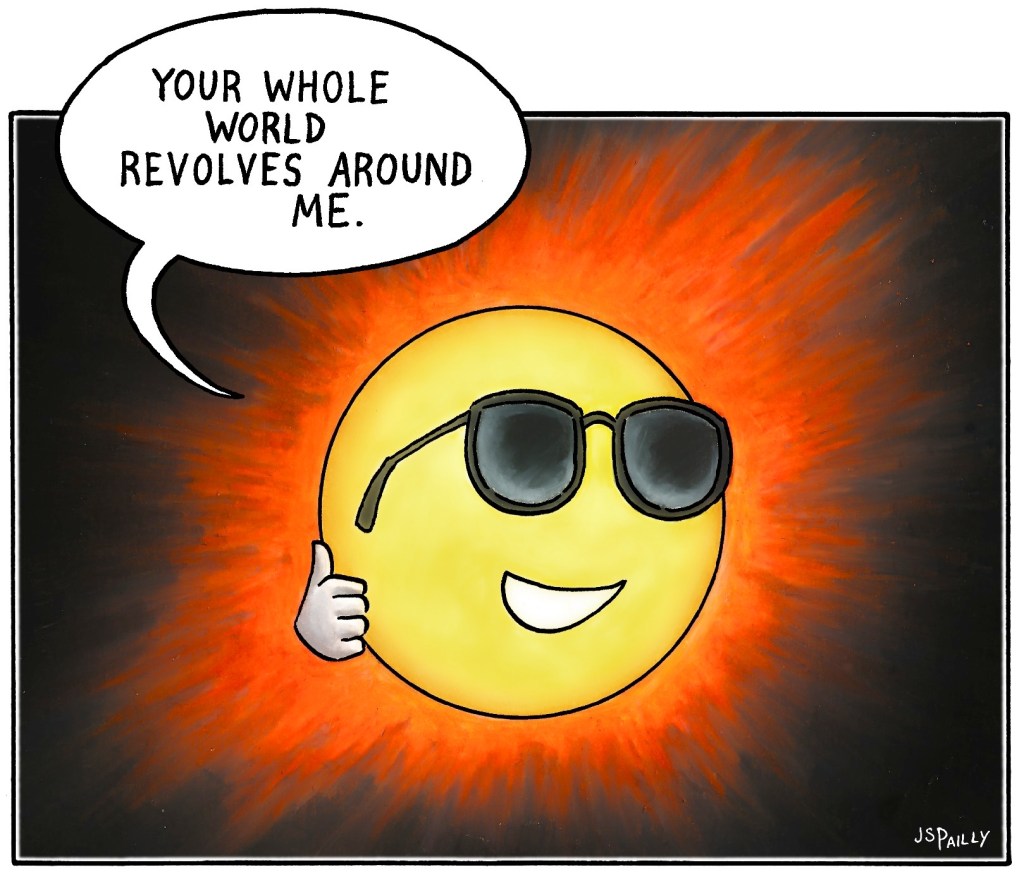
Earth has a complicated relationship with the Sun.  Sure, the Sun gives Earth something to orbit.  It also provides Earth with light and heat and generally makes this planet livable.  However, the Sun also throws spectacular temper tantrums, flinging all sorts of high energy radiation and electrically charged particles out into space.  Sometimes, when the Sun throws a temper tantrum, it flings all those charged particles and all that super scary radiation directly at Earth.

Fortunately, Earth’s magnetic field protects us, deflecting the danger away or redirecting it toward Earth’s poles (this is what causes auroras).  And so, for the vast majority of human history, the Sun could throw all the temper tantrums she liked, and we haven’t had to worry about it much down here on the ground.  That changed on September 1st, 1859.

On that day, English astronomer Richard Carrington was studying sunspots on the Sun (using the proper safety filters on his telescope, I presume) when he observed an absolutely stupendous flash of light.  Most likely, Carrington witnessed what we now call a coronal mass ejection, or C.M.E.  Seventeen hours later, that C.M.E. hit Earth.  It’s said that the resulting auroras stretched from the poles to the tropics and were bright enough to turn night into day.  I’ve read some versions of this story that claim auroras were even visible at Earth’s equator.

The Carrington Event, as we now call it, in Richard Carrington’s honor, must have been a beautiful sight.  However, this was also the first time a C.M.E. of that magnitude hit Earth while Earth was wired up with telegraph lines.  As Earth’s magnetic field reacted to the impact of the C.M.E., induced electric currents wreaked havoc up and down the world’s telegraph network.  Telegraph operators received electric shocks.  Telegraph equipment started shooting sparks.  In some instances, those sparks started fires.

The world today is even more wired up with technology than it was in 1859, so how bad would it be if something like the Carrington Event happened again?  No one really knows, but the Sun doesn’t need to produce another Carrington Event to mess with our technology.  Much weaker solar events have damaged or disabled our satellites in orbit, triggered power outages here on the ground, and caused radio communications blackouts.  Solar storms pose radiation hazards for astronauts, obviously, but they can also put the passengers and crew of aircraft at risk, especially if those aircraft are flying anywhere near Earth’s north or south poles.  Solar storms are enough of a problem that insurance companies are paying attention, and they get nervous whenever the Sun stars acting up (see the “want to learn more?” section below if you want to learn more).

So in the early 2000’s, NASA created the Living With a Star program, or L.W.S.  Because, for better or worse, the Sun is right there, and we have to live with it.  As of this writing, there are three active L.W.S. missions in space, plus a few other solar science missions that operate outside the L.W.S. program.  They’re all monitoring the Sun, gathering new data about solar physics, doing their best to give us a least a little warning whenever the Sun decides to hurl a giant, radioactive fireball our way.  In time, perhaps these missions will teach us why the Sun’s temper tantrums happen in the first place, so that we can better predict when they’ll happen next.

I heard something on a podcast recently: there is a difference between knowing the cost of a thing and understanding the value of that thing.  Space exploration costs an enormous amount of money.  There’s no denying that.  But for a society like ours, on an increasingly technological world like ours, the value of something like the International Living With a Star program far exceeds the cost.  This is just one example of why space exploration is worthwhile, despite the high price tag, and in upcoming posts I’m planning to offer other examples, too.

Thank you for reading, friends.  I hope to talk to you again soon.

WANT TO LEARN MORE?

Click here to read “The Carrington Event: History’s greatest solar storm” from Space.com

Click here to visit NASA’s website for the Living With a Star Program.

I mentioned that solar storms can make insurance companies nervous.  Click here for an article on how much money the insurance industry could potentially lose due to an “extreme space weather event.”

And lastly, here’s a link to the podcast I mentioned near the end of my post.  The podcast is called Stories from Space, and the episode is titled “WTF is Happening at NASA?”

The art used in today’s post is my own original work.  If you like my art, please consider visiting the I-Love-Space store on RedBubble.  Shopping on RedBubble is a great way to support artists (like me) so that we can keep doing what we do.  Thank you!

Mr. Pailly Goes to Washington

Hello, friends!

Sometimes I say I’m shy.  Sometimes I call myself an introvert.  But that’s not the full truth.  I have some deep-rooted social anxiety issues which date back to some unpleasant experiences I had around the age of ten.  And yet, despite that deep-rooted social anxiety, I recently took a big risk.  A week an a half ago, I participated in an event in Washington, D.C., where ordinary citizens (not professional lobbyists) talk to Congress about why we love space and why we support NASA funding.

This event was organized by the Planetary Society, a non-profit group that was established in 1980.  Carl Sagan was among the original founders, and Bill Nye is the group’s current C.E.O.  Americans like to gripe about our government, but NASA stands out as one of the few government agencies that’s actually popular with the American people.  And yet Congress seems to believe, at times, that voters don’t really care about space exploration.  This makes NASA more vulnerable to budget cuts than most other federal agencies.  The Planetary Society exists to help show Congress that voters do care, that voters do support NASA, and that voters want to see NASA properly funded.

Now I fully understand that space exploration is expensive, and I fully understand that we have a lot of problems here on Earth.  But year after year, I keep hearing about budget cuts at NASA.  I keep hearing about important missions falling behind schedule or being canceled outright.  And earlier this year, I heard about mass layoffs at NASA’s Jet Propulsion Laboratory, along with more layoffs at various companies that serve as NASA contractors.  I believe space exploration is our pathway to the future, and so when I keep hearing about all these cutbacks at NASA, I worry that we’re so focused on the problems of today that we’re letting our future slowly slip from our grasp (in case you’re wondering what I said to Congress, that’s almost word-for-word what I said to Congress).

As I said at the top of this post, I went to D.C. despite having some deep-rooted social anxiety issues.  That’s how much I care about this issue.  But there’s more to it than that.  I didn’t just do this despite my social anxiety; I also did it because of my social anxiety.  I wanted to push myself.  I wanted to test myself.  I’m tired of this problem holding me back in life, and I want to overcome it.  I knew this trip wouldn’t be easy for me, and in some respects it ended up being even harder than I expected.  But I got through it, and hopefully what I said to Congress will make a difference.

The Planetary Society does this “Day of Action,” as they call it, every year, and I plan to go again next year.  The way I see it, if I can learn to be a better advocate for space exploration, then I can also learn to be a better advocate for myself.  Time will tell how much my trip to D.C. has helped me, but I can already say that it has helped me at least a little.

WANT TO LEARN MORE?

Here’s some information from Pew Research about the popularity of various U.S. federal agencies, with NASA ranked the third most popular agency after the National Parks Service and the Post Office (two other agencies that Congress seems to keep trying to cut).

And here’s an article from SpaceNews.com about the recent layoffs at NASA JPL.

And lastly, you don’t have to personally go to Congress to advocate for space exploration.  You can also call your congressional representatives on the phone.  Here’s an article from the Planetary Society explaining how to do that and how to do it effectively.

IWSG: Real Reasons vs. Acceptable Reasons

Hello, friends!  Welcome to the Insecure Writer’s Support Group, a blog hop created by Alex J. Cavanaugh and cohosted this month by Victoria Marie Lees, Kim Lajevardi, Nancy Gideon, and Cathrina Constantine.  I’ve been an IWSG member for many years now, over on my previous blog, but this is my first IWSG post here on my new blog, I Love Space.  If you’re a writer, and if you feel insecure about your writing life, click here to learn more about this amazingly supportive group and to see a list of participating blogs.

I just got back from an event in Washington D.C., an event where ordinary citizens (as opposed to professional lobbyists) got a chance to advocate for space exploration to U.S. lawmakers.  I’ll have more to say about that in upcoming blog posts.  Stay tuned!  But there was one aspect of this experience that felt super relevant to the challenges of being a writer.

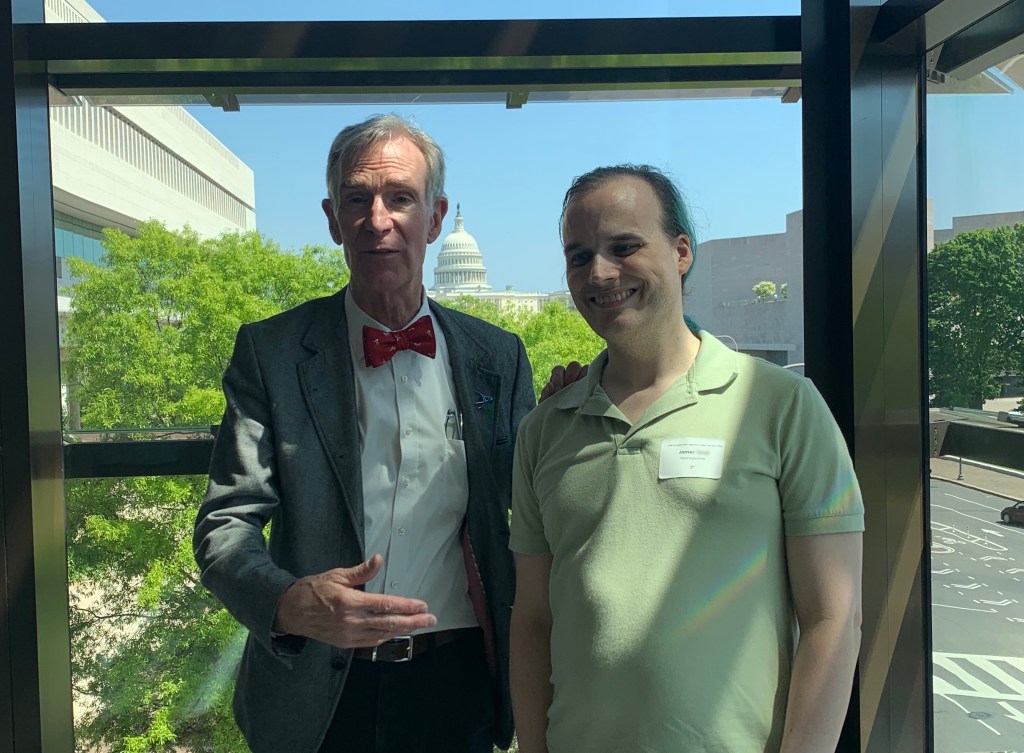
This is a picture of me with Bill Nye.  You probably know him as “the Science Guy,” but he’s also the current C.E.O. of the Planetary Society, the non-profit group that organized the space advocacy event in D.C. which I attended.

I’ve often felt like there’s an easy and obvious metaphor to be made between pursuing a writing career and running the U.S. space program.  Both involve big dreams and lofty aspirations.  Both involve shooting for the stars, so to speak.  Both also involve some harsh economic realities.  And in both cases, balancing those big dreams against those economic realities can be a real challenge.

As former NASA administrator Mike Griffin put it, there are the “real reasons” we explore space (our curiosity, our sense of awe and wonder), but there are also the “acceptable reasons” we must use to justify space exploration to Congress (job creation, spin-off technologies, planetary defense, and so forth).  In a similar way, for us writers, there are the “real reasons” we write, but then there are the “acceptable reasons” we must use to justify ourselves if/when we chose to pursue writing as a career.

For me, the real reasons I write are, in fact, the same as the real reasons NASA exists: a sense of awe and wonder about the cosmos, plus a deep sense of curiosity about what else might be out there.  That’s why I write this blog about space.  And that’s also why I want to pursue a career writing science fiction.  As for my “acceptable reasons,” well… I’m still working on those.  Plenty of cynical people in my life have told me that my writing is good, but that I should stick to a more sensible, more economically viable career path.  I’m never sure what to say to these people.  But I’m working on it.

So, my fellow writers, what are the “real reasons” you write, and what are the “acceptable reasons” you use to justify yourself if you’re pursuing writing as a career?

P.S.: Former NASA Administrator Mike Griffin was recently interviewed on the Planetary Society’s podcast, as part of the lead-up to their big event in D.C.  Click here to hear what Griffin himself has to say about the real reasons vs. the acceptable reasons for space exploration.