
Hello, friends!
Right now, there’s an interstellar object passing through our Solar System. Astronomers have named this object 3I/ATLAS, and in my last post I explained how 3I/ATLAS is just a comet and NOT an alien spacecraft. But let’s pretend for a moment that an alien spaceship were traveling through the Solar System, perhaps on some sort of survey mission. What would the aliens see when they turn their scientific instruments toward Earth? How much would they learn about us and our planet?
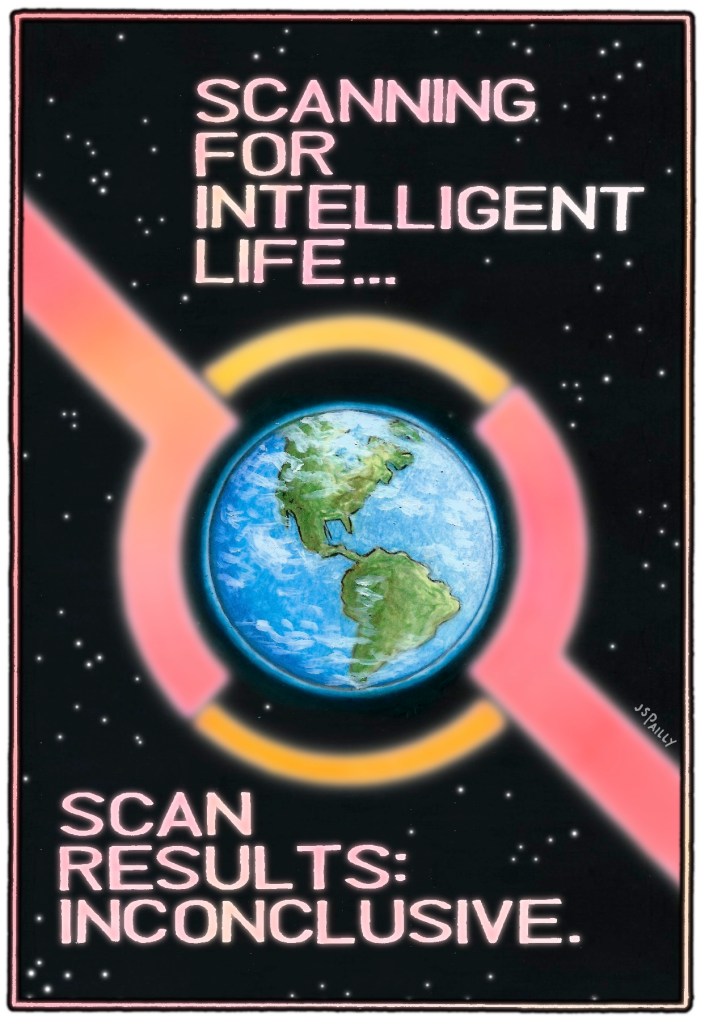
Much depends on how technologically advanced we imagine these aliens to be, of course, but we humans have been observing Earth from space for decades now. We know some things are pretty obvious about our planet, even when viewed from a great distance away. For a start, the aliens would notice that Earth has an abnormally large moon. They’d also notice that Earth has oceans. The glint of sunlight reflecting off water would give that away. And then there’s oxygen. The spectrographic fingerprints of oxygen are all over Earth’s atmosphere.
Do these aliens breathe oxygen like we do? Maybe, maybe not. Either way, Earth’s oxygen-rich atmosphere would make the aliens stop and think, “Huh, that’s weird.” Most planets don’t have atmospheres like that. Even weirder, though, the aliens would also detect traces of methane in our atmosphere. Methane is an easily oxidized chemical, so you’d think all that oxygen would oxidize any atmospheric methane out of existence pretty quick. Something must keep replenishing the methane as quickly as oxygen destroys it. Something alive, perhaps? It’s hard to guess if the aliens would reach that conclusion yet.
As the aliens draw nearer, they’d soon notice this odd green stuff covering much of Earth’s landmasses. To say that in a more technobabbly way, the extraterrestrials would detect a chemical substance with a strong reflection spectrum in green light (and an even stronger reflection spectrum in infrared). You and I know what all that green stuff is, but would the aliens figure it out? Do they have plants back home? Do their plants contain chlorophyll and perform photosynthesis like ours do? Hard to say, but Earth’s green stuff would at least make the aliens think, “Huh, that’s also weird.”
A few more things our hypothetical aliens would notice: a substantial ozone layer, continents shaped by recent (or possibly ongoing) tectonic activity, a complex hydrological cycle with water existing as a solid, a liquid, and a gas… oh, and radio emissions. Lots and lots of narrow-band, amplitude modulated radio emissions, which cannot possibly be a natural phenomenon.
The idea that aliens many lightyears away are watching I Love Lucy, The Brady Bunch, or The Dick Van Dyke Show is probably false. As radio/television broadcasts propagate through space, those signals grow weaker and eventually blend into the background radiation. But for the purposes of this blog post, we’re imagining that an alien spaceship is right here in the Solar System with us. They’re close enough to pick up our broadcasts. At that point, the aliens wouldn’t just think, “Huh, weird.” They’d be forced to conclude not only that life exists on Earth but that intelligent life exists on Earth (unless they start watching our news or listening to our talk radio; if they do that, they might second guess the “intelligent” part).
How much more could the aliens learn about us? Again, it depends on how technologically advanced these aliens are. Consider the stuff I listed in this blog post to be the bare minimum of what they’d know.
WHAT TO LEARN MORE?
This blog post is based off several research papers, which are listed below. Detecting life on a planet—even a planet teeming with life, like Earth—is more of a challenge than you might realize. If that’s a topic you want to learn more about, please check out some of the papers below, especially the first one (the one written by Carl Sagan).
- A Search for Life from the Galileo Spacecraft, by Carl Sagan et al.
- Galileo Multispectral Imaging of Earth, by Paul Geissler et al.
- Earthshine Observation of Vegetation and Implication for Life Detection on Other Planets, by Luc Arnold.
- Detection of Ocean Glint and Ozone Absorption Using LCROSS Earth Observations, by Tyler D. Robinson et al.
- Earth as an Exoplanet: A Two-dimensional Alien Map, by Siteng Fan et al.
The art in today’s post is my own original work. I didn’t take it from the Internet or ask an A.I. to generate it. If you like my art, please consider visiting my store on RedBubble. Shopping on RedBubble is a great way to support artists (like me!) so that we can keep doing what we do. Thank you!

 i-love-space.com