IWSG: I Promise I Won’t Spread Misinformation

Hello, friends!  Welcome to this month’s meeting of the Insecure Writers’ Support Group, a blog hop created by Alex J. Cavanaugh and co-hosted this month by Jennifer Lane, Jenni Enzor, Renee Scattergood, Rebecca Douglas, Lynn Bradshaw, and Melissa Maygrove.  Are you a writer?  Do you feel insecure?  Well, then this is the support group for you!  Click here to learn more and to see a list of participating blogs.
I have a problem.  I write a blog about space (or rather, I’m supposed to be writing a blog about space).  That requires a lot of research, and I do most of my research here on the Internet.  But it turns out that people tell lies on the Internet, or if they don’t lie outright, they tell half-truths, or quarter-truths, or one-eighth of the truth, or they offer alternative truths, or they misremember things they learned were true in grade school, or they dumb down the truth so much that it no longer resembles the truth.

Misinformation is everywhere.  Misinformation about space, science, and technology?  Check, check, and check.  Early in my blogging journey, I made a promise to myself: I promised that, to the very best of my abilities, I would not make the spread of misinformation worse.  I’m only one blogger, so there’s only so much I can do, but I promised I would not make this problem worse.  Not on my blog, not if I could help it!  So before I’d share a space fact on my blog or on social media, I’d stop and fact check it, and if I came across any space news that sounded super juicy, extra awesome, and extremely clickbait-worthy… I’d fact check that even harder.
But the sea of misinformation is growing deep, and wading through it is becoming increasingly arduous.  Fake research papers are getting harder for me to spot, and sources of information that I used to trust I now find questionable.  I succumbed briefly to the temptation of A.I., until I realized how it was slowly and subtly leading me astray.  I’m at the point now where I’m scared to post anything on my blog, because I’m not sure if my fact checking is enough, and I still don’t want to break my promise.  I still do not want to contribute to the further spread of misinformation.

So what am I going to do?  Fact check everything even harder than ever, I guess.  Do less research online and try to rely, instead, on books, science magazines, and peer-reviewed journals.  If I still have doubts about the topics I write about, I can talk about those doubts, and if I find out later that I made a mistake, I can always correct that mistake—but also, I can call more attention to my own mistakes, to make sure that you, dear reader, get the updated and corrected information.

I still love space.  Despite all the headaches my research process has caused me lately, I still love space, and I still want to share my love of space with others.  I do not want to spread misinformation.  That would be unacceptable.  But to stop writing about space, to stop blogging about space all together, out of fear that I might miss something?  Out of fear that I might make a mistake?  That would be unacceptable, too.

IWSG: Where Do You Get Your Ideas?

Hello, friends!  Welcome to this month’s meeting of the Insecure Writers’ Support Group, a blog hop created by Alex J. Cavanaugh and co-hosted this month by Beth Camp, Crystal Collier, and Cathrina Constantine.  Are you a writer?  Do you feel insecure?  Well, then this is the support group for you!  Click here to learn more and to see a list of participating blogs.

One of the most annoying questions you can ask a writer is “Where do your ideas come from?”  Ideas just happen, and most of them aren’t any good.  However, day after day, week after week, year after year, the average writer has so many ideas that it becomes a statistical impossibility for all of those ideas to be bad.  But if somebody insists on asking me this question—if they insist on asking “Where do you get your ideas?”—I have an easy answer, cocked and loaded.  I write science fiction.  I get my ideas from science.

Does that seem self-evident?  That should seem self-evident.  The tradition of Sci-Fi writers getting story ideas from science dates back to Mary Shelley, the woman widely regarded as the very first science fiction author.  In 1780, Italian biologist Luigi Galvani discovered that applying an electric current to a severed frog leg would cause that leg to twitch.  It was almost as if electricity could imbue life into non-living organic matter.  When Mary Shelley wrote Frankenstein, she’d heard about Galvani’s work.  She may not have known all the details, but she knew enough to jolt her creative brain into action.

Just recently, I learned that you can save computer files to birds.  Step one: convert computer data into music.  Step two: have a bird listen to the music until the bird memorizes the data-encoded music.  You can now retrieve your data from the resulting birdsong.  Does this give me a story idea?  Of course!  Is it a good idea?  Eh… we’ll see.  I also recently learned that Earth once had Saturn-like rings, that mosquitos can smell which viruses are in your blood, and that woolly mammoths still existed when the Pyramids of Giza were built.  Oh, and then there’s the latest news from Mars.  That’s obviously giving me ideas, too.

Having ideas is the easy part of writing.  That’s why we writers get annoyed by the “Where do you get your ideas?” question.  It’s like asking if we know how to chew our own food or tie our own shoes.  Me?  I get most of my ideas from reading and learning about science.  Are they good ideas?  No, they usually aren’t, but the more science facts I’m exposed to day after day, week after week, year after year,  the more Sci-Fi ideas I’m going to have.  Eventually, one of those ideas will be good.  It’s a statistical inevitability.

WANT TO LEARN MORE?

I threw a bunch of science facts at you today.  If any of those science facts gave you a story idea, check out the links below to learn more.

IWSG: Writing is Like Oxygen

Hello, friends!  Welcome to this month’s meeting of the Insecure Writers’ Support Group, a blog hop created by Alex J. Cavanaugh and co-hosted this month by Kim Lajevardi, Natalie Aguirre, Nancy Gideon, and Diedre Knight.  Are you a writer?  Do you feel insecure?  Well, good news!  This is the support group for you!  Click here to learn more and to see a list of participating blogs.

I’m not happy with my writing right now.  I haven’t been doing nearly enough writing.  True, there are a lot of distractions in my life—some good, some not so good—but that’s not important.  No matter what’s going on in my life at any given time, I am still a writer.  Writing is like oxygen to me, and when I go too long without writing I feel like I’m suffocating.

So I have a new plan.  This new plan should help me catch my breath, so to speak, by getting a whole lot more writing done.  Ironically, though, this plan begins with a few things that are not actually writing.

First off, I need to stretch more.  You see, I do almost all of my writing on the floor, lying on my belly, with my feet kicked up in the air like I’m a seven-year-old kid.  But I’m not seven.  I’m forty-two, and lying on the floor like that is not great for my back.  Sitting in a chair for extended periods of time hurts my back even more, so I am not going to change my ways.  But stretching before a writing session, as I would stretch before exercise, does help.

Second, there’s a lot of paper clutter in my house, most of which is concentrated in the room where I do my writing.  Years and years worth of paper, produced by years and years worth of writing, the vast majority of which I have no use for today.  It feels a little sacrilegious to throw away so much writing, but the paper clutter is annoying.  Distracting.  It makes me feel slightly claustrophobic sometimes.  And so it has to go, because old writing cannot be allowed to hamper new writing.

And lastly, I’m not sure if everyone will understand this, but I need to get back in the habit of dressing up nice when I write.  When do you dress up nice?  When you’re doing something important, when you’re doing something special.  Writing is important to me, and also very special, and dressing up nice for writing time reminds me of that fact.

None of these things are new discoveries.  I’ve known for years that I should stretch more.  I’ve known for years that all this paper clutter was a problem.  And I’ve known for years that dressing up helps me get into the mood for writing.  But just because I know these things doesn’t mean I was doing them.

So that’s step one of my plan: do those three things.  I’ll be able to breathe easier (and write easier) if I do those three things.

Now what about you?  What non-writing things do you do to make your writing process easier?

I Love Earth

Hello, friends!

As you know, I love space, and as you might imagine, I socialize with a lot of other people (both online and I.R.L.) who also love space.  But in the last year or so, I’ve noticed a change in the space love community.  It used to be that if you loved space, it naturally followed that you also loved planet Earth.  But that’s not the case anymore.  Not for everybody.  These days, for some people, it seems that love for space equals disdain for Earth.

I’ve seen this disdain for Earth expressed in some of the recent discourse about the Moon and Mars, as well as other proposals for the colonization of outer space: rotating space stations, generation ships to other star systems, far future megastructures encircling our Sun.  Basically, these people say Earth sucks.  Earth is boring.  And Earth’s doomed anyway, so let’s cut our loses and move on from this stupid blue planet.  Let’s all go to Mars, or Proxima Centauri, or anywhere else that might be nominally habitable for humans.

So I want you to know something: when I say I love space, that does not mean I share in this weird disdain for Earth.  As of the time of this writing, astronomers have confirmed the discovery of about 6000 exoplanets (planets orbiting stars other than our Sun), but they have yet to confirm the existence of a single exoEarth.  Not one.  For me, loving space means having the context to understand how extremely rare, extremely special, and extremely precious Earth is.

I love space.  It naturally follows from my love of space that I also feel a deep and profound love for the Earth, too.  How about you?

The art in today’s post is my own original work.  I didn’t take it from the Internet or ask an A.I. to generate it.  If you like my art, please consider visiting my store on RedBubble.  Shopping on RedBubble is a great way to support artists (like me!) so that we can keep doing what we do.  Thank you!

IWSG: Sci-Fi Writers Don’t Need Research… Really?

Hello, friends!  Welcome to this month’s meeting of the Insecure Writers’ Support Group, a blog hop created by Alex J. Cavanaugh and cohosted this month by Ronel Janse van Vuuren, Natalie Aguirre, Sarah – The Faux Fountain Pen, and Olga Godim.  Are you a writer?  Do you feel insecure?  Well, good news!  This is the support group for you!  Click here to learn more and to see a list of participating blogs.

Today, I’d like to tell you a story.  This story is half true, half not true, but I think it’s a good story nonetheless, and maybe some of you will find it relatable.

A long time ago, I was at a party for writers—one of those networking events they say you have to go to if you want to get published.  I ended up sitting at a table with some dude who wrote historical fiction.  He was apparently a big shot in the historical fiction genre, or at least he talked about himself as if he were a big shot in the historical fiction genre.

As the evening wore on, the conversation turned to research.  Mr. Historical Fiction knew a lot about doing research, obviously.  He and his wife had just returned from a trip to Europe, where they’d toured some castle that was going to feature prominently in his next magnum opus.  Anyway, this guy went on and on about how important research is for every writer.  Not just historical fiction writers but every writer, in ever genre.

“Unless you write science fiction,” this guy said, with a gracious nod toward me.  “Sci-Fi and fantasy writers do ‘world building’ where the rest of us do research.”

At this point, I’d run out of patience.  “Well, yeah,” I said.  “Fantasy writers have no need for research.  What would they even do research about?  Horses?  Livestock?  Agriculture?  Blacksmithing?  Swords and armor?  Military strategy?  Medieval architecture?  None of that ever comes up in fantasy.

“And as for Sci-Fi, well… my need for research is even less.  Outer space is a mysterious void that we can fill with pure imagination.  Biology?  Geology?  Chemistry?  Don’t need them.  Newton’s laws?  Not important—not when you’re writing about spaceflight.  As a Sci-Fi author, I will never need to know the difference between an asteroid and a meteor, or between dark matter and dark energy, or between special and general relativity.  It’s a good thing, too, because that relativity stuff is complicated.  Have you seen how much math Einstein put into special and general relativity?

“Nope, I have it easy.  I get to just make stuff up.  Maybe I’ll throw the word ‘quantum’ in there so that I sound smart, but don’t worry!  I don’t need to know what the word quantum actually means.  And when I get my stories published, I can rest easy in the knowledge that my audience—i.e., the nerdy people who read science fiction on a regular basis—will not notice my laziness and will not call me out for my ignorance.”

The room was dead silent now.  I carefully set down my drink.  “My point is,” I said, “we Sci-Fi and fantasy writers do world building on top of our research.  Not instead of research.”

Okay, I lied.  I didn’t say all those things.  That whole rant is the part of this story that’s not true.  But I really wanted to say that stuff.  I really, really wanted to.

IWSG: Just Keep Learning

Hello, friends!  Welcome to this month’s meeting of the Insecure Writers’ Support Group, a blog hop created by Alex J. Cavanaugh and co-hosted this month by Rebecca Douglass, Natalie Aguirre, Cathrina Constantine, and Louise Barbour.  Are you a writer?  Do you feel insecure?  Well, then this is the support group for you!  Click here to learn more!

A long time ago, I was talking to some friends about space.  I don’t remember what space thing I was talking about, specifically; I just remember it was something I didn’t understand at the time, and I was trying to learn more about it.  Anyway, I was telling my friends about all the work I was doing, trying to learn about this one specific space thing, and I guess my enthusiasm was showing, which prompted one of my friends to say: “You make me want to go learn stuff.”

To this day, I still consider that to be the single nicest thing anyone has ever said to me.  I love space, obviously, but even more than that, I love learning.  That’s what drives me to be a writer.  On a superficial level, I write because I want to share my love of space with others, and I want to show off some of the cool space facts I’ve learned over the years.  But on a deeper, more fundamental level, I write because I want to show people that learning is fun, that learning creates joy.  Yes, learning can be hard sometimes, but the struggle of learning a difficult or complicated thing increases the joy when you finally do understand that thing.

Writing is not always easy for me.  Sometimes I get discouraged.  Sometimes I get frustrated.  Sometimes I wonder: “Why am I doing this?”  But that thing my friend said to me, all those years ago, is a good reminder: “You make me want to go learn stuff.”

I realize not everybody loves space as much as I do, and I realize not everybody wants to learn everything there is to know about space the way I do.  But if you read any of my stuff, and if you still don’t care much about space, then I hope I can at least inspire you to go learn stuff about the things you do care about, the things that do interest you, the things that you do love.

The art in today’s post—that drawing of a brain hovering over an open book—is my own original work.  If you like my art, please consider checking out the I-Love-Space store on RedBubble.  Shopping on RedBubble is a great way to support artists (like me!) so that we can keep doing what we do.  Thank you!

How Venus Saved Earth’s Ozone Layer

Hello, friends!

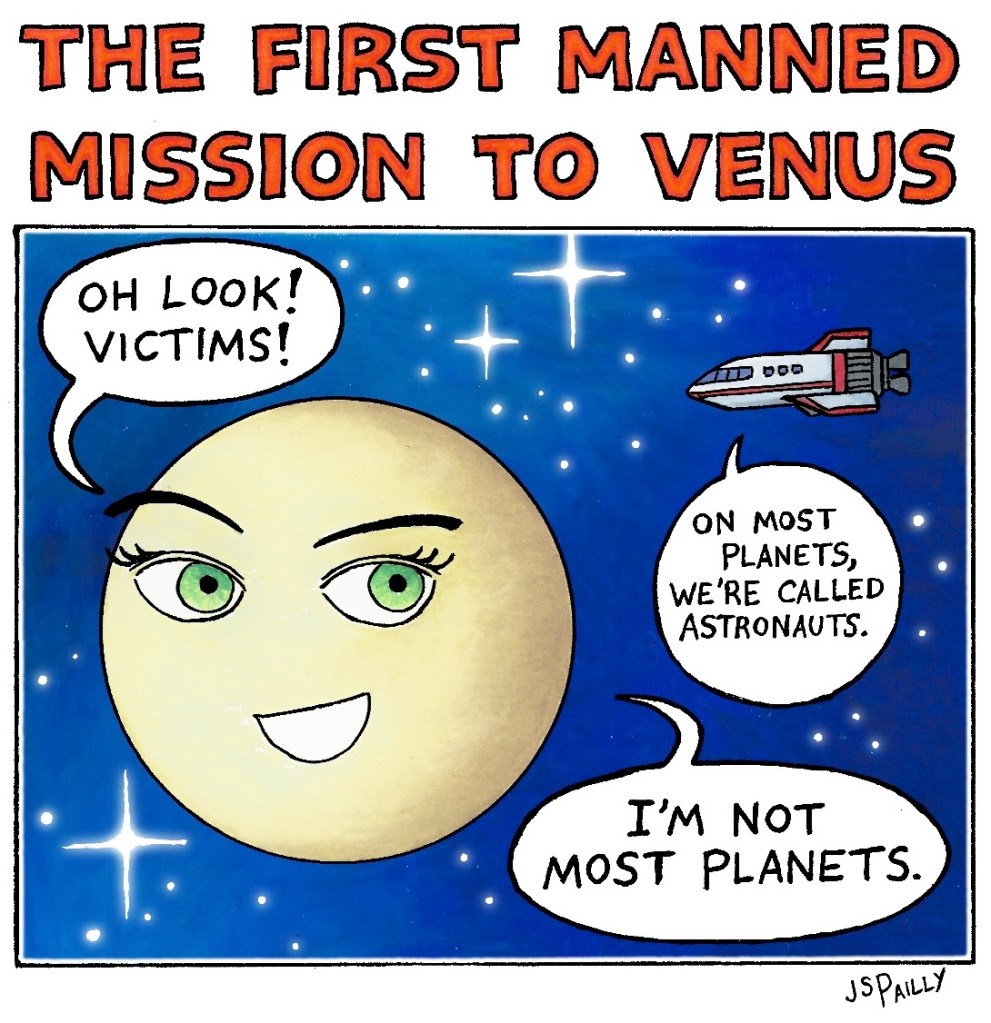
Fun fact about me: Venus is my favorite planet.  I just feel like, out of all the planets in the Solar System, Venus has the most personality.  Granted, it’s the personality of a mad scientist, or maybe a serial killer.  But still… so much personality!  Anyway, today I want to share one of my favorite stories about my favorite planet.  It’s the story of how Venus (the mad scientist/serial killer planet) accidentally saved all life on Earth.

In 1962, NASA’s Mariner 2 space probe became the first spacecraft to send data back from Venus (the Soviet Union’s Venera 1 probe visited Venus a year before, but due to communications issues, it couldn’t transmit any data back to Earth).  In the decade that followed, more missions to Venus sent back even more data, and we learned that Venus spends all her time brewing this super deadly mix of chemicals in her atmosphere.  As I said, Venus has the personality of a mad scientist/serial killer.  If future astronauts ever try to land on the surface of Venus, she will straight up murder them.

As scientists in the 1960’s and 70’s catalogued all the absolutely terrifying stuff in Venus’s atmosphere, they realized something was missing: ozone.  I won’t go into all the chemistry details here, but given the kinds of chemical reactions happening on Venus, Venus should have produced something similar to Earth’s ozone layer.  And yet little to no ozone was detected.  So what gives?

Well, among all the other horrifying chemicals in Venus’s atmosphere, there are some chlorine-based molecules.  Turns out those chlorine-based molecules were interfering with ozone production.  Mystery solved!  But then somebody said, “Wait, what about chlorofluorocarbons?  Those are chlorine-based molecules, and we’ve been releasing them into Earth’s atmosphere for decades.”  More research followed, comparing and contrasting Earth and Venus.  It turned out that, yes, chlorofluorocarbons (better known as C.F.C.s) were interfering with Earth’s ozone layer just as similar chlorine-based molecules interfered with ozone production on Venus.

By the mid-1970’s, scientists were calling for action.  By the end of the 1980’s, politicians were listening, and they actually did something about the problem.  The Montreal Protocol is an international agreement restricting the production and use of C.F.C.s and other ozone-depleting chemicals.  As a direct result, today Earth’s ozone layer is healing, and there’s hope that the ozone layer will fully recover by the end of the 21st Century.  Would scientists have figured out what C.F.C.s were doing to Earth’s ozone layer without Venus’s help?  Probably.  But they might have figured it out too late.

A couple months ago, I did a post about solar storms and the danger they pose to our modern technological world.  In that post, I cited solar storms as one of the reasons why space exploration is worthwhile, despite the notoriously high price tag.  This story about Venus and the ozone layer?  This is another example of why space exploration is worth the money.  Comparing and contrasting Earth with another planet helped save us from disaster once before.  Who knows what other valuable lessons Venus (or Mars, or any of the other planets) still have to teach us?

WANT TO LEARN MORE?

Click here for a video from Sci-Show entitled “How Studying Venus Saved Earth.”

Or click here for an article from The Conversation entitled “What Venus has taught us about protecting the ozone layer.”

If you’re wondering why the ozone layer’s so important, click here for an article from How Stuff Works entitled “What If the Ozone Layer Disappeared?”

And lastly, some of you may be thinking, “Hey, didn’t they discover an ozone layer on Venus just a few years ago?”  You’re right, they did!  It’s at a much higher altitude than Earth’s ozone layer, and it’s much thinner and more tenuous, too.  But Venus does have just a little bit of ozone after all.  Click here to learn more.

The art used in today’s post is my own original work.  If you like my art, please consider visiting the I-Love-Space store on RedBubble.  Shopping on RedBubble is a great way to support artists (like me) so that we can keep doing what we do.  Thank you!

IWSG: 42

Hello, friends!  Welcome to this month’s meeting of the Insecure Writer’s Support Group, a blog hop created by Alex J. Cavanaugh and co-hosted this month by PJ Colando, Pat Garcia, Kim Lajevardi, Melisa Maygrove, and Jean Davis.  Are you a writer?  Do you feel insecure?  Well, then this is the support group for you!  Click here to learn more.

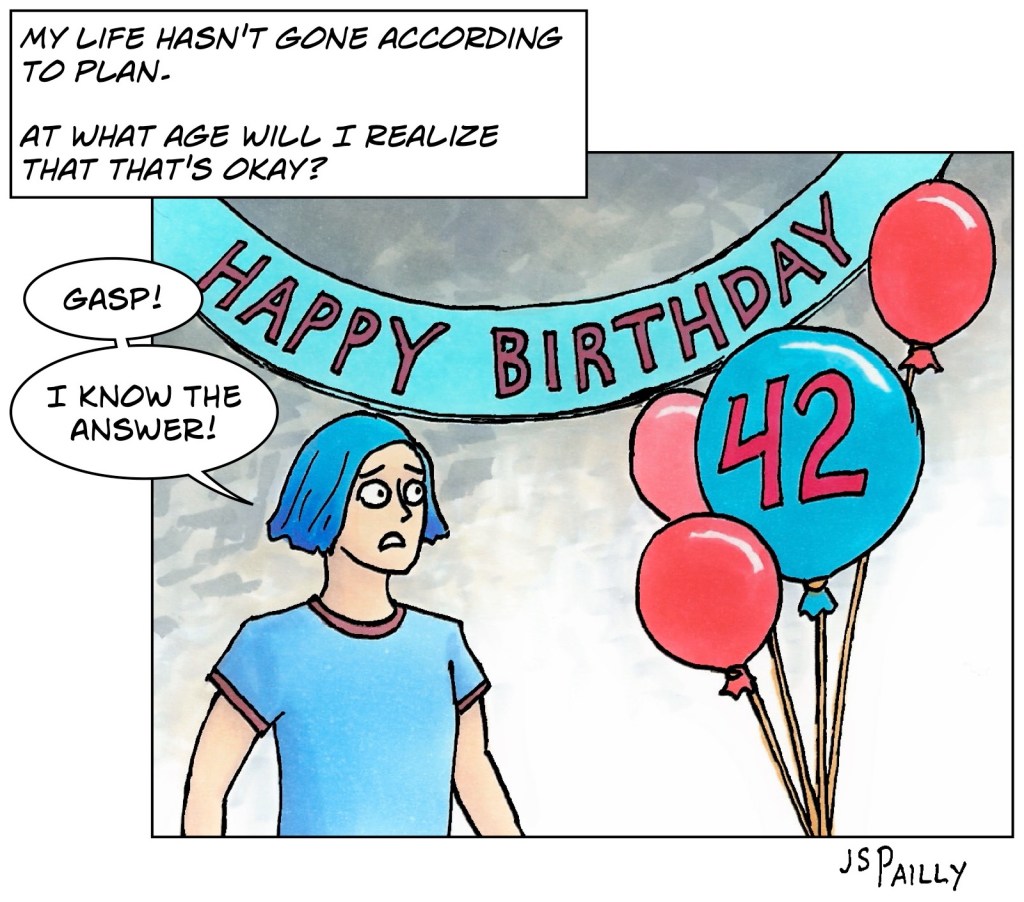
I’m turning 42 this month, a truly momentous age in the life of any geeky person.  For much of my life, I’ve been a collector of inspiring quotes, so I thought this would be a good time to share a quote that’s come to be one of my favorites:

I may not have gone where I intended to go, but I think I have ended up where I needed to be.

– Douglas Adams

I have to admit, the first time I heard this quote, I did not like it much.  I was very young at the time, and I was very ambitious.  I had a very clear vision of what I intended to do with my life.  I had what I called my “master plan,” and I believed that so long as I followed my master plan I would become a rich and successful author.  The notion that Douglas Adams, one of the authors young me admired most, could end up where he ended up in life by accident didn’t make any sense to me.

I managed to stick to my master plan fairly well for a while, up until the 2008 financial crisis.  Master plans don’t hold up well in the face of global financial crises of that magnitude.  Anyway, very little in my life has gone according to plan since then.  Young me would have been distressed to hear that.  Young me would have assumed that meant I’d given up on writing by now.  Writing careers are hard.  How could anyone pursue a writing career without a plan?

Well, it turns out my love of writing is more resilient than that.  No matter what happens, I keep writing.  Even on days when I hate my own writing, I still feel that urge to write.  And I’ve come to appreciate how all the unplanned events in my life and in the world around me help make me a better writer.

How about you, friends?  Whatever age you are, whatever place you’re at in life, are there any inspiring quotes that have helped you along the way?

Does Science Make the World Less Magical?

Hello, friends!

For some reason, whenever I show up at parties, I end up having conversations with people about space.  I swear it’s not always my fault.  I am not always the first person to mention space; however, if anyone does happen to mention space in my presence, my brain contains a wealth of random space trivia, and I am all too eager to share that wealth with others.

A few years back, I was at a dinner party where somebody said something about Mars.  I think this was shortly after the Opportunity rover died, so Mars had been in the news.  Anyway, I love Mars.  I love talking about Mars.  Mars has the largest volcano in the entire Solar System, and also the deepest canyon, and sometimes the dust storms get so bad they conceal the entire planet’s surface from our view.

I could talk about Mars all night if you let me.  Unfortunately, there was one woman at that dinner party who would not let me.  All my Mars facts, all my space facts, all my science facts… she didn’t want to hear any of it.  As she explained herself, she loved to look up at the stars.  She loved to see the stars and wonder about them.  She loved wondering so much that she was afraid all my facts and information about space might spoil her experience of wonderment.

As the evening progressed, I learned that this wasn’t just about space facts.  She also enjoyed wondering how mountains could form, how birds could fly, how a tiny seed could grow into a massive redwood tree.  She loved wondering about these sorts of questions, but she adamantly refused to learn the answers.  It’s not that she was anti-science.  She agreed that science is necessary and valuable.  It’s just that science also made her sad because (in her view) it spoiled all the magic and mystery of the world around us.

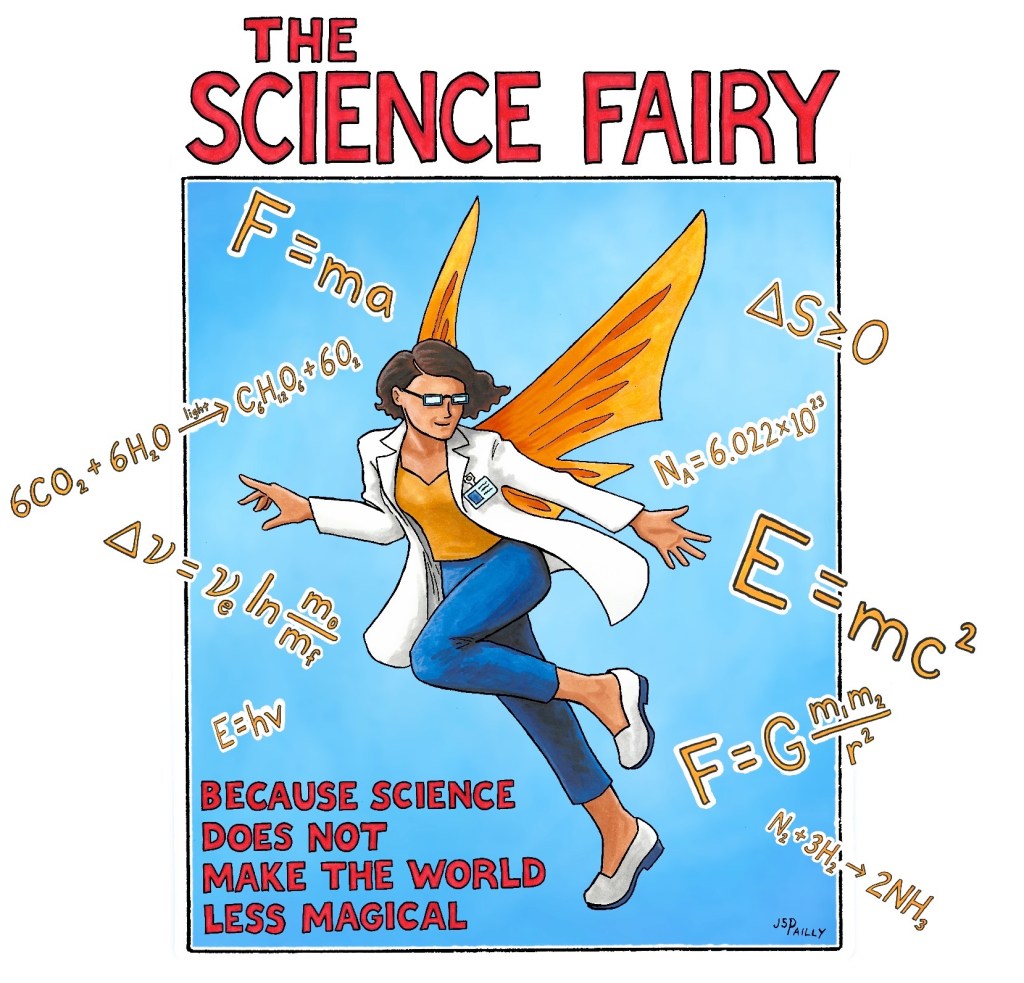
I was, and still am, utterly baffled by this point of view.  It sounds like a celebration of ignorance to me.  I mean, I do understand the joy of wonder.  I wouldn’t want to lose the experience of wonderment either.  But science does not diminish wonder.  It enhances it.

Consider looking up at the night sky, noticing one slightly orange, non-twinkling point of light, and saying: “Gee, I wonder what that is.”  Now consider looking up at that same orangey point of light and thinking: “That’s Mars.  That’s a whole other world.  In some ways, it’s eerily similar to our world, and in other ways it’s wildly and terrifyingly different.  Long ago, that world was covered in water, and maybe also life.  Then something went wrong.  The whole planet dried up, and all that life (assuming it was ever there in the first place) most surely died out.  I wonder what happened.  I wonder if we’ll find fossils.  I wonder if we could ever turn Mars into a living planet again.”

Who’s having the greater experience of wonder?  Rather than spoil any magic or mystery, science has given me far bigger and far more interesting questions to wonder about.  Science has enriched my life, and if you are the kind of person who enjoys (who genuinely enjoys) the experience of wonder, I promise you that learning even a little about science will enrich your life, too.

The art used in today’s post is my own original work.  If you like my art, please consider visiting the I-Love-Space store on RedBubble.  Shopping on RedBubble is a great way to support artists (like me) so that we can keep doing what we do.  Thank you!

IWSG: What Are Books For?

Hello, friends!  Welcome to this month’s meeting of the Insecure Writer’s Support Group, a blog hop created by Alex J. Cavanaugh and co-hosted this month by Feather Stone, Janet Alcorn, Rebecca Douglass, Jemima Pett, and Pat Garcia.  Are you a writer?  Do you feel insecure?  Well, then this is the support group for you!  Click here to learn more and to see a list of participating blogs.

What are books for?  When I was young, the answer seemed self-evident.  You read a book, and the ideas and information on the page get absorbed into your brain, like uploading data into a computer.  But over the years, I’ve come to realize that books can do something far more magical than that.

You see, there are a handful of books that I’ve read and re-read over and over again.  The Lord of the Rings, The War of the Worlds, and Dune are probably my top three most re-read books.  I’ve read each of them half a dozen times at least over the course of my life.  Weirdly enough, each time, the reading experience feels different.  Some characters seem more relatable, or less relatable.  Little details seem to gain or lose significance, and the overall meaning or moral of the story seems to keep changing.

How can this be?  I haven’t bought new, updated editions of these books.  The text on the page is the same as it’s always been.  Even the typos (for some reason, my copy of Dune has a lot of typos).  So what’s happening?  If my reading experience keeps changing, but the books themselves always stay the same, then the only other factor in this equation is… me, the reader.  I’m the one who’s changed.  And every time I re-read one of my favorite books, I get a glimpse of who I am now compared to who I was five, or ten, or twenty years ago.  In the case of The Lord of the Rings, it’s been almost thirty years since the first time I read that book.

Books can impart ideas and information from the author to the reader.  That is one of their functions.  But there’s a deeper magic at work, too.  Books can also serve as psychological mirrors for their readers.  When you read a book that you love, what does that tell you about yourself?  What is the book reflecting back at you that makes you so happy?  Or, if you hate a book, what is that book reflecting back at you that makes you so mad?

As writers, our job is not merely to put words down on the page.  Our job is not merely to inform and/or entertain our readers.  Our job is also to make good mirrors.  To offer people a chance to see themselves a little more clearly.  To help them catch a glimpse of their own hearts, their own souls.  What an awesome and helpful service we writers provide!

P.S.: Oh!  Maybe that’s why they talk about “polishing” your manuscript!