
3I/ATLAS: But What If It Were Aliens?

Hello, friends!

Right now, there’s an interstellar object passing through our Solar System.  Astronomers have named this object 3I/ATLAS, and in my last post I explained how 3I/ATLAS is just a comet and NOT an alien spacecraft.  But let’s pretend for a moment that an alien spaceship were traveling through the Solar System, perhaps on some sort of survey mission.  What would the aliens see when they turn their scientific instruments toward Earth?  How much would they learn about us and our planet?
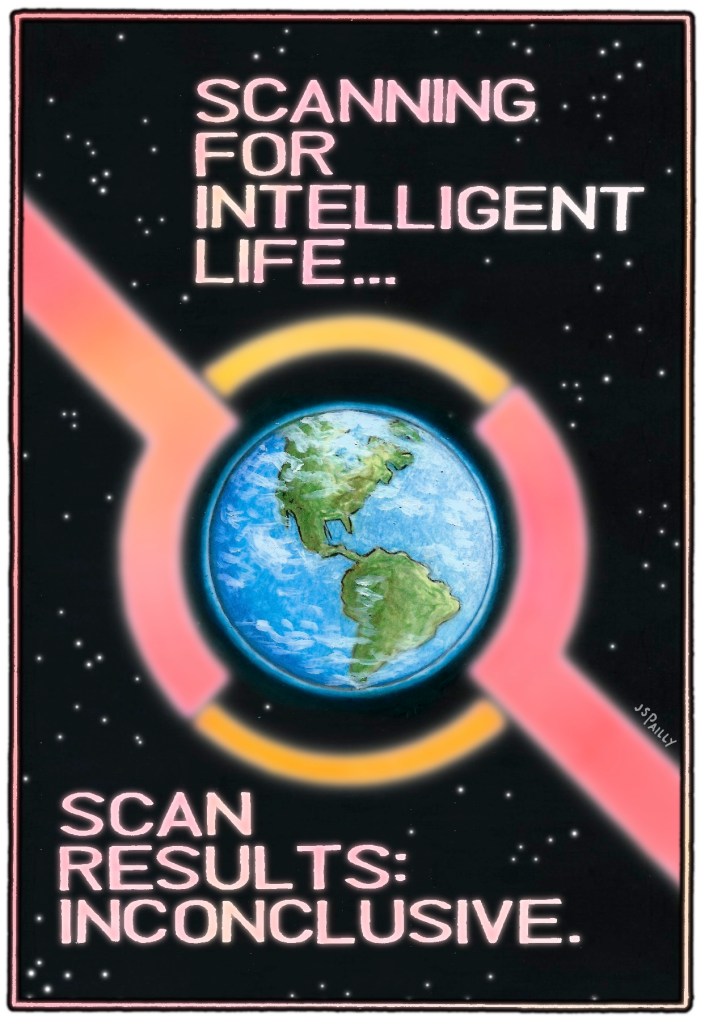
Much depends on how technologically advanced we imagine these aliens to be, of course, but we humans have been observing Earth from space for decades now.  We know some things are pretty obvious about our planet, even when viewed from a great distance away.  For a start, the aliens would notice that Earth has an abnormally large moon.  They’d also notice that Earth has oceans.  The glint of sunlight reflecting off water would give that away.  And then there’s oxygen.  The spectrographic fingerprints of oxygen are all over Earth’s atmosphere.

Do these aliens breathe oxygen like we do?  Maybe, maybe not.  Either way, Earth’s oxygen-rich atmosphere would make the aliens stop and think, “Huh, that’s weird.”  Most planets don’t have atmospheres like that.  Even weirder, though, the aliens would also detect traces of methane in our atmosphere.  Methane is an easily oxidized chemical, so you’d think all that oxygen would oxidize any atmospheric methane out of existence pretty quick.  Something must keep replenishing the methane as quickly as oxygen destroys it.  Something alive, perhaps?  It’s hard to guess if the aliens would reach that conclusion yet.

As the aliens draw nearer, they’d soon notice this odd green stuff covering much of Earth’s landmasses.  To say that in a more technobabbly way, the extraterrestrials would detect a chemical substance with a strong reflection spectrum in green light (and an even stronger reflection spectrum in infrared).  You and I know what all that green stuff is, but would the aliens figure it out?  Do they have plants back home?  Do their plants contain chlorophyll and perform photosynthesis like ours do?  Hard to say, but Earth’s green stuff would at least make the aliens think, “Huh, that’s also weird.”

A few more things our hypothetical aliens would notice: a substantial ozone layer, continents shaped by recent (or possibly ongoing) tectonic activity, a complex hydrological cycle with water existing as a solid, a liquid, and a gas… oh, and radio emissions.  Lots and lots of narrow-band, amplitude modulated radio emissions, which cannot possibly be a natural phenomenon.

The idea that aliens many lightyears away are watching I Love Lucy, The Brady Bunch, or The Dick Van Dyke Show is probably false.  As radio/television broadcasts propagate through space, those signals grow weaker and eventually blend into the background radiation.  But for the purposes of this blog post, we’re imagining that an alien spaceship is right here in the Solar System with us.  They’re close enough to pick up our broadcasts.  At that point, the aliens wouldn’t just think, “Huh, weird.”  They’d be forced to conclude not only that life exists on Earth but that intelligent life exists on Earth (unless they start watching our news or listening to our talk radio; if they do that, they might second guess the “intelligent” part).

How much more could the aliens learn about us?  Again, it depends on how technologically advanced these aliens are.  Consider the stuff I listed in this blog post to be the bare minimum of what they’d know.

WHAT TO LEARN MORE?

This blog post is based off several research papers, which are listed below.  Detecting life on a planet—even a planet teeming with life, like Earth—is more of a challenge than you might realize.  If that’s a topic you want to learn more about, please check out some of the papers below, especially the first one (the one written by Carl Sagan).

The art in today’s post is my own original work.  I didn’t take it from the Internet or ask an A.I. to generate it.  If you like my art, please consider visiting my store on RedBubble.  Shopping on RedBubble is a great way to support artists (like me!) so that we can keep doing what we do.  Thank you!

I Love Earth

Hello, friends!

As you know, I love space, and as you might imagine, I socialize with a lot of other people (both online and I.R.L.) who also love space.  But in the last year or so, I’ve noticed a change in the space love community.  It used to be that if you loved space, it naturally followed that you also loved planet Earth.  But that’s not the case anymore.  Not for everybody.  These days, for some people, it seems that love for space equals disdain for Earth.

I’ve seen this disdain for Earth expressed in some of the recent discourse about the Moon and Mars, as well as other proposals for the colonization of outer space: rotating space stations, generation ships to other star systems, far future megastructures encircling our Sun.  Basically, these people say Earth sucks.  Earth is boring.  And Earth’s doomed anyway, so let’s cut our loses and move on from this stupid blue planet.  Let’s all go to Mars, or Proxima Centauri, or anywhere else that might be nominally habitable for humans.

So I want you to know something: when I say I love space, that does not mean I share in this weird disdain for Earth.  As of the time of this writing, astronomers have confirmed the discovery of about 6000 exoplanets (planets orbiting stars other than our Sun), but they have yet to confirm the existence of a single exoEarth.  Not one.  For me, loving space means having the context to understand how extremely rare, extremely special, and extremely precious Earth is.

I love space.  It naturally follows from my love of space that I also feel a deep and profound love for the Earth, too.  How about you?

The art in today’s post is my own original work.  I didn’t take it from the Internet or ask an A.I. to generate it.  If you like my art, please consider visiting my store on RedBubble.  Shopping on RedBubble is a great way to support artists (like me!) so that we can keep doing what we do.  Thank you!
How Venus Saved Earth’s Ozone Layer

Hello, friends!

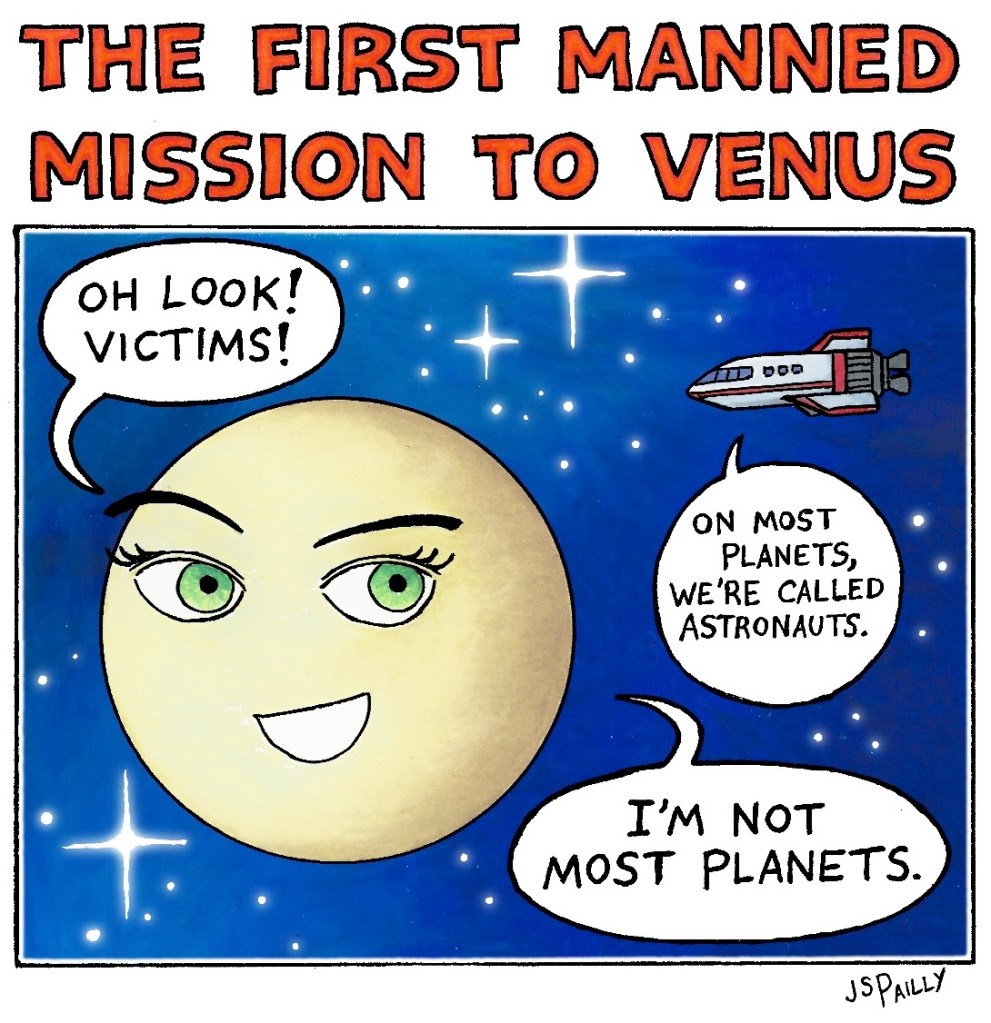
Fun fact about me: Venus is my favorite planet.  I just feel like, out of all the planets in the Solar System, Venus has the most personality.  Granted, it’s the personality of a mad scientist, or maybe a serial killer.  But still… so much personality!  Anyway, today I want to share one of my favorite stories about my favorite planet.  It’s the story of how Venus (the mad scientist/serial killer planet) accidentally saved all life on Earth.

In 1962, NASA’s Mariner 2 space probe became the first spacecraft to send data back from Venus (the Soviet Union’s Venera 1 probe visited Venus a year before, but due to communications issues, it couldn’t transmit any data back to Earth).  In the decade that followed, more missions to Venus sent back even more data, and we learned that Venus spends all her time brewing this super deadly mix of chemicals in her atmosphere.  As I said, Venus has the personality of a mad scientist/serial killer.  If future astronauts ever try to land on the surface of Venus, she will straight up murder them.

As scientists in the 1960’s and 70’s catalogued all the absolutely terrifying stuff in Venus’s atmosphere, they realized something was missing: ozone.  I won’t go into all the chemistry details here, but given the kinds of chemical reactions happening on Venus, Venus should have produced something similar to Earth’s ozone layer.  And yet little to no ozone was detected.  So what gives?

Well, among all the other horrifying chemicals in Venus’s atmosphere, there are some chlorine-based molecules.  Turns out those chlorine-based molecules were interfering with ozone production.  Mystery solved!  But then somebody said, “Wait, what about chlorofluorocarbons?  Those are chlorine-based molecules, and we’ve been releasing them into Earth’s atmosphere for decades.”  More research followed, comparing and contrasting Earth and Venus.  It turned out that, yes, chlorofluorocarbons (better known as C.F.C.s) were interfering with Earth’s ozone layer just as similar chlorine-based molecules interfered with ozone production on Venus.

By the mid-1970’s, scientists were calling for action.  By the end of the 1980’s, politicians were listening, and they actually did something about the problem.  The Montreal Protocol is an international agreement restricting the production and use of C.F.C.s and other ozone-depleting chemicals.  As a direct result, today Earth’s ozone layer is healing, and there’s hope that the ozone layer will fully recover by the end of the 21st Century.  Would scientists have figured out what C.F.C.s were doing to Earth’s ozone layer without Venus’s help?  Probably.  But they might have figured it out too late.

A couple months ago, I did a post about solar storms and the danger they pose to our modern technological world.  In that post, I cited solar storms as one of the reasons why space exploration is worthwhile, despite the notoriously high price tag.  This story about Venus and the ozone layer?  This is another example of why space exploration is worth the money.  Comparing and contrasting Earth with another planet helped save us from disaster once before.  Who knows what other valuable lessons Venus (or Mars, or any of the other planets) still have to teach us?

WANT TO LEARN MORE?

Click here for a video from Sci-Show entitled “How Studying Venus Saved Earth.”

Or click here for an article from The Conversation entitled “What Venus has taught us about protecting the ozone layer.”

If you’re wondering why the ozone layer’s so important, click here for an article from How Stuff Works entitled “What If the Ozone Layer Disappeared?”

And lastly, some of you may be thinking, “Hey, didn’t they discover an ozone layer on Venus just a few years ago?”  You’re right, they did!  It’s at a much higher altitude than Earth’s ozone layer, and it’s much thinner and more tenuous, too.  But Venus does have just a little bit of ozone after all.  Click here to learn more.

The art used in today’s post is my own original work.  If you like my art, please consider visiting the I-Love-Space store on RedBubble.  Shopping on RedBubble is a great way to support artists (like me) so that we can keep doing what we do.  Thank you!
What’s It Like Seeing Earth from Space?

Hello, friends!

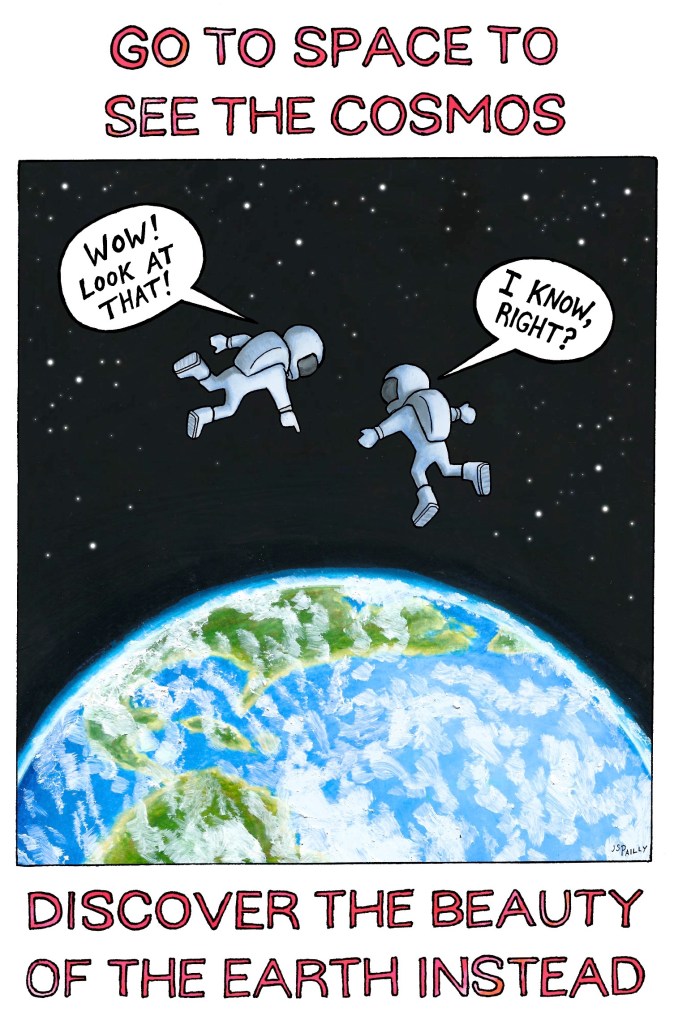
I don’t know about you, but whenever I stop and look up at the nighttime sky, I feel… something.  It’s hard to explain.  And if I take out my telescope to look more closely at the planets and nebulae and galaxies up there, I feel that same indescribable something even more.  Whatever it is I feel, it’s a powerful, almost spiritual thing.  But as powerful as that experience is, I’m told it’s nothing compared to the feeling you get when you’re up in space, looking not farther out into the cosmos but rather looking back at the Earth.

In 1987, American author and space exploration advocate Frank White coined the term “overview effect” to describe the experience so many astronauts report having when they first see the Earth from space.  These astronauts don’t just look at Earth and think, “Huh, neat view.”  They describe this as a life changing experience, a dramatic shift in belief and perspective, a sudden realization that our world is precious and fragile and that we all must set aside our differences and work toward the common good.

If only more people could have an experience like that, maybe the world would be in a better state than it is currently in.  That would be great, wouldn’t it?  Well, there are individuals and organizations working to make this an experience more people can have.  One option is, of course, to make commercial spaceflight more affordable.  Another is to try to simulate the overview effect in virtual reality.  But if more people could see our planet for what it truly is—not as a globe crisscrossed by national borders but rather as a singular world that we all must share—that might bring about some real change.  It might, right?

Now obviously there’s been some criticism of this idea, and I do think some of the criticism is valid.  Even among those who’ve been to space, who’ve experienced the overview effect for themselves, and who’ve come back eager to do good things for our planet and our species… even among those people, some of them still say some troubling things.  For example, during the Cold War, Soviet cosmonauts would sometimes remark that seeing the Earth laid out before them reinforced their belief that communism must be spread all across the world.  American astronauts occasionally say similar things about spreading freedom and democracy.  Even if we all want to do good things for our planet, we’ll still disagree about what good things our planet needs us to do.

Frank White has acknowledged this issue in some of his writings.  If you’re one of the people lucky enough to see the Earth from space, cultural and political biases, religious beliefs, personal history… all sorts of factors may influence how you describe the overview effect to others, or how you interpret the experience for yourself.  But it does seem that no matter who you are or where you come from, seeing the Earth from space is a powerful and humbling experience.  Maybe White and others in the overview effect movement are right.  Maybe it would do some good if more people could have this experience for themselves.

WANT TO LEARN MORE?

A few years ago, William Shatner (a.k.a. Captain Kirk from Star Trek) went to space aboard a Blue Origin rocket.  What he saw moved him to tears.  Regardless of how you might feel about Blue Origin or its owner, Jeff Bezos, I think what Shatner had to say about the experience is worth hearing.  Click here.

Friend of the blog Matt Williams had the chance to interview Frank White a few years back, and I’m super jealous about it.  Click here to listen to that interview on Matt’s podcast, Stories from Space.

Jordan Bimm is one of the most noteworthy critics of the overview effect and the overview effect movement.  Click here to read his paper “Rethinking the Overview Effect,” which lays out his main points.

I’d also recommend reading Frank White’s response, entitled “Rethinking ‘Rethinking the Overview Effect.’”  Click here for that.

The art used in today’s post is my own original work. If you like my art, please consider visiting the I-Love-Space store on RedBubble. Shopping on RedBubble is a great way to support artists (like me) so that we can keep doing what we do. Thank you!