3I/ATLAS: But What If It Were Aliens?

Hello, friends!

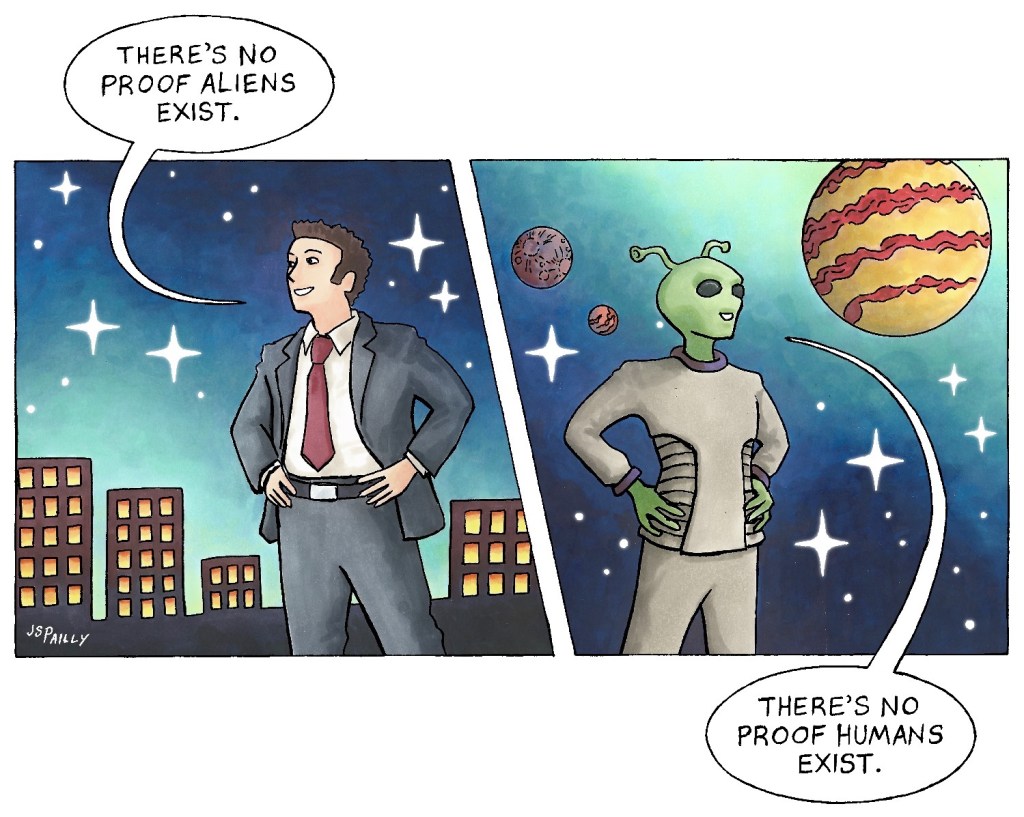
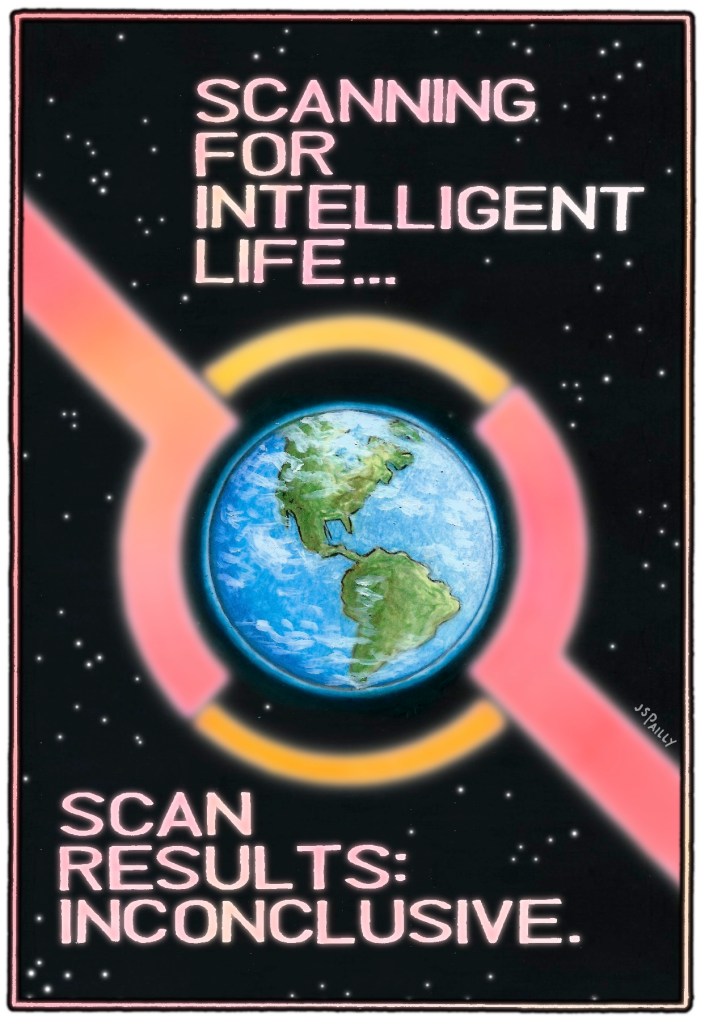
Right now, there’s an interstellar object passing through our Solar System.  Astronomers have named this object 3I/ATLAS, and in my last post I explained how 3I/ATLAS is just a comet and NOT an alien spacecraft.  But let’s pretend for a moment that an alien spaceship were traveling through the Solar System, perhaps on some sort of survey mission.  What would the aliens see when they turn their scientific instruments toward Earth?  How much would they learn about us and our planet?

Much depends on how technologically advanced we imagine these aliens to be, of course, but we humans have been observing Earth from space for decades now.  We know some things are pretty obvious about our planet, even when viewed from a great distance away.  For a start, the aliens would notice that Earth has an abnormally large moon.  They’d also notice that Earth has oceans.  The glint of sunlight reflecting off water would give that away.  And then there’s oxygen.  The spectrographic fingerprints of oxygen are all over Earth’s atmosphere.

Do these aliens breathe oxygen like we do?  Maybe, maybe not.  Either way, Earth’s oxygen-rich atmosphere would make the aliens stop and think, “Huh, that’s weird.”  Most planets don’t have atmospheres like that.  Even weirder, though, the aliens would also detect traces of methane in our atmosphere.  Methane is an easily oxidized chemical, so you’d think all that oxygen would oxidize any atmospheric methane out of existence pretty quick.  Something must keep replenishing the methane as quickly as oxygen destroys it.  Something alive, perhaps?  It’s hard to guess if the aliens would reach that conclusion yet.

As the aliens draw nearer, they’d soon notice this odd green stuff covering much of Earth’s landmasses.  To say that in a more technobabbly way, the extraterrestrials would detect a chemical substance with a strong reflection spectrum in green light (and an even stronger reflection spectrum in infrared).  You and I know what all that green stuff is, but would the aliens figure it out?  Do they have plants back home?  Do their plants contain chlorophyll and perform photosynthesis like ours do?  Hard to say, but Earth’s green stuff would at least make the aliens think, “Huh, that’s also weird.”

A few more things our hypothetical aliens would notice: a substantial ozone layer, continents shaped by recent (or possibly ongoing) tectonic activity, a complex hydrological cycle with water existing as a solid, a liquid, and a gas… oh, and radio emissions.  Lots and lots of narrow-band, amplitude modulated radio emissions, which cannot possibly be a natural phenomenon.

The idea that aliens many lightyears away are watching I Love Lucy, The Brady Bunch, or The Dick Van Dyke Show is probably false.  As radio/television broadcasts propagate through space, those signals grow weaker and eventually blend into the background radiation.  But for the purposes of this blog post, we’re imagining that an alien spaceship is right here in the Solar System with us.  They’re close enough to pick up our broadcasts.  At that point, the aliens wouldn’t just think, “Huh, weird.”  They’d be forced to conclude not only that life exists on Earth but that intelligent life exists on Earth (unless they start watching our news or listening to our talk radio; if they do that, they might second guess the “intelligent” part).

How much more could the aliens learn about us?  Again, it depends on how technologically advanced these aliens are.  Consider the stuff I listed in this blog post to be the bare minimum of what they’d know.

WHAT TO LEARN MORE?

This blog post is based off several research papers, which are listed below.  Detecting life on a planet—even a planet teeming with life, like Earth—is more of a challenge than you might realize.  If that’s a topic you want to learn more about, please check out some of the papers below, especially the first one (the one written by Carl Sagan).

The art in today’s post is my own original work.  I didn’t take it from the Internet or ask an A.I. to generate it.  If you like my art, please consider visiting my store on RedBubble.  Shopping on RedBubble is a great way to support artists (like me!) so that we can keep doing what we do.  Thank you!

3I/ATLAS: It’s Not Aliens

Hello, friends!

You know the expression “If it looks like a duck, swims like a duck, and quacks like a duck, it’s probably just a duck”?  Well, to a certain kind of person, if it looks like a duck and swims like a duck and quacks like a duck, then it must be an extraterrestrial life form that the government has disguised as a duck.  Right now, there’s an interstellar object passing through our Solar System.  It looks like a comet.  It moves like a comet.   It’s grown a tail like a comet.  I think you know where I’m going with this.

Astronomers have named this object 3I/ATLAS.  The “3I” part of the name means this is the 3rd interstellar object we’ve spotted inside our Solar System (the previous two were 1I/Oumuamua and 2I/Borisov).  The “ATLAS” part means this object was first detected by the Asteroid Terrestrial-impact Last Alert System (ATLAS for short).  Ever since the discovery of 3I/ATLAS, there’s been a lot of speculation online, in the news, and even in some corners of the scientific community about how this object might/must be an alien spaceship or alien space probe—or even an alien space weapon!  But this is coming from the same people who cry aliens whenever anything even remotely interesting happens in outer space.

As someone who loves space, I find all this “BuT WhaT iF iT’s ALieNs?” talk annoying and disheartening, because 3I/ATLAS doesn’t need to be aliens in order for it to be interesting.  For example, did you know 3I/ATLAS is insanely old?  By most estimates, it’s approximately 7 billion years old, which makes it 50% older than our entire Solar System.  3I/ATLAS also seems to be composed of unusually high quantities of frozen carbon dioxide (and correspondingly low quantities of frozen H2O).  I’ve read several different possible explanations for this, but the one I find most intriguing is that 3I/ATLAS may come from a star system where water is extremely scarce.

When we learn new things about outer space, ironically, we often end up learning even more about the Earth.  I’ve said before on this blog that our ability to compare and contrast Earth with other planets in the Solar System has taught us a great deal about our home planet.  Now our science has advanced to a point where we can identify interstellar objects as they pass through our Solar System.  We can observe them and study them and use that information to start comparing and contrasting our Solar System with whatever star systems these objects originally came from.  I don’t know what we’ll learn by doing that, but I know we’re going to learn something, and I love that for us!

As for the aliens… someday, I believe we will discover alien life, and that day will be awesome!  If 3I/ATLAS really were an alien spacecraft, that would be awesome, too, but that hypothesis is based more on wishful thinking than actual evidence.  I, for one, think the actual evidence about comet 3I/ATLAS tells a far more interesting story than all the wishful thinking in the world ever could.  How about you?

WANT TO LEARN MORE?

There’s a lot of confusing and conflicting information out there right now about 3I/ATLAS, even without the people crying “it’s aliens!”  That’s because 3I/ATLAS is still under heavy observation at the moment, and new data is coming in at a rapid pace.  That being said, I’m going to recommend these two articles, which I feel give a pretty good synopsis of how much we know so far and how much more we’re hoping to learn.

I also want to recommend this video from Hank Green, titled “Why it’s Never Aliens,” for a more detailed analysis of why, whenever people cry aliens, it never turns out to be aliens.

IWSG: I Love Lovecraftian Horror

Hello, friends!  Welcome to this month’s meeting of the Insecure Writer’s Support Group, a blog hop created by Alex J. Cavanaugh and co-hosted this month by Nancy Gideon, Jennifer Lane, Jacqui Murray, and Natalie Aguirre.  Are you a writer?  Do you feel insecure?  If so, then this is the support group for you!  Click here to learn more.

Each month, the Insecure Writer’s Support Group asks us an optional question.  IWSG members can answer the question if they want, or they can skip it if there’s something else they want/need to talk about instead.  This month’s optional question is:

Ghost stories fit right in during this month.  What’s your favorite classic ghostly tale?  Tell us about it and why it sends chills up your spine.

I almost skipped this month’s question.  Ghost stories don’t do much for me.  I have a very sciency worldview, unfortunately, so stories about the occult or the paranormal don’t give me much of a thrill or a fright.  But there is an author who bridged the gap between science and the supernatural well enough to freak me the f*** out.  That authors’ name is H.P. Lovecraft.

Lovecraft did most of his writing in the 1920’s and 30’s.  He died young, unfortunately, in 1937.  As I understand his biography, Lovecraft was a huge fan of Edgar Allan Poe and was inspired by Poe’s work; however, Lovecraft believed that the traditional ghost story needed to be updated for modern times and modern, scientific sensibilities.  So rather than leaning on ghosts and devils, Lovecraft filled his stories with theoretical physics, extraterrestrial intelligences, and occasional references to a certain newly discovered planet (Pluto).

My favorite Lovecraft story is called “The Colour Out of Space.”  In that story, a meteor crashes on Earth, introducing an extraterrestrial something to the local environment.  The local environment begins to change as a result.  Plants and animals become weirdly mutated, and the humans living on a nearby farm gradually lose their sanity.  No one can explain what’s happening.  No one can explain what that thing from outer space is or even describe what it looks like.  The best anyone can say is that it’s a color unlike any color seen before by human eyes (hence the title of the story).

I can’t think of many stories where alien life forms are presented as truly unknowable beings.  There are the alien monoliths from 2001: A Space Odyssey.  There are the replicas from Solaris, or the sphere from Michael Crichton’s Sphere.  But that thing from “The Colour Out of Space”… whatever that thing was, it was the most incomprehensible of all incomprehensible aliens in science fiction.  And that truly scares me.

I love space and I love science fiction.  One of my dearest hopes for the future is that we will one day make contact with aliens—aliens like E.T. or Mr. Spock.  You know: the kind of aliens we can be friends with.  But that may not be what happens.  If/when we discover alien life, the aliens may be something totally and completely beyond human comprehension (and we humans may seem equally incomprehensible to whatever alien intelligence happens to discover us).  That’s a scenario that terrifies me, and it should terrify anyone who lives on this rather small and extremely vulnerable planet.