IWSG: I Wish I Were…

Hello, friends!  Welcome to this month’s meeting of the Insecure Writer’s Support Group, a blog hop created by Alex J. Cavanaugh and cohosted this month by Ronel Janse Van Vuuren, Pat Garcia, and Liza @ Middle Passages.  Are you a writer?  Do you feel insecure?  Well, then this is the support group for you!  Click here to learn more and to see a list of participating blogs.

Each month, IWSG asks its members a question, and this month’s question is kind of a strange one:

If for one day you could be anyone or *thing* in the world, what would it be?  Describe, tell why, and any themes, goals, or values they/it inspire in you.

I wasn’t sure how to respond to this question at first, and I was considering skipping it and talking about something else.  But then I got thinking….

I’m pretty unhappy at the moment: unhappy with the state of my personal life, the state of my art/writing progress, the state of my financial situation, the state of my country and of the world at large….  Given all that, there are plenty of other people I’d rather be right now.  Transforming into an inanimate object doesn’t sound so bad at the moment, either.

But despite all of the problems I’m facing, there are a few things I wouldn’t want to give up.  Chief among them: my stories.  The weird, Sc-Fi worlds I’ve created inside my own head.  All the characters (humans, aliens, robots, etc.) who inhabit those worlds.  No matter what, I wouldn’t want to give any of that up.  I especially do not want to give up the two or three new story ideas that popped into my head within that last few months.

And the thing is all of the story worlds I’ve created are the product of my experiences.  My good experiences, my bad experiences.  My hopes and dreams, my successes and triumphs, and also my failures.  My disappointments.  My mistakes.  Swap my life with the life of somebody else, replace my experiences with the experiences of another person, and those stories wouldn’t be the same.  And the two (or maybe three) new story ideas that I’m currently working on… the ones that I am most excited about right now… they wouldn’t exist at all if not for the particular blend of fears and anxieties that I’m dealing with right now.

So despite everything, the only person (or thing) that I want to be right now is myself, because I am the only person who can tell the stories currently sitting in my head.

P.S.: Okay, after writing this whole post, I reread the initial question and realized that I’d misunderstood it.  I missed the “for one day” part.  If I could become someone else for just one day, I’d want to be an astronaut on the International Space Station.  I think my writing would benefit from me knowing, first hand, what it’s like to be in space (provided I got to go back to being myself the next day).
What the Heck Do Astrobiologists Do?

Hello, friends!

I don’t remember when or where I first heard about astrobiology (the scientific study of alien life), but I do remember my initial gut reaction: “If we haven’t discovered alien life yet, what the heck do astrobiologists study?”  Then I learned more.  I learned that astrobiologists are concerned, first and foremost, with studying the only life we currently know of in this universe: life on Earth.  That provoked another instant, incredulous question in my mind: “How is that different from regular biology?”

But there is a difference!  Yes, astrobiologists and regular biologists both study life on Earth.  There’s some overlap between these two scientific fields.  However, astrobiologists and regular biologists are working to understand life on very different scales.  How do plants do photosynthesis?  Why do cows need so many stomachs?  What’s the purpose of that giant claw on the fiddler crab?  Those are biology questions.  Astrobiology is less interested in individual organisms or individual species and more interested in life as a “planetary phenomenon.”

So here’s this planet.  We call it Earth, and we know for a fact that there’s life on it (NASA checked).

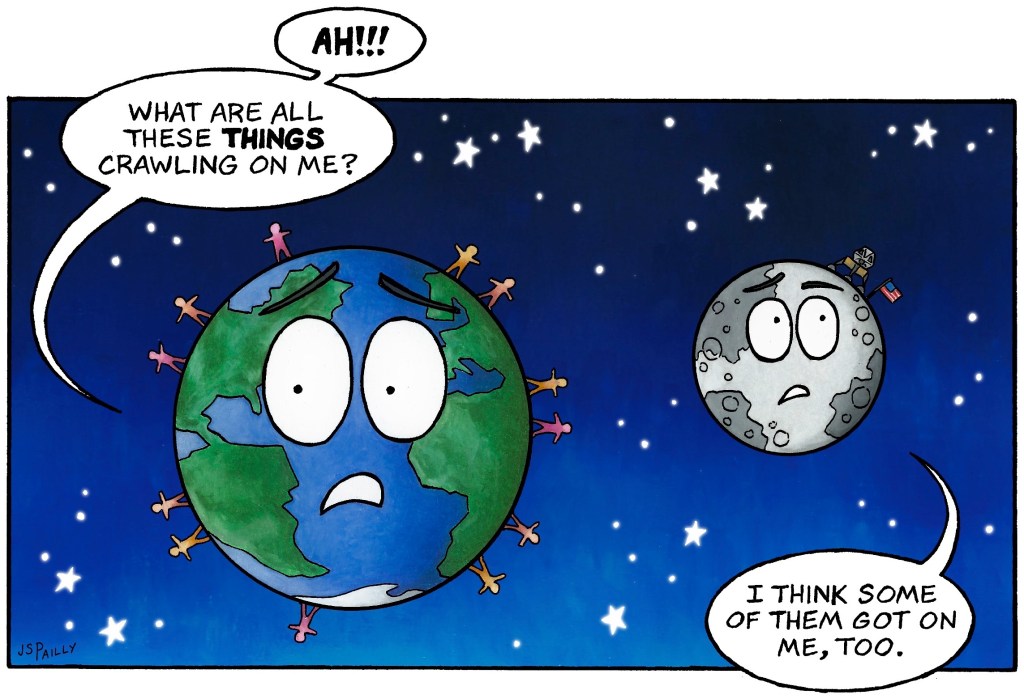
What’s more, life from Earth has already started spreading to neighboring celestial bodies.  A bunch of astronauts left their footprints on the Moon, and there’s a possibility that our robotic landers and rovers may have contaminated Mars with our Earth germs.  So how did life as a planetary (and now interplanetary) phenomenon happen here on Earth?  And more importantly, what does the example of life on Earth tell us about what might be happening elsewhere in the cosmos?

In 1950, nuclear physicist Enrico Fermi famously asked “Where is everybody?”  Funny story: Fermi actually blurted this out at lunch, as a total non sequitur.  It was a weird and awkward moment.  Fortunately, Fermi was having lunch with some physicist friends, and they quickly got the gist of what he was trying to say.  The universe is vast.  Mindbogglingly huge.  It does not make sense for life to exist on one and only one planet.  So where is everybody?

That pretty much sums up the work astrobiologists do.  They’re trying to figure out where everybody is.  Their research begins, first and foremost, with life on Earth.  How did life begin here on Earth?  Which environmental factors mattered most?  As life evolved and spread across this planet, how did the planet change as a result?

Obviously Earth is a special planet.  If astrobiologists can figure out which qualities make Earth so special (special enough for life), then perhaps they’ll know what qualities to look for on other planets out there among the stars.

WANT TO LEARN MORE?

That story about Enrico Fermi, where he blurts out “Where is everybody?” at lunch, is true.  It’s the origin of what we now call the Fermi Paradox.  Click here to read some first hand accounts of people who were having lunch with Fermi that day.

Contaminating Mars with our Earth germs is a real concern.  Unfortunately, it may have already happened.  As a result, if we ever do discover microorganisms on Mars, it may be hard to tell whether or not those microbes are actually native to Mars.  Click here to learn more.

And lastly, in 1990 NASA “discovered” life on Earth, but it turned out that detecting life from space-based observations alone was really difficult.  More difficult that you might expect.  The astrobiological implications are obvious.  Click here to learn more.

Hello, World!

As of this writing, this blog is still under construction.  I’ll have a more official launch post soon.  In the meantime, all I want to say is I love space.  If you also love space, please consider hitting subscribe, or bookmarking this website, or adding this website to your RSS reader—whatever your preferred method of following blogs happens to be.  More space art and more space love will be coming soon!