Living with a Star

Hello, friends!

I love space, you love space—lots and lots of people love space.  It’s easy to get large numbers of people hyped up about outer space!  But as soon as you start talking about funding space exploration, the mood shifts.  Folks get uncomfortable, and it turns out that space can be a controversial topic after all.  So today, I want to talk about one of the reasons (just one of the reasons) why space exploration is worth the high price tag.  It has to do with the Sun.

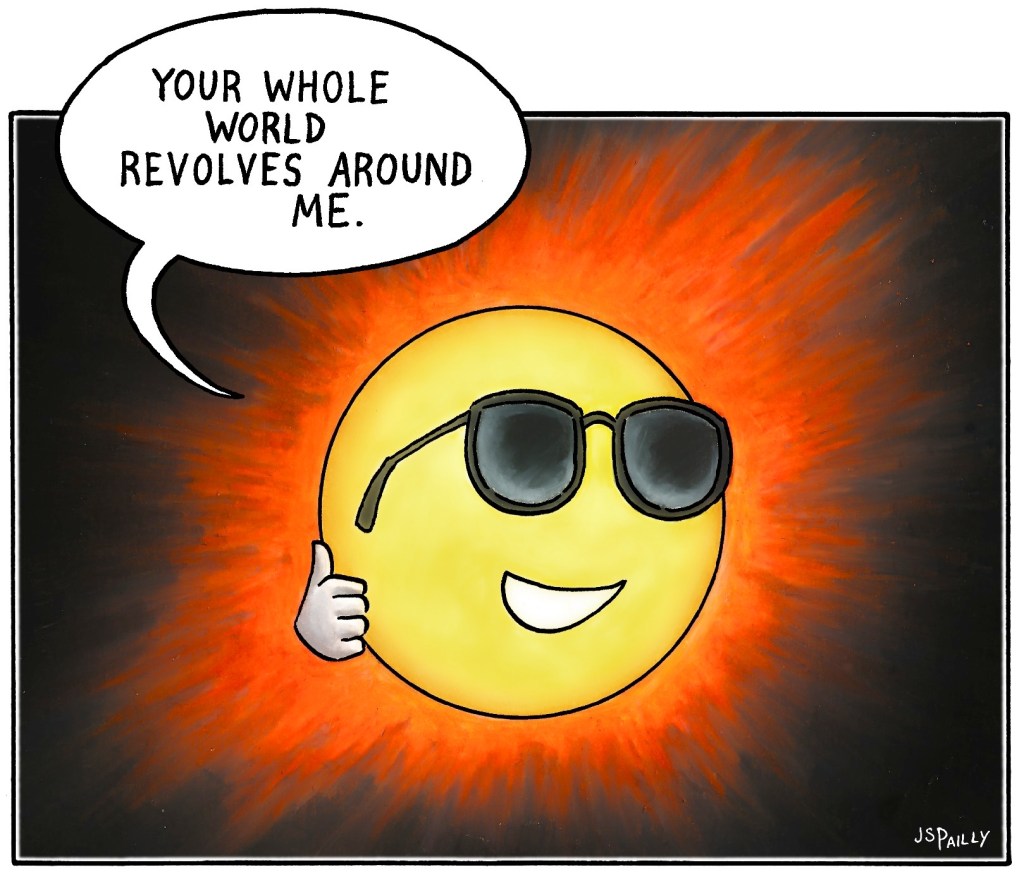
Earth has a complicated relationship with the Sun.  Sure, the Sun gives Earth something to orbit.  It also provides Earth with light and heat and generally makes this planet livable.  However, the Sun also throws spectacular temper tantrums, flinging all sorts of high energy radiation and electrically charged particles out into space.  Sometimes, when the Sun throws a temper tantrum, it flings all those charged particles and all that super scary radiation directly at Earth.

Fortunately, Earth’s magnetic field protects us, deflecting the danger away or redirecting it toward Earth’s poles (this is what causes auroras).  And so, for the vast majority of human history, the Sun could throw all the temper tantrums she liked, and we haven’t had to worry about it much down here on the ground.  That changed on September 1st, 1859.

On that day, English astronomer Richard Carrington was studying sunspots on the Sun (using the proper safety filters on his telescope, I presume) when he observed an absolutely stupendous flash of light.  Most likely, Carrington witnessed what we now call a coronal mass ejection, or C.M.E.  Seventeen hours later, that C.M.E. hit Earth.  It’s said that the resulting auroras stretched from the poles to the tropics and were bright enough to turn night into day.  I’ve read some versions of this story that claim auroras were even visible at Earth’s equator.

The Carrington Event, as we now call it, in Richard Carrington’s honor, must have been a beautiful sight.  However, this was also the first time a C.M.E. of that magnitude hit Earth while Earth was wired up with telegraph lines.  As Earth’s magnetic field reacted to the impact of the C.M.E., induced electric currents wreaked havoc up and down the world’s telegraph network.  Telegraph operators received electric shocks.  Telegraph equipment started shooting sparks.  In some instances, those sparks started fires.

The world today is even more wired up with technology than it was in 1859, so how bad would it be if something like the Carrington Event happened again?  No one really knows, but the Sun doesn’t need to produce another Carrington Event to mess with our technology.  Much weaker solar events have damaged or disabled our satellites in orbit, triggered power outages here on the ground, and caused radio communications blackouts.  Solar storms pose radiation hazards for astronauts, obviously, but they can also put the passengers and crew of aircraft at risk, especially if those aircraft are flying anywhere near Earth’s north or south poles.  Solar storms are enough of a problem that insurance companies are paying attention, and they get nervous whenever the Sun stars acting up (see the “want to learn more?” section below if you want to learn more).

So in the early 2000’s, NASA created the Living With a Star program, or L.W.S.  Because, for better or worse, the Sun is right there, and we have to live with it.  As of this writing, there are three active L.W.S. missions in space, plus a few other solar science missions that operate outside the L.W.S. program.  They’re all monitoring the Sun, gathering new data about solar physics, doing their best to give us a least a little warning whenever the Sun decides to hurl a giant, radioactive fireball our way.  In time, perhaps these missions will teach us why the Sun’s temper tantrums happen in the first place, so that we can better predict when they’ll happen next.

I heard something on a podcast recently: there is a difference between knowing the cost of a thing and understanding the value of that thing.  Space exploration costs an enormous amount of money.  There’s no denying that.  But for a society like ours, on an increasingly technological world like ours, the value of something like the International Living With a Star program far exceeds the cost.  This is just one example of why space exploration is worthwhile, despite the high price tag, and in upcoming posts I’m planning to offer other examples, too.

Thank you for reading, friends.  I hope to talk to you again soon.

WANT TO LEARN MORE?

Click here to read “The Carrington Event: History’s greatest solar storm” from Space.com

Click here to visit NASA’s website for the Living With a Star Program.

I mentioned that solar storms can make insurance companies nervous.  Click here for an article on how much money the insurance industry could potentially lose due to an “extreme space weather event.”

And lastly, here’s a link to the podcast I mentioned near the end of my post.  The podcast is called Stories from Space, and the episode is titled “WTF is Happening at NASA?”

The art used in today’s post is my own original work.  If you like my art, please consider visiting the I-Love-Space store on RedBubble.  Shopping on RedBubble is a great way to support artists (like me) so that we can keep doing what we do.  Thank you!

IWSG: I Believe in Fairies

Hello, friends!  Welcome to this month’s meeting of the Insecure Writer’s Support Group, a blog hop created by Alex J. Cavanaugh and co-hosted this month by Jennifer Lane, L Diane Wolfe, Jenni Enzor, and Natalie Aguirre.  Are you a writer?  Do you feel insecure?  Well then good news!  This is the support group for you!  Click here to learn more and to see a list of participating blogs.

As you can probably tell from the name of my blog, I love space.  I also love science and science fiction.  I’ve been loving space, science, and science fiction for such a long time now that I’ve developed a highly scientific, highly evidence-based view of the world.  I don’t pay attention to astrology.  I don’t take tarot cards or Ouija boards seriously.  I don’t knock on wood or worry about black cats crossing my path.  I don’t believe in any superstitions except one: I do believe in fairies.

That’s because I happen to know a fairy.  I call her my muse, and she can be super annoying sometimes, always pestering me with new ideas and nagging me about writing whenever I take even the shortest possible break from writing.

It’s hard to deny the existence of fairies when there’s this one fairy who just will not leave you alone, not even for one goddamn minute!

Anyway, the real point I’m trying to make is that there is a highly scientific, highly evidence-based approach you could take to writing.  You could learn all about the craft of writing.  You could study plot and characterization.  You could memorize all the heroic archetypes and all twelve steps of the monomythic journey.  You could find out what words like synecdoche and antimetabole mean and then apply those concepts to your writing.

And… okay, sure, you should spend some time learning about those things.  But don’t get too technical about writing.  Don’t take too scientific of an approach.  Leave room for sudden inspiration.  Be prepared for things to suddenly make sense, and you can’t explain why.  That’s probably your muse sprinkling fairy dust on your head, causing the magical side of writing to happen.

P.S.: Of course, the great science communicator Carl Sagan once said exactly what I’m trying to say, except much more succinctly: “A book is proof that humans are capable of working magic.”

Who Is J.S. Pailly?

Hello, friends!  Every once in a while, I think it’s good for bloggers to reintroduce themselves.  My name is James Serain Pailly, and I love space.

I love other things too, of course.  I love good food.  I love a glass of fine wine.  I love taking naps in the middle of the afternoon.  I collect books.  I have a few really nice leather-bound classics that I’m really, really proud of.  I also collect Lego, and I have several Lego sets on display in my house that I’m really proud of, too.  I love making art.  I love… well, sometimes I have mixed feelings about writing, but when the  muse is with me, I do love to write.  Oh, and I have a few close friends whom I love very much (you know who you are!).

But on this blog, I mainly talk about my love for space.  And on that note, dear reader, there is something I want to make sure you understand about me: I am not a scientist.  I’m not an aerospace engineer.  I don’t have any professional experience with space exploration whatsoever.  I’m just really enthusiastic about this stuff.  I read a lot about space, and I’m always trying to learn more.  Thanks to all that learning and all that reading, plus all that enthusiasm, the way I talk about space sometimes makes people think I must work at NASA, or something.  So I just want to clarify, for anybody who might get the wrong impression, that I don’t work at NASA.  I don’t work in the aerospace industry.  I’m just a big, big fan of space.

I also want to clarify (because this is another assumption people sometimes make about me) that my obsession with space and space exploration does not extend to U.F.O.s.  I used to be more openminded about U.F.O.s (or U.A.P.s, which seems to be the more politically correct term for them these days), but time and again the evidence never seems to hold up to scrutiny.  So no, I don’t take U.F.O.s seriously.  Or alien abductions, or conspiracy theories about reptilians running the government, or anything else along those lines.

I’m also not into astrology, though I do enjoy the astrology aesthetic.

One last thing I feel I should tell you: I’m in the LGBT community.  To be more specific, I’m a genderqueer bisexual.  That’s not super relevant to anything we talk about on this blog, but I also don’t want anyone to think I have something to hide or that I’m ashamed of who I am.  In other words: I’m here, I’m queer, now let’s get back to talking about space.

I haven’t been blogging much these last few months.  That’s due primarily to work-related stress.  You may be wondering: “So James, if you don’t work at NASA, where do you work?”  Well, dear reader, I work in news.  News is a depressing line of work, even at the best of times, and these are not exactly the best of times.  All the stress and all the anxiety of my day job has kept me from blogging, which is a real shame because blogging about space (i.e. blogging about a thing I love!) is one of the best ways I know to manage my stress and reduce my anxiety.

But I’m hoping to turn that around.  Today, I’m recommitting myself to writing this blog and posting on a more regular basis, because despite everything, I still love space.  If you also love space, then I hope you’ll join me on this adventure.

Thanks for reading, friends.  I’ll talk to you again soon.

What’s It Like Seeing Earth from Space?

Hello, friends!

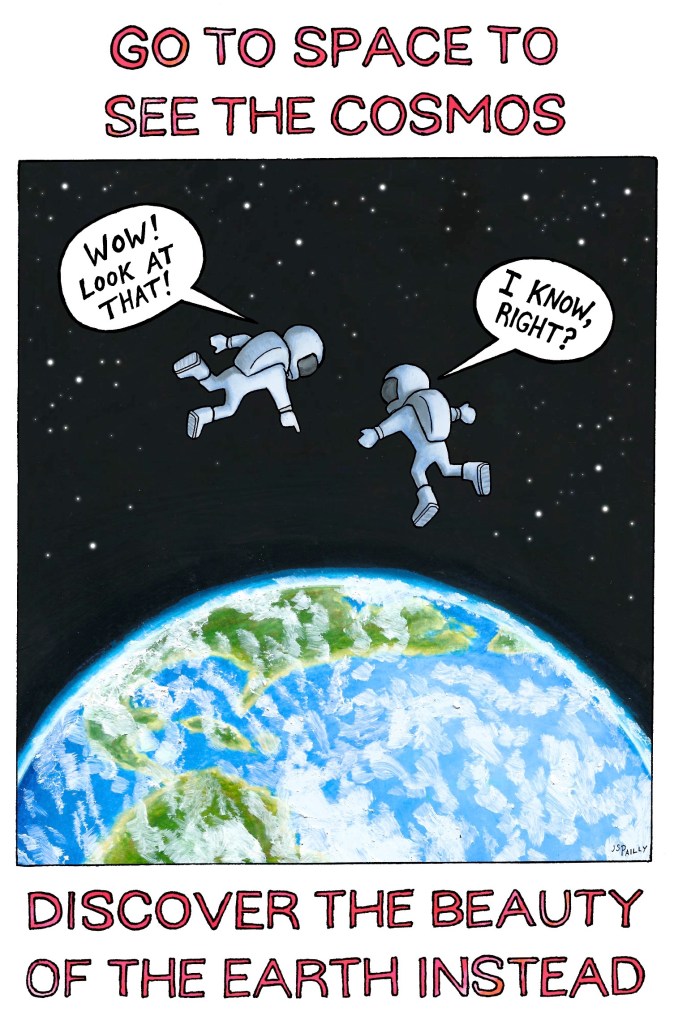
I don’t know about you, but whenever I stop and look up at the nighttime sky, I feel… something.  It’s hard to explain.  And if I take out my telescope to look more closely at the planets and nebulae and galaxies up there, I feel that same indescribable something even more.  Whatever it is I feel, it’s a powerful, almost spiritual thing.  But as powerful as that experience is, I’m told it’s nothing compared to the feeling you get when you’re up in space, looking not farther out into the cosmos but rather looking back at the Earth.

In 1987, American author and space exploration advocate Frank White coined the term “overview effect” to describe the experience so many astronauts report having when they first see the Earth from space.  These astronauts don’t just look at Earth and think, “Huh, neat view.”  They describe this as a life changing experience, a dramatic shift in belief and perspective, a sudden realization that our world is precious and fragile and that we all must set aside our differences and work toward the common good.

If only more people could have an experience like that, maybe the world would be in a better state than it is currently in.  That would be great, wouldn’t it?  Well, there are individuals and organizations working to make this an experience more people can have.  One option is, of course, to make commercial spaceflight more affordable.  Another is to try to simulate the overview effect in virtual reality.  But if more people could see our planet for what it truly is—not as a globe crisscrossed by national borders but rather as a singular world that we all must share—that might bring about some real change.  It might, right?

Now obviously there’s been some criticism of this idea, and I do think some of the criticism is valid.  Even among those who’ve been to space, who’ve experienced the overview effect for themselves, and who’ve come back eager to do good things for our planet and our species… even among those people, some of them still say some troubling things.  For example, during the Cold War, Soviet cosmonauts would sometimes remark that seeing the Earth laid out before them reinforced their belief that communism must be spread all across the world.  American astronauts occasionally say similar things about spreading freedom and democracy.  Even if we all want to do good things for our planet, we’ll still disagree about what good things our planet needs us to do.

Frank White has acknowledged this issue in some of his writings.  If you’re one of the people lucky enough to see the Earth from space, cultural and political biases, religious beliefs, personal history… all sorts of factors may influence how you describe the overview effect to others, or how you interpret the experience for yourself.  But it does seem that no matter who you are or where you come from, seeing the Earth from space is a powerful and humbling experience.  Maybe White and others in the overview effect movement are right.  Maybe it would do some good if more people could have this experience for themselves.

WANT TO LEARN MORE?

A few years ago, William Shatner (a.k.a. Captain Kirk from Star Trek) went to space aboard a Blue Origin rocket.  What he saw moved him to tears.  Regardless of how you might feel about Blue Origin or its owner, Jeff Bezos, I think what Shatner had to say about the experience is worth hearing.  Click here.

Friend of the blog Matt Williams had the chance to interview Frank White a few years back, and I’m super jealous about it.  Click here to listen to that interview on Matt’s podcast, Stories from Space.

Jordan Bimm is one of the most noteworthy critics of the overview effect and the overview effect movement.  Click here to read his paper “Rethinking the Overview Effect,” which lays out his main points.

I’d also recommend reading Frank White’s response, entitled “Rethinking ‘Rethinking the Overview Effect.’”  Click here for that.

The art used in today’s post is my own original work. If you like my art, please consider visiting the I-Love-Space store on RedBubble. Shopping on RedBubble is a great way to support artists (like me) so that we can keep doing what we do. Thank you!
Mr. Pailly Goes to Washington

Hello, friends!

Sometimes I say I’m shy.  Sometimes I call myself an introvert.  But that’s not the full truth.  I have some deep-rooted social anxiety issues which date back to some unpleasant experiences I had around the age of ten.  And yet, despite that deep-rooted social anxiety, I recently took a big risk.  A week an a half ago, I participated in an event in Washington, D.C., where ordinary citizens (not professional lobbyists) talk to Congress about why we love space and why we support NASA funding.

This event was organized by the Planetary Society, a non-profit group that was established in 1980.  Carl Sagan was among the original founders, and Bill Nye is the group’s current C.E.O.  Americans like to gripe about our government, but NASA stands out as one of the few government agencies that’s actually popular with the American people.  And yet Congress seems to believe, at times, that voters don’t really care about space exploration.  This makes NASA more vulnerable to budget cuts than most other federal agencies.  The Planetary Society exists to help show Congress that voters do care, that voters do support NASA, and that voters want to see NASA properly funded.

Now I fully understand that space exploration is expensive, and I fully understand that we have a lot of problems here on Earth.  But year after year, I keep hearing about budget cuts at NASA.  I keep hearing about important missions falling behind schedule or being canceled outright.  And earlier this year, I heard about mass layoffs at NASA’s Jet Propulsion Laboratory, along with more layoffs at various companies that serve as NASA contractors.  I believe space exploration is our pathway to the future, and so when I keep hearing about all these cutbacks at NASA, I worry that we’re so focused on the problems of today that we’re letting our future slowly slip from our grasp (in case you’re wondering what I said to Congress, that’s almost word-for-word what I said to Congress).

As I said at the top of this post, I went to D.C. despite having some deep-rooted social anxiety issues.  That’s how much I care about this issue.  But there’s more to it than that.  I didn’t just do this despite my social anxiety; I also did it because of my social anxiety.  I wanted to push myself.  I wanted to test myself.  I’m tired of this problem holding me back in life, and I want to overcome it.  I knew this trip wouldn’t be easy for me, and in some respects it ended up being even harder than I expected.  But I got through it, and hopefully what I said to Congress will make a difference.

The Planetary Society does this “Day of Action,” as they call it, every year, and I plan to go again next year.  The way I see it, if I can learn to be a better advocate for space exploration, then I can also learn to be a better advocate for myself.  Time will tell how much my trip to D.C. has helped me, but I can already say that it has helped me at least a little.

WANT TO LEARN MORE?

Here’s some information from Pew Research about the popularity of various U.S. federal agencies, with NASA ranked the third most popular agency after the National Parks Service and the Post Office (two other agencies that Congress seems to keep trying to cut).

And here’s an article from SpaceNews.com about the recent layoffs at NASA JPL.

And lastly, you don’t have to personally go to Congress to advocate for space exploration.  You can also call your congressional representatives on the phone.  Here’s an article from the Planetary Society explaining how to do that and how to do it effectively.

Why Do I Love Space?

Hello, friends!

This is my first “real” post here on my new blog.  The main message I’m hoping to convey with this new blog is, quite frankly, right there in the title: I Love Space!  If you’re still wondering how I feel about space, then… I don’t know what else to do.  I don’t know how to make my feelings for space any clearer.  However, the title of this blog does raise another question that I think is worth talking about.  Sure, I love space.  But why do I love space?

I think everyone will understand what I mean when I say space represents the future.  This “space equals the future” idea has been part of the zeitgeist for a long time now.  I can’t say what, precisely, our future in space will look like.  Will there be humans on Mars?  Face-to-face contact with extraterrestrials?  Fleets of starships exploring the Orion Nebula?  Maybe.  Maybe not.  Perhaps the work of exploring space, gathering resources from space, and defending our planet from space-based threats (like asteroids and comets) will be left to machines while we humans remain safe and comfortable here on the ground.

Either way, I do believe space will be a big part of our future.  That’s always in the back of my mind whenever I look up at the stars.  That’s always in the back of my mind whenever I learn a new space fact (like the many space facts I hope to share with you, dear reader, on this blog).  It’s in the back of my mind whenever anything even remotely space-related comes up in conversation.  Space isn’t just an empty void.  The other planets aren’t just barren rocks or giant gas balls.  These things represent our future as a species, our future as a civilization.

Given the state of the world today, it’s easy to lose hope.  It’s easy to get so wrapped up in the problems and conflicts of the present that we lose sight of the future.  Reading the news these days fills me with a sense of hopelessness.  And that, my friends, is why I love space.  I love space because no matter how bad things get here on Earth, space always reminds me that there is still a future to look forward to, a future worth living for, a future worth fighting for.

And so that is what space means to me.  It represents the future—but even more than that, it represents hope.  Every single one of us needs to find hope in something.  I find my hope up there, among the planets and stars.  Where do you find yours?