IWSG: The Ultimate Writing Machine

Hello, friends!  Welcome to this month’s meeting of the Insecure Writer’s Support Group, a blog hop created by Alex J. Cavanaugh and cohosted this month by Rebecca Douglass, Pat Garcia, Louise-Fundy Blue, Natalie Aguirre, and J.S. Pailly (hey wait a minute, that’s me!!!).  If you’re a writer and if you feel insecure about your writing life, click here to learn more about this amazingly supportive group, or click here to check out the IWSG Facebook page.

Each month, IWSG asks us an optional question.  It is totally optional!  IWSG members do not have to answer the question if they don’t want to, or if there’s something else they need to talk about instead.  This month’s optional question is:

What are your favorite writing processing (e.g. Word, Scrivner, yWriter, Dabble), writing apps, software, and tools?  Why do you recommend them?  And which one is your all time favorite that you cannot live without and use daily or at least whenever you write?

As you know, I love space, and I love science.  Based on those two statements, you might expect that I’d also love technology, or that I’d at least feel somewhat comfortable using technology.  But no.  There’s something about sitting in front of a computer screen that makes the creative side of my brain switch off.  Ergo, I don’t use writing software or writing apps much.  I do almost all of my writing the old fashioned way, with pen and paper.

Now I’m not trying to be a hipster about this.  I don’t want to wax poetic about the magical sound of a pen scratching on crisp, white paper.  Writing by hand is not—absolutely not—a better, more sophisticated, more intellectually proper way to write.  It is simply that I cannot “good words do” (as Patrick Rothfuss once described writing) when I’m staring at a computer screen, so writing by hand is my only option.

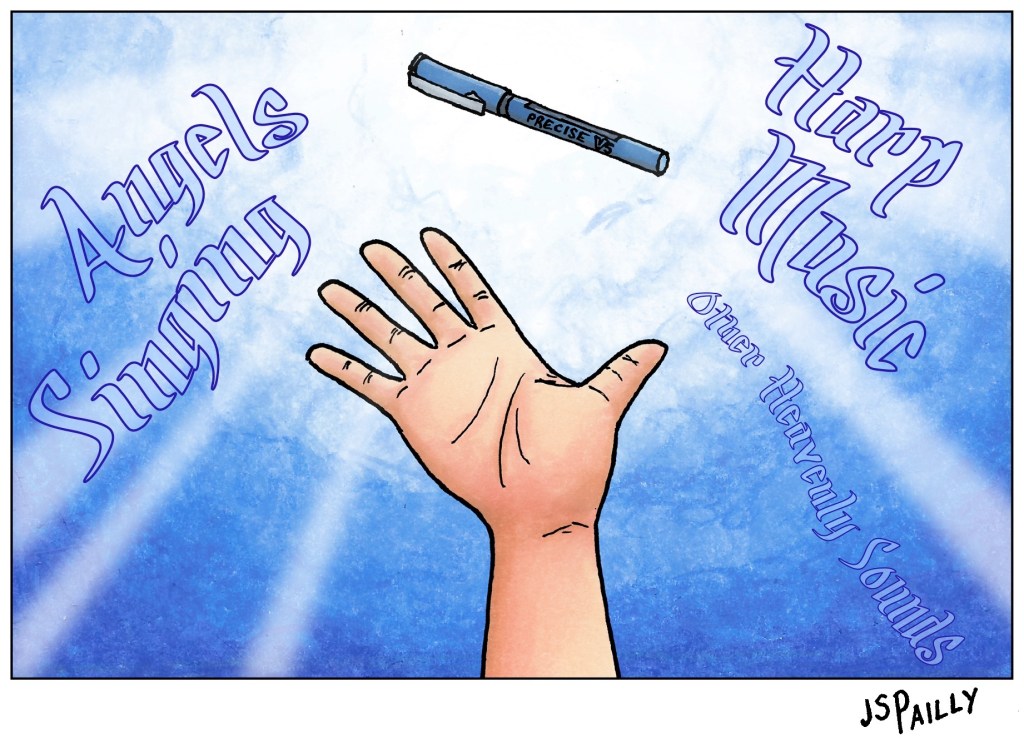
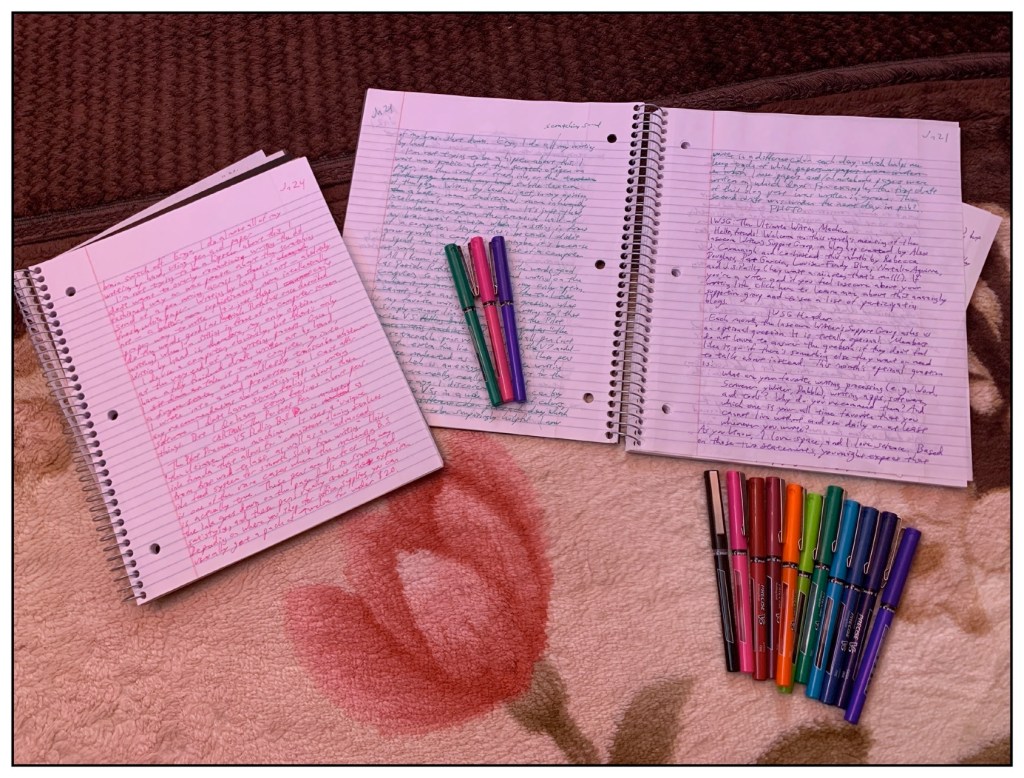
I do use a computer (obviously!), but only at the very end of my writing process.  Once I have a fully finished draft written out by hand, I take it to my computer, go into a fugue state, and mindlessly transcribe whatever I wrote into a word processor.  Which word processor?  It doesn’t matter.  I don’t have strong feelings about these things.  But I do have strong feelings about pens.  So let me tell you about the Pilot Precise V5 Rolling Ball Pen.

Pilot Precise Rolling Ball pens are marketed as “the ultimate writing machine.”  They’re ballpoint pens with super fine, almost needle-like tips.  According to the marketing copy, these pens use a “unique ink formula” and an “advanced ink feed system for smooth, skip free writing.”  That sounds like marketing B.S., but this is one of the rare cases where the marketing B.S. is actually true.

When I’m in the zone, deep in the flow state of writing, totally lost in my own imaginary world, I don’t want to worry about having any sort of trouble with my pen.  And with Pilot Precise pens, I never do.  Just as words flow from my mind, ink flows smoothly and consistently from my pen onto the page.  It’s such a satisfying writing experience.  And given how incredible these pens are, they’re surprisingly affordable.  Depending on where you shop for office supplies, you can usually get a pack of twelve pens for under $20.

The pens come in two sizes: the V7 and the V5.  I prefer the V5.  The V7 makes a slightly thicker, slightly heavier line.  Nothing wrong with that, but the V5’s slightly thinner, slightly finer line feels more elegant and graceful.  The pens also come in a wide variety of colors, which helps me color code different projects, or keep track of different drafts of the same project.  The first draft of this blog post was written in green.  The second draft was pink, and the third draft was purple.  This made it easy for me to see, at a glance, which pages needed to be transcribed into the computer and which ones didn’t.

So I can’t offer any recommendations for writing apps or writing software.  I barely use a computer at all in my writing process.  But for those of you who write using pen and paper, I can recommend the Pilot Precise V5 Rolling Ball Pen.  And try out the multicolor variety packs, if you see them in stores!  These are the only pens I use for writing.  They really are the ultimate writing machines (and nobody’s paying me to say that).

P.S.: This is my first time cohosting IWSG.  I’m super excited to be doing this today, and (fingers crossed) I hope I do a good job.

IWSG: Time

Hello, friends!  Welcome to the Insecure Writer’s Support Group, a blog hop created by Alex J. Cavanaugh and co-hosted this month by Liza at Middle Passages, Shannon Lawrence, Melissa Maygrove, and Olga Godim.  If you’re a writer and if you feel insecure about your writing life, click here to learn more about this amazingly supportive group!

Each month, the Insecure Writer’s Support Group asks a question.  The question is totally optional.  Members of the group can choose to answer it in their blog posts, or not.  This month’s question is:

In this constantly evolving industry, what kind of offering/service do you think the IWSG should consider offering to members?

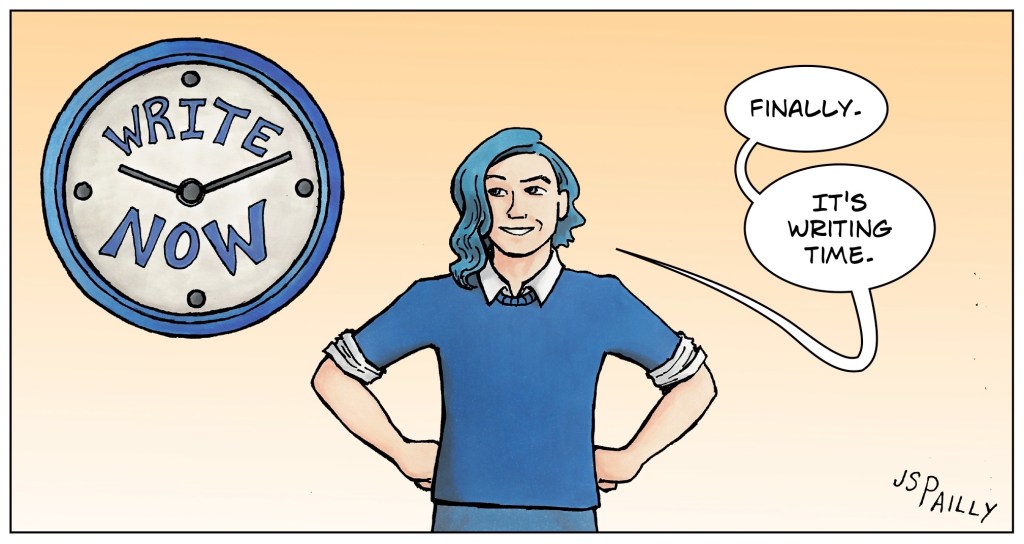
As you know, I love space, but I also love writing (almost as much as I love space).  Unfortunately, love isn’t always enough.  Enthusiasm isn’t always enough.  I have plenty of love and enthusiasm.  What I really need right now is time.  Maybe I’m asking for too much here, but is there any way the IWSG could make the day a little longer?  That’s something I think every writer would appreciate.

I can think of several ways we could do this.  As demonstrated in this comic from xkcd, if we all started spinning counterclockwise, we’d alter Earth’s angular momentum, slowing the planet’s rotation and making Earth’s day just a fraction of a second longer.

Or we could start relocating writers to Mars.  Mars’s rotation rate is already slower than Earth’s, making a Mars day about 36 minutes longer than a day on Earth.  That’s 36 extra minutes for writing!  True, we’d have to deal with the ultra-thin  atmosphere, the scarcity of oxygen, the toxic soil, the radiation, the extreme cold… but think of how much more writing we’d get done!

Another option: a while back, there were rumors that the Large Hadron Collider at CERN (a nuclear physics laboratory in Europe) might cause the accidental creation of a black hole.  That sounds scary, but hear me out: black holes create major distortions in both space AND time.  Could those space-time distortions allow us to make more time for writing?  Maybe!  Or maybe not.  I’m not great at math, so I’m not sure.  Alex, check with a physicist before you try this idea.

In the meantime, I recently negotiated a new work schedule for myself at my day job.  My new schedule is a little weird.  My boss and several of my coworkers were initially confused about why I’d want to work such strange hours.  But my new schedule frees up several hours worth of time, which I can now use for writing.  And I did it without altering Earth’s rotation, moving to Mars, or generating an artificial black hole.  So that’s a win for me!

Mr. Pailly Goes to Washington

Hello, friends!

Sometimes I say I’m shy.  Sometimes I call myself an introvert.  But that’s not the full truth.  I have some deep-rooted social anxiety issues which date back to some unpleasant experiences I had around the age of ten.  And yet, despite that deep-rooted social anxiety, I recently took a big risk.  A week an a half ago, I participated in an event in Washington, D.C., where ordinary citizens (not professional lobbyists) talk to Congress about why we love space and why we support NASA funding.

This event was organized by the Planetary Society, a non-profit group that was established in 1980.  Carl Sagan was among the original founders, and Bill Nye is the group’s current C.E.O.  Americans like to gripe about our government, but NASA stands out as one of the few government agencies that’s actually popular with the American people.  And yet Congress seems to believe, at times, that voters don’t really care about space exploration.  This makes NASA more vulnerable to budget cuts than most other federal agencies.  The Planetary Society exists to help show Congress that voters do care, that voters do support NASA, and that voters want to see NASA properly funded.

Now I fully understand that space exploration is expensive, and I fully understand that we have a lot of problems here on Earth.  But year after year, I keep hearing about budget cuts at NASA.  I keep hearing about important missions falling behind schedule or being canceled outright.  And earlier this year, I heard about mass layoffs at NASA’s Jet Propulsion Laboratory, along with more layoffs at various companies that serve as NASA contractors.  I believe space exploration is our pathway to the future, and so when I keep hearing about all these cutbacks at NASA, I worry that we’re so focused on the problems of today that we’re letting our future slowly slip from our grasp (in case you’re wondering what I said to Congress, that’s almost word-for-word what I said to Congress).

As I said at the top of this post, I went to D.C. despite having some deep-rooted social anxiety issues.  That’s how much I care about this issue.  But there’s more to it than that.  I didn’t just do this despite my social anxiety; I also did it because of my social anxiety.  I wanted to push myself.  I wanted to test myself.  I’m tired of this problem holding me back in life, and I want to overcome it.  I knew this trip wouldn’t be easy for me, and in some respects it ended up being even harder than I expected.  But I got through it, and hopefully what I said to Congress will make a difference.

The Planetary Society does this “Day of Action,” as they call it, every year, and I plan to go again next year.  The way I see it, if I can learn to be a better advocate for space exploration, then I can also learn to be a better advocate for myself.  Time will tell how much my trip to D.C. has helped me, but I can already say that it has helped me at least a little.

WANT TO LEARN MORE?

Here’s some information from Pew Research about the popularity of various U.S. federal agencies, with NASA ranked the third most popular agency after the National Parks Service and the Post Office (two other agencies that Congress seems to keep trying to cut).

And here’s an article from SpaceNews.com about the recent layoffs at NASA JPL.

And lastly, you don’t have to personally go to Congress to advocate for space exploration.  You can also call your congressional representatives on the phone.  Here’s an article from the Planetary Society explaining how to do that and how to do it effectively.

IWSG: Real Reasons vs. Acceptable Reasons

Hello, friends!  Welcome to the Insecure Writer’s Support Group, a blog hop created by Alex J. Cavanaugh and cohosted this month by Victoria Marie Lees, Kim Lajevardi, Nancy Gideon, and Cathrina Constantine.  I’ve been an IWSG member for many years now, over on my previous blog, but this is my first IWSG post here on my new blog, I Love Space.  If you’re a writer, and if you feel insecure about your writing life, click here to learn more about this amazingly supportive group and to see a list of participating blogs.

I just got back from an event in Washington D.C., an event where ordinary citizens (as opposed to professional lobbyists) got a chance to advocate for space exploration to U.S. lawmakers.  I’ll have more to say about that in upcoming blog posts.  Stay tuned!  But there was one aspect of this experience that felt super relevant to the challenges of being a writer.

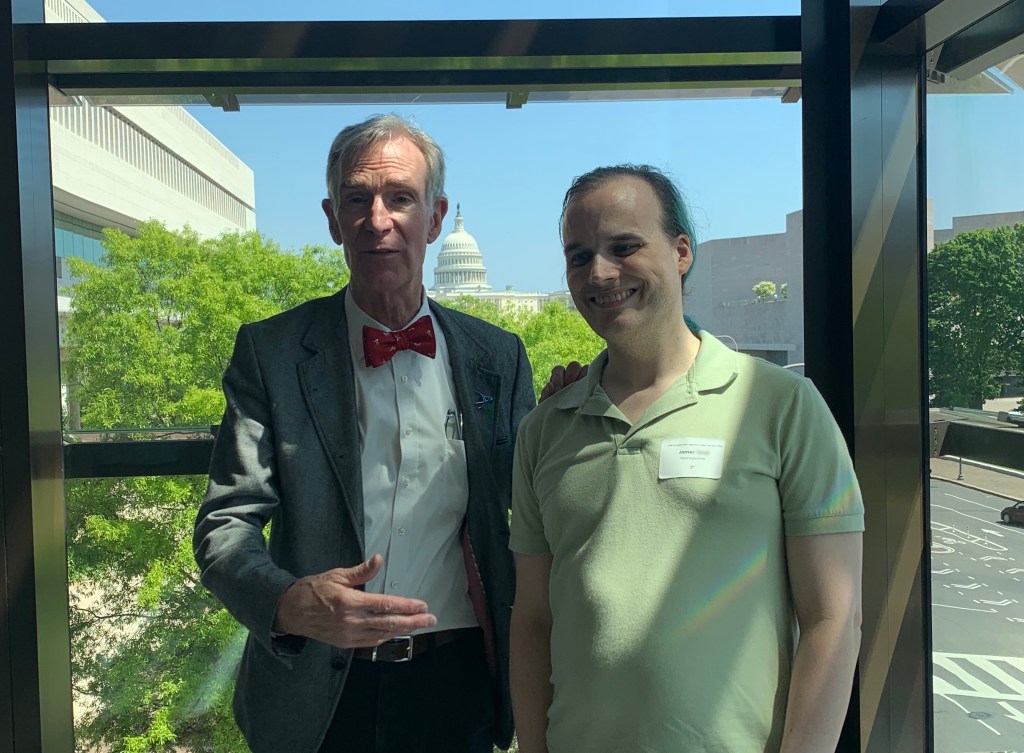
This is a picture of me with Bill Nye.  You probably know him as “the Science Guy,” but he’s also the current C.E.O. of the Planetary Society, the non-profit group that organized the space advocacy event in D.C. which I attended.

I’ve often felt like there’s an easy and obvious metaphor to be made between pursuing a writing career and running the U.S. space program.  Both involve big dreams and lofty aspirations.  Both involve shooting for the stars, so to speak.  Both also involve some harsh economic realities.  And in both cases, balancing those big dreams against those economic realities can be a real challenge.

As former NASA administrator Mike Griffin put it, there are the “real reasons” we explore space (our curiosity, our sense of awe and wonder), but there are also the “acceptable reasons” we must use to justify space exploration to Congress (job creation, spin-off technologies, planetary defense, and so forth).  In a similar way, for us writers, there are the “real reasons” we write, but then there are the “acceptable reasons” we must use to justify ourselves if/when we chose to pursue writing as a career.

For me, the real reasons I write are, in fact, the same as the real reasons NASA exists: a sense of awe and wonder about the cosmos, plus a deep sense of curiosity about what else might be out there.  That’s why I write this blog about space.  And that’s also why I want to pursue a career writing science fiction.  As for my “acceptable reasons,” well… I’m still working on those.  Plenty of cynical people in my life have told me that my writing is good, but that I should stick to a more sensible, more economically viable career path.  I’m never sure what to say to these people.  But I’m working on it.

So, my fellow writers, what are the “real reasons” you write, and what are the “acceptable reasons” you use to justify yourself if you’re pursuing writing as a career?

P.S.: Former NASA Administrator Mike Griffin was recently interviewed on the Planetary Society’s podcast, as part of the lead-up to their big event in D.C.  Click here to hear what Griffin himself has to say about the real reasons vs. the acceptable reasons for space exploration.

Why Do I Love Space?

Hello, friends!

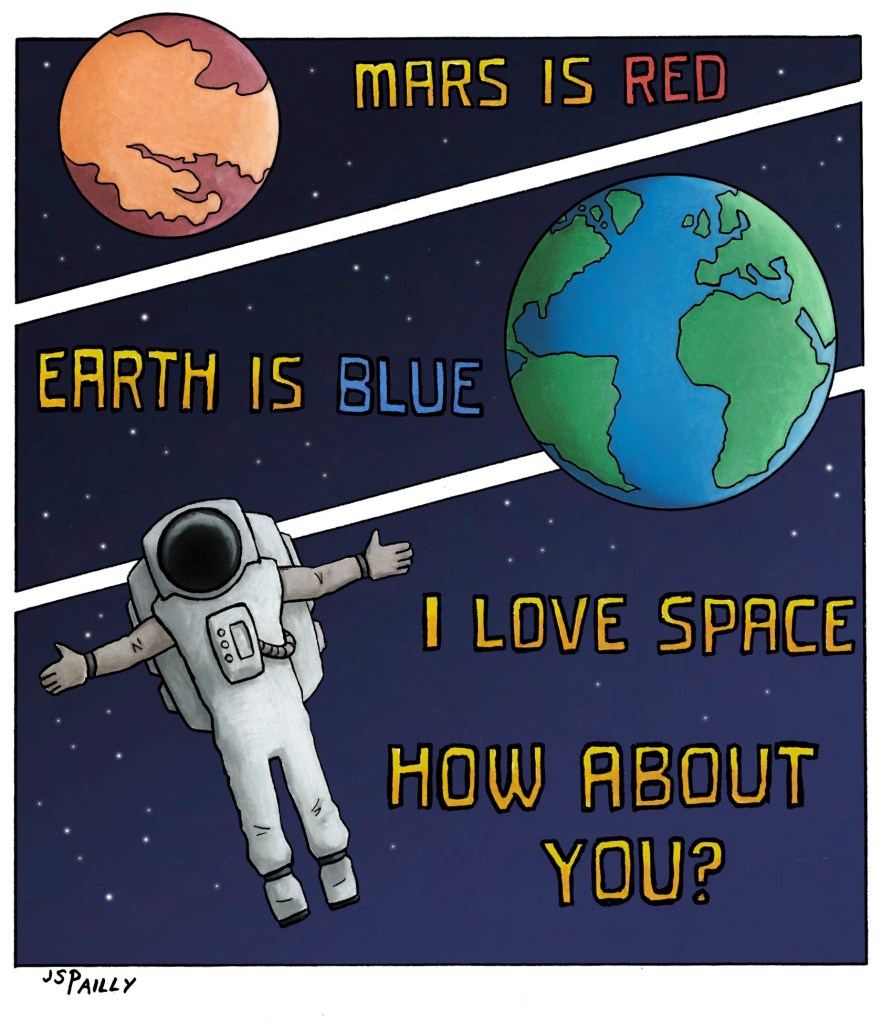
This is my first “real” post here on my new blog.  The main message I’m hoping to convey with this new blog is, quite frankly, right there in the title: I Love Space!  If you’re still wondering how I feel about space, then… I don’t know what else to do.  I don’t know how to make my feelings for space any clearer.  However, the title of this blog does raise another question that I think is worth talking about.  Sure, I love space.  But why do I love space?

I think everyone will understand what I mean when I say space represents the future.  This “space equals the future” idea has been part of the zeitgeist for a long time now.  I can’t say what, precisely, our future in space will look like.  Will there be humans on Mars?  Face-to-face contact with extraterrestrials?  Fleets of starships exploring the Orion Nebula?  Maybe.  Maybe not.  Perhaps the work of exploring space, gathering resources from space, and defending our planet from space-based threats (like asteroids and comets) will be left to machines while we humans remain safe and comfortable here on the ground.

Either way, I do believe space will be a big part of our future.  That’s always in the back of my mind whenever I look up at the stars.  That’s always in the back of my mind whenever I learn a new space fact (like the many space facts I hope to share with you, dear reader, on this blog).  It’s in the back of my mind whenever anything even remotely space-related comes up in conversation.  Space isn’t just an empty void.  The other planets aren’t just barren rocks or giant gas balls.  These things represent our future as a species, our future as a civilization.

Given the state of the world today, it’s easy to lose hope.  It’s easy to get so wrapped up in the problems and conflicts of the present that we lose sight of the future.  Reading the news these days fills me with a sense of hopelessness.  And that, my friends, is why I love space.  I love space because no matter how bad things get here on Earth, space always reminds me that there is still a future to look forward to, a future worth living for, a future worth fighting for.

And so that is what space means to me.  It represents the future—but even more than that, it represents hope.  Every single one of us needs to find hope in something.  I find my hope up there, among the planets and stars.  Where do you find yours?

Hello, World!

As of this writing, this blog is still under construction.  I’ll have a more official launch post soon.  In the meantime, all I want to say is I love space.  If you also love space, please consider hitting subscribe, or bookmarking this website, or adding this website to your RSS reader—whatever your preferred method of following blogs happens to be.  More space art and more space love will be coming soon!