What’s It Like Seeing Earth from Space?

Hello, friends!

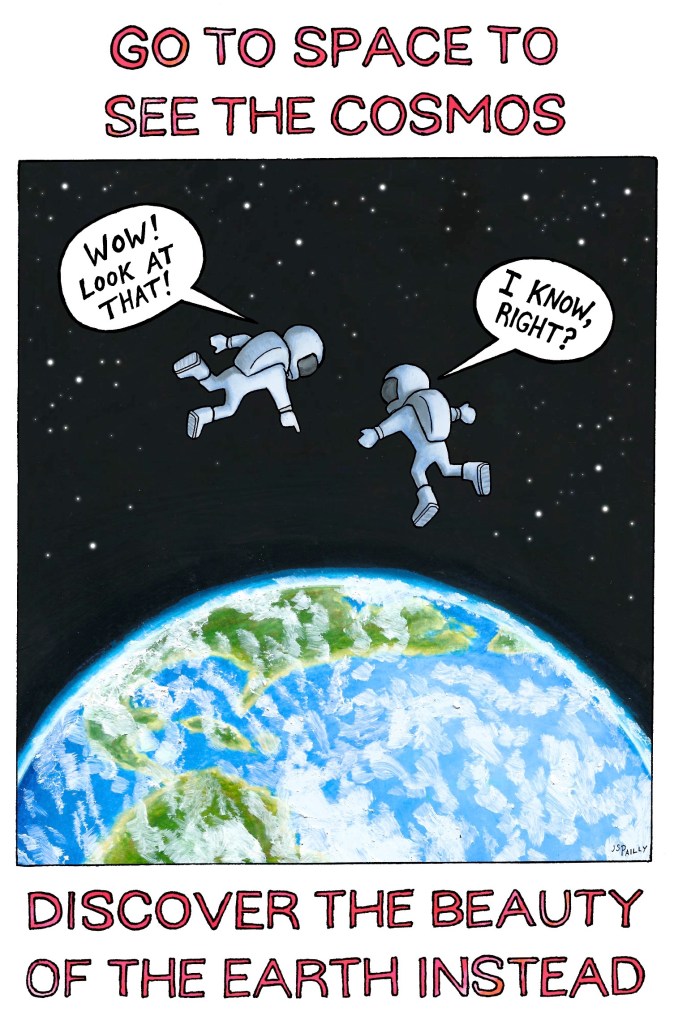
I don’t know about you, but whenever I stop and look up at the nighttime sky, I feel… something.  It’s hard to explain.  And if I take out my telescope to look more closely at the planets and nebulae and galaxies up there, I feel that same indescribable something even more.  Whatever it is I feel, it’s a powerful, almost spiritual thing.  But as powerful as that experience is, I’m told it’s nothing compared to the feeling you get when you’re up in space, looking not farther out into the cosmos but rather looking back at the Earth.

In 1987, American author and space exploration advocate Frank White coined the term “overview effect” to describe the experience so many astronauts report having when they first see the Earth from space.  These astronauts don’t just look at Earth and think, “Huh, neat view.”  They describe this as a life changing experience, a dramatic shift in belief and perspective, a sudden realization that our world is precious and fragile and that we all must set aside our differences and work toward the common good.

If only more people could have an experience like that, maybe the world would be in a better state than it is currently in.  That would be great, wouldn’t it?  Well, there are individuals and organizations working to make this an experience more people can have.  One option is, of course, to make commercial spaceflight more affordable.  Another is to try to simulate the overview effect in virtual reality.  But if more people could see our planet for what it truly is—not as a globe crisscrossed by national borders but rather as a singular world that we all must share—that might bring about some real change.  It might, right?

Now obviously there’s been some criticism of this idea, and I do think some of the criticism is valid.  Even among those who’ve been to space, who’ve experienced the overview effect for themselves, and who’ve come back eager to do good things for our planet and our species… even among those people, some of them still say some troubling things.  For example, during the Cold War, Soviet cosmonauts would sometimes remark that seeing the Earth laid out before them reinforced their belief that communism must be spread all across the world.  American astronauts occasionally say similar things about spreading freedom and democracy.  Even if we all want to do good things for our planet, we’ll still disagree about what good things our planet needs us to do.

Frank White has acknowledged this issue in some of his writings.  If you’re one of the people lucky enough to see the Earth from space, cultural and political biases, religious beliefs, personal history… all sorts of factors may influence how you describe the overview effect to others, or how you interpret the experience for yourself.  But it does seem that no matter who you are or where you come from, seeing the Earth from space is a powerful and humbling experience.  Maybe White and others in the overview effect movement are right.  Maybe it would do some good if more people could have this experience for themselves.

WANT TO LEARN MORE?

A few years ago, William Shatner (a.k.a. Captain Kirk from Star Trek) went to space aboard a Blue Origin rocket.  What he saw moved him to tears.  Regardless of how you might feel about Blue Origin or its owner, Jeff Bezos, I think what Shatner had to say about the experience is worth hearing.  Click here.

Friend of the blog Matt Williams had the chance to interview Frank White a few years back, and I’m super jealous about it.  Click here to listen to that interview on Matt’s podcast, Stories from Space.

Jordan Bimm is one of the most noteworthy critics of the overview effect and the overview effect movement.  Click here to read his paper “Rethinking the Overview Effect,” which lays out his main points.

I’d also recommend reading Frank White’s response, entitled “Rethinking ‘Rethinking the Overview Effect.’”  Click here for that.

The art used in today’s post is my own original work. If you like my art, please consider visiting the I-Love-Space store on RedBubble. Shopping on RedBubble is a great way to support artists (like me) so that we can keep doing what we do. Thank you!
IWSG: Hope for the Future

Hello, friends!  Welcome to this month’s meeting of the Insecure Writer’s Support Group, a blog hop created by Alex J. Cavanaugh and co-hosted this month by Rebecca Douglass, Beth Camp, Liza @ Middle Passages, and Natalie @ Literary Rambles.  Are you a writer?  Do you feel insecure?  Then this is the support group for you!  Click here to learn more and to see a list of participating blogs.

Each month, the Insecure Writer’s Support Group asks us a question.  The question is totally optional!  IWSG member can answer it if they like, or they can talk about something else if that’s what they want (or need) to do this month.  No pressure, no judgment.  This month’s optional question is:

Describe someone you admired when you were a kid.  Did your opinion of that person change when you grew up?

Oh boy… so I had an assignment in school once.  I had to pick an American historical figure I admired and give an oral presentation on that person to the class.  The teacher said we could pick anybody, so I picked Gene Roddenberry.  Then the teacher said to take this seriously and made me pick somebody else.  I’ve been bitter about that ever since, but now—finally!—I can satisfy little kid me’s dream and tell you why I admired Gene Roddenberry so much.

Truth be told, though, little kid me didn’t know much about Roddenberry.  All I knew was that he created Star Trek, and I absolutely adored Star Trek.  When I was happy, Star Trek was the most fun and exciting thing on television.  And when I was no so happy, Star Trek offered hope and the promise that the future would be better than today.  No matter who was bullying me at school, and no matter what I was dealing with at home, Star Trek reassured me that the future would be better.

It’s also one of the main reasons I started writing.  Some of the first “books” I wrote as a kid were just Star Trek fan fiction.  I then branched out into writing Jurassic Park fan ficiton, Aliens fan fiction, Star Wars fan fiction, Battlestar Galactica fan fiction, Doctor Who fan fiction….  Later, I created my own original characters and sent them off adventuring in my own original Sci-Fi universe.  Meanwhile, I started reading Scientific American, Sky and Telescope, Universe Today… I tried reading more challenging, more technical sources of science info, too.  I didn’t understand everything I read, but the more I learned about space and science, the more convinced I became that Star Trek got it right: the future will be better than today.  Or at least, the future can be better, if we don’t lose faith in ourselves.

This isn’t a message unique to Star Trek.  All Sci-Fi, regardless of how realistic or unrealistic the science may be, offers us hope for the future.  Even darker, more dystopian visions of the future still offer hope, in their own way: hope that we may yet choose a different path forward.

As an adult, I’ve come to learn that Gene Roddenberry was kind of a jerk.  He cheated Alexander Courage (the guy who wrote the Star Trek theme song) out of half of the royalties he was owed.  He was wildly unfaithful to his wife.  He had a notoriously short temper and created a toxic work environment on set.  In short, Roddenberry was not the hero little kid me might have thought.

Still, Roddenberry had some good ideas, and (with the help of many other talented people) he made something that made a real difference in my life.  Now more than ever, here on this blog and in all my other creative work, I hope I can pass on some of that Star Trek-ian optimism to others.

IWSG: I Don’t Actually Like Writing

Hello, friends!  Welcome to this month’s meeting of the Insecure Writer’s Support Group, a blog hop created by Alex J. Cavanaugh and co-hosted this month by Ronel, Deniz, Pat Garcia, Olga Godim, and Cathrina Constantine.  Are you a writer?  Do you feel insecure?  Well, then this is the support group for you!  Click here to learn more and to see a list of participating blogs.

For most of my life, I’ve been telling people that I love writing.  But (confession time) that’s not entirely true.  I don’t love writing.  Most days, I don’t even like writing.  Writing is a tedious, time-consuming process that requires me to think really hard about words when I’d rather be watching Netflix.  I mean, have you seen Arcane?  That show is so good!!!  Wait, no… I need to stay on topic.  What was I talking about?  Oh yeah: writing sucks.  I hate it.  So why do I keep doing it?

Whenever I go around claiming (erroneously, as you now know) that I love to write, people will inevitably start suggesting things that I ought to write about.  I’ve been told that I ought to write smut, because that’s how you make the easy money (I’ve met writers who write erotica, and I know it’s not such an easy way to make money).  I’ve been told I ought to write a book about Abraham Lincoln, because it’s about time the truth came out about Lincoln (the person who suggested this… I do not know what he was talking about, and I don’t want to know).  I’ve been told I ought to write about what it was like to live through a global pandemic, because that’s an interesting experience that I’ve had (and other people haven’t, I guess???).

As a writer, it takes a lot to get me to sit down and do my writing.  All those suggestions from random people in my life—I’m sure somebody could write a good book about those things, but I cannot muster up enough enthusiasm to write about them myself.  I’d much rather curl up in bed and rewatch Three Body Problem on my laptop.  That scene in the Panama Canal gives me chills every time.  So upsetting.  Anyway… sorry, we were talking about writing.

For some strange reason, those same people who keep telling me what I ought to write about also keep telling me what not to write about.  They don’t think I should spend so much time writing about space.  They say I’ll never get rich, like E.L. James, by writing about space.  And maybe that’s true.  But here’s the thing: I love space.  I hecking LOVE outer space.  I mean, outer space is so cool!  Unless you wander too close to a star, in which case outer space gets face-meltingly hot.  Gravity’s weird up there.  There might be aliens.  All the planets (besides Earth, of course) are straight-up death traps, but we’re going to try to live on some of them anyway.  Remember to bring your own oxygen, and remember to hold on to your oxygen tank like your life depends on it (because it does).

Space is just so exciting to me!  It’s exciting enough that I’m willing to spend hours upon hours of my own free time writing about it.  That’s time I could’ve spent watching… I don’t know, Stranger Things, or something?  Doesn’t matter.  The point is I love space so much that I’m willing and eager to write about it, despite the fact that I don’t actually like writing all that much.

So going forward, I may still tell people, from time to time, that I love writing.  But between you and me, dear reader, you’ll know what I really mean.  You’re in on my secret now.  To me, writing is merely a means to an end.  It’s a tool I use to express a more important thought.  Namely, that I love space.

So friends, what do you love?  What do you love so much that you’re willing to write about it?

IWSG: Let’s Talk About Politics

Hello, friends!  Welcome to this month’s meeting of the Insecure Writer’s Support Group, a blog hop created by Alex J. Cavanaugh and co-hosted this month by Diedre Knight, Lisa Buie Collard, Kim Lajevardi, and JQ Rose.  Are you a writer?  Do you feel insecure?  Then this is the support group for you!  Click here to learn more!

So this blog post is scheduled to come out the day after the U.S. Presidential Election; however, I am writing this a few days before the election.  Therefore, the me who is writing this post does not yet know what the outcome of the election will be.  Perhaps, when this post comes out, we still won’t know what the election results will be.  It’s hard for me to guess what might happen, here in the past.

But I do know one thing.  I know that, whatever the outcome of the election happens to be, a whole lot of people will be real happy about it, and a whole lot of other people will be real mad.  I know I personally will be either really happy or really mad, depending on who wins this one.  But it’s important to remember that elections are not the only things that matter in a democratic society.  There are other ways to express your beliefs and advocate for causes you care about.

Which brings me, finally, to the real topic of today’s blog post: writing.  I’m a science communicator and science fiction writer.  I write about space, science, and the future of humanity.  I believe in a future where we don’t destroy ourselves through nuclear war or climate change.  I believe in a future where we come together as a species and where we go on to become explorers of the cosmos.  In other words, I believe in the Star Trek future.

Sometimes, my writing gets a little preachy.  Sometimes I want to get preachy in my writing.  And sometimes I don’t.  But even when I’m not deliberately trying to make some sort of moral or political statement, my beliefs and values still come through in everything I write.  You can’t be a writer and not have your beliefs and values creep into your work somehow.

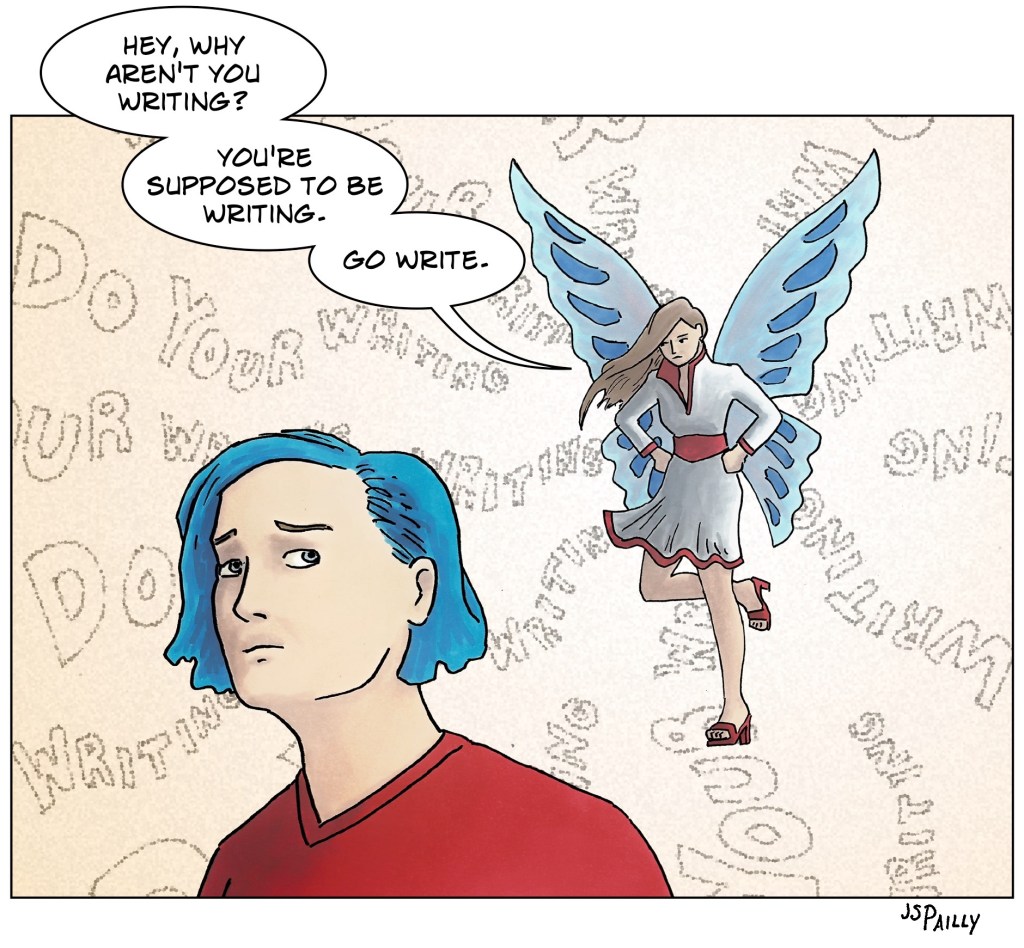
So if you’re a writer and if you have strong feelings (positive or negative) about whatever just happened in the U.S. Presidential election, my advice to you is this: go write.  It doesn’t have to be overtly political writing.  Write whatever makes you happy.  Write whatever you’re passionate about writing.  Just write.  Your words matter more than you know.  Your words can help people understand your point of view.  Your words may change somebody’s mind.  Your words can make the world a better place.  So go write, keep writing, and make a difference.

P.S.: Oh no, I just wrote a blog post about politics and scheduled it for the day after a Presidential election.  Okay, everybody, please try to be kind in the comments below.  At the very least, try to be respectful.  If you want to get into a fight with somebody about politics, there are plenty of other places on the Internet where you can go do that.

IWSG: I Love Lovecraftian Horror

Hello, friends!  Welcome to this month’s meeting of the Insecure Writer’s Support Group, a blog hop created by Alex J. Cavanaugh and co-hosted this month by Nancy Gideon, Jennifer Lane, Jacqui Murray, and Natalie Aguirre.  Are you a writer?  Do you feel insecure?  If so, then this is the support group for you!  Click here to learn more.

Each month, the Insecure Writer’s Support Group asks us an optional question.  IWSG members can answer the question if they want, or they can skip it if there’s something else they want/need to talk about instead.  This month’s optional question is:

Ghost stories fit right in during this month.  What’s your favorite classic ghostly tale?  Tell us about it and why it sends chills up your spine.

I almost skipped this month’s question.  Ghost stories don’t do much for me.  I have a very sciency worldview, unfortunately, so stories about the occult or the paranormal don’t give me much of a thrill or a fright.  But there is an author who bridged the gap between science and the supernatural well enough to freak me the f*** out.  That authors’ name is H.P. Lovecraft.

Lovecraft did most of his writing in the 1920’s and 30’s.  He died young, unfortunately, in 1937.  As I understand his biography, Lovecraft was a huge fan of Edgar Allan Poe and was inspired by Poe’s work; however, Lovecraft believed that the traditional ghost story needed to be updated for modern times and modern, scientific sensibilities.  So rather than leaning on ghosts and devils, Lovecraft filled his stories with theoretical physics, extraterrestrial intelligences, and occasional references to a certain newly discovered planet (Pluto).

My favorite Lovecraft story is called “The Colour Out of Space.”  In that story, a meteor crashes on Earth, introducing an extraterrestrial something to the local environment.  The local environment begins to change as a result.  Plants and animals become weirdly mutated, and the humans living on a nearby farm gradually lose their sanity.  No one can explain what’s happening.  No one can explain what that thing from outer space is or even describe what it looks like.  The best anyone can say is that it’s a color unlike any color seen before by human eyes (hence the title of the story).

I can’t think of many stories where alien life forms are presented as truly unknowable beings.  There are the alien monoliths from 2001: A Space Odyssey.  There are the replicas from Solaris, or the sphere from Michael Crichton’s Sphere.  But that thing from “The Colour Out of Space”… whatever that thing was, it was the most incomprehensible of all incomprehensible aliens in science fiction.  And that truly scares me.

I love space and I love science fiction.  One of my dearest hopes for the future is that we will one day make contact with aliens—aliens like E.T. or Mr. Spock.  You know: the kind of aliens we can be friends with.  But that may not be what happens.  If/when we discover alien life, the aliens may be something totally and completely beyond human comprehension (and we humans may seem equally incomprehensible to whatever alien intelligence happens to discover us).  That’s a scenario that terrifies me, and it should terrify anyone who lives on this rather small and extremely vulnerable planet.

What the Heck Do Astrobiologists Do?

Hello, friends!

I don’t remember when or where I first heard about astrobiology (the scientific study of alien life), but I do remember my initial gut reaction: “If we haven’t discovered alien life yet, what the heck do astrobiologists study?”  Then I learned more.  I learned that astrobiologists are concerned, first and foremost, with studying the only life we currently know of in this universe: life on Earth.  That provoked another instant, incredulous question in my mind: “How is that different from regular biology?”

But there is a difference!  Yes, astrobiologists and regular biologists both study life on Earth.  There’s some overlap between these two scientific fields.  However, astrobiologists and regular biologists are working to understand life on very different scales.  How do plants do photosynthesis?  Why do cows need so many stomachs?  What’s the purpose of that giant claw on the fiddler crab?  Those are biology questions.  Astrobiology is less interested in individual organisms or individual species and more interested in life as a “planetary phenomenon.”

So here’s this planet.  We call it Earth, and we know for a fact that there’s life on it (NASA checked).

What’s more, life from Earth has already started spreading to neighboring celestial bodies.  A bunch of astronauts left their footprints on the Moon, and there’s a possibility that our robotic landers and rovers may have contaminated Mars with our Earth germs.  So how did life as a planetary (and now interplanetary) phenomenon happen here on Earth?  And more importantly, what does the example of life on Earth tell us about what might be happening elsewhere in the cosmos?

In 1950, nuclear physicist Enrico Fermi famously asked “Where is everybody?”  Funny story: Fermi actually blurted this out at lunch, as a total non sequitur.  It was a weird and awkward moment.  Fortunately, Fermi was having lunch with some physicist friends, and they quickly got the gist of what he was trying to say.  The universe is vast.  Mindbogglingly huge.  It does not make sense for life to exist on one and only one planet.  So where is everybody?

That pretty much sums up the work astrobiologists do.  They’re trying to figure out where everybody is.  Their research begins, first and foremost, with life on Earth.  How did life begin here on Earth?  Which environmental factors mattered most?  As life evolved and spread across this planet, how did the planet change as a result?

Obviously Earth is a special planet.  If astrobiologists can figure out which qualities make Earth so special (special enough for life), then perhaps they’ll know what qualities to look for on other planets out there among the stars.

WANT TO LEARN MORE?

That story about Enrico Fermi, where he blurts out “Where is everybody?” at lunch, is true.  It’s the origin of what we now call the Fermi Paradox.  Click here to read some first hand accounts of people who were having lunch with Fermi that day.

Contaminating Mars with our Earth germs is a real concern.  Unfortunately, it may have already happened.  As a result, if we ever do discover microorganisms on Mars, it may be hard to tell whether or not those microbes are actually native to Mars.  Click here to learn more.

And lastly, in 1990 NASA “discovered” life on Earth, but it turned out that detecting life from space-based observations alone was really difficult.  More difficult that you might expect.  The astrobiological implications are obvious.  Click here to learn more.

IWSG: Unlearning Grammar Rules

Hello, friends!  Welcome to this month’s meeting of the Insecure Writer’s Support Group, a blog hop created by Alex J. Cavanaugh and co-hosted this month by Beth Camp, Jean Davis, Yvonne Ventresca, and PJ Colando.  If you’re a writer and if you feel insecure about your writing life, click here to learn more about this awesomely supportive group!

Each month, IWSG asks members an optional question.  This month’s question is:

Since it’s back to school time, let’s talk about English class.  What’s a writing rule you learned in school that messed you up as a writer?

One of the nicest things anyone’s ever said to me is: “You make me want to go learn stuff.”  I love learning.  I love learning about history, about mythology, about the arts, about science—most of all, I love learning about space!  But one of the most important lessons I’ve learned as a life-long learner is that you need to unlearn many of the things they taught you in school.  Today, I’d like to share a few rules of English grammar that I had to unlearn in order to become a better writer.

Thou shalt not split an infinitive.

I’m a Star Trek fan.  I’ve been hearing various captains of the starship Enterprise split infinitives my whole life, every time they say “to boldly go where no one has gone before.”  Aside from the fact that “to boldly go” sounds way cooler that “to go boldly,” there are instances where splitting or not splitting an infinitive might change the meaning of a sentence.  For example, “She decided to quickly fight back” does not mean the same thing as “She decided quickly to fight back.”

Thou shalt not end a sentence with a preposition.

There’s a famous quote about this rule.  “This is the sort of English up with which I will not put.”  I always thought that quote came from Winston Churchill, making him a staunch opponent of both real Nazis and grammar Nazis.  But while fact checking this blog post, I learned that there’s some dispute over whether or not Churchill really said this.

Anyway, the quote still illustrates what’s wrong with the “don’t end sentences with prepositions” rule.  Strict adherence to the rule can produce some cumbersome and convoluted writing.  Part of the problem is that sometimes what looks like a preposition is actually part of a phrasal verb: a string of words that function, grammatically, as a single verb.  “To put up with” is a phrasal verb, and “This is the sort of English I won’t put up with” would be a perfectly normal and natural English sentence.

Thou shalt not use “they” as a singular pronoun.

Okay, I’m going to gloss over the usage of “they/them” to refer to non-binary people, at least for now.  That’s related to the point I want to make, but it is not the main point I want to make.

In school, I was taught that “they,” “their,” and “them” must never be used to refer back to a singular noun.  For example, if somebody wrote “A person cannot help their birth,” this would be marked as wrong because “a person” is singular and “their” is supposedly plural.

But some pronouns do serve double duty.  For example, the word “you” does double duty as both a singular and plural pronoun, and there are examples in other languages of pronouns serving multiple grammatical functions as well.  Regarding singular they in English, it’s been around for centuries.  Examples can be found in Chaucer, Shakespeare, and the King James Bible.  The example I used above comes from Vanity Fair by William Thackeray, published in 1848.

At some point in by life-long learning journey, I came across a more honest and accurate rule for the usage of singular they: they, their, and them can refer back to a singular noun when a plural noun in implied or when the gender of the singular noun is ambiguous (the ambiguous gender part then leads to the modern usage of they/them for non-binary people).


So why did my teachers in school tell me I can’t split an infinitive when Captain Kirk and Captain Picard did it so freely?  Why did they tell me I can’t end a sentence with a preposition when all I did was use a phrasal verb?  Why did they tell me not to use singular they when singular they has been part of the English language for hundreds and hundreds of years?  Because of Latin.

At some point in history, the intellectual class in England decided that English was too messy and improper of a language.  They looked at Latin, with all its noun declensions and elaborate verb conjugations, and said, “Now that’s what a right and proper language ought to be,” and they started to impose the rules of Latin grammar onto English.  And that’s why we have these dumb rules in our language today.

Now I love Latin.  It’s a fun and beautiful language, and I wish more people were familiar with it.  But English is a fun and beautiful language in its own right.  English is also a weird and quirky language, whereas Latin tends to be more rigid and strict.  So if you want to be a better writer of English (not Latin), it helps to unlearn some of those Latinesque rules we learned in school, and start to understand and appreciate the weirdness and quirkiness of natural English grammar.

WANT TO LEARN MORE?

I’m going to recommend this article from JSTOR Daily, titled “Dear Pedants: Your Fav Gammar Rule is Probably Fake.”

Regarding singular they, a particularly controversial grammar issue these days, here’s an article from Medium entitled “Befuddled by Singular They?”

And lastly, if you’re looking for a deep dive into the history of English grammar, I highly recommend the book Our Magnificent Bastard Tongue: The Untold History of English by John McWhorter.

IWSG: No One Can Say It For Me, Not Even an AI

Hello, friends!  Welcome to this month’s meeting of the Insecure Writer’s Support Group, a blog hop created by Alex J. Cavanaugh and co-hosted this month by Feather Stone, Kim Lajevardi, Diedre Knight, C. Lee MaKanzie, and Sarah – The Faux Fountain Pen!  If you’re a writer and if you feel insecure about your writing life, click here to learn more about this awesomely supportive group.

Each month, IWSG asks us an optional question, and this month’s question taps into one of my current insecurities as both a writer and an artist.

Do you use AI in your writing and if so how?  Do you use it for your posts?  Incorporate it into your stories?  Use it for research?  Audio?

Short answer: no.  No, I don’t, and I doubt that I ever will.

Longer answer: a year or two ago, when the AI craze started taking hold, I did experiment with AI a little, just to see what the hype was about.  I had an AI generate some Sci-Fi art for me, and I had a different AI rewrite some of my old blog posts.  My initial reaction, when I saw the work AI could produce, was “Wow, this is really impressive.”  I also thought, initially, “Oh no… this is better than what I can do.”

But as I played with AI more and more, I became less and less impressed with it.  Sometimes, it does shockingly good work, but more often it spits out garbage.

More importantly, the AI never (not even once) gave me what I actually wanted.  The AI generated Sci-Fi art looked cool, but it wasn’t what I was picturing in my head.  Not even close.  As for the AI rewritten blog posts, I’ll admit that the AI wrote cleaner, tighter prose than I do.  It had this verbally efficient style that many style guides and writing gurus try to teach you.  But after a while, all that super clean, super tight writing started to sound very samey.  It felt dull and soulless to me.

Also, when I write blog posts about space and science, I’m really trying to express two things: first, my sense of awe and wonder about the cosmos, and second, my hope for humanity’s future out there among the stars.  When I let the AI rewrite my blog posts, it repackaged all the space and science facts reasonably well, but any themes of wonder or hope for the future got lost in translation.

I’m still deeply concerned about AI intruding into the domains of art and literature, mainly because so many big players in the tech industry keep insisting that AI can and should be used for these things.  But for my own creative process, AI offers me very little.  Basically nothing.  I do my art and I do my writing because there’s something inside me that I desperately want to express, that I desperately need to express.  This thing inside me that I’m trying to express through my art and my writing—no one else can express it for me, not even an AI.

P.S.: Sorry for not being active on the blog this past month.  I haven’t been feeling well, but I’m recovering, and I should have more space and science stuff for you in the month to come.

IWSG: The Ultimate Writing Machine

Hello, friends!  Welcome to this month’s meeting of the Insecure Writer’s Support Group, a blog hop created by Alex J. Cavanaugh and cohosted this month by Rebecca Douglass, Pat Garcia, Louise-Fundy Blue, Natalie Aguirre, and J.S. Pailly (hey wait a minute, that’s me!!!).  If you’re a writer and if you feel insecure about your writing life, click here to learn more about this amazingly supportive group, or click here to check out the IWSG Facebook page.

Each month, IWSG asks us an optional question.  It is totally optional!  IWSG members do not have to answer the question if they don’t want to, or if there’s something else they need to talk about instead.  This month’s optional question is:

What are your favorite writing processing (e.g. Word, Scrivner, yWriter, Dabble), writing apps, software, and tools?  Why do you recommend them?  And which one is your all time favorite that you cannot live without and use daily or at least whenever you write?

As you know, I love space, and I love science.  Based on those two statements, you might expect that I’d also love technology, or that I’d at least feel somewhat comfortable using technology.  But no.  There’s something about sitting in front of a computer screen that makes the creative side of my brain switch off.  Ergo, I don’t use writing software or writing apps much.  I do almost all of my writing the old fashioned way, with pen and paper.

Now I’m not trying to be a hipster about this.  I don’t want to wax poetic about the magical sound of a pen scratching on crisp, white paper.  Writing by hand is not—absolutely not—a better, more sophisticated, more intellectually proper way to write.  It is simply that I cannot “good words do” (as Patrick Rothfuss once described writing) when I’m staring at a computer screen, so writing by hand is my only option.

I do use a computer (obviously!), but only at the very end of my writing process.  Once I have a fully finished draft written out by hand, I take it to my computer, go into a fugue state, and mindlessly transcribe whatever I wrote into a word processor.  Which word processor?  It doesn’t matter.  I don’t have strong feelings about these things.  But I do have strong feelings about pens.  So let me tell you about the Pilot Precise V5 Rolling Ball Pen.

Pilot Precise Rolling Ball pens are marketed as “the ultimate writing machine.”  They’re ballpoint pens with super fine, almost needle-like tips.  According to the marketing copy, these pens use a “unique ink formula” and an “advanced ink feed system for smooth, skip free writing.”  That sounds like marketing B.S., but this is one of the rare cases where the marketing B.S. is actually true.

When I’m in the zone, deep in the flow state of writing, totally lost in my own imaginary world, I don’t want to worry about having any sort of trouble with my pen.  And with Pilot Precise pens, I never do.  Just as words flow from my mind, ink flows smoothly and consistently from my pen onto the page.  It’s such a satisfying writing experience.  And given how incredible these pens are, they’re surprisingly affordable.  Depending on where you shop for office supplies, you can usually get a pack of twelve pens for under $20.

The pens come in two sizes: the V7 and the V5.  I prefer the V5.  The V7 makes a slightly thicker, slightly heavier line.  Nothing wrong with that, but the V5’s slightly thinner, slightly finer line feels more elegant and graceful.  The pens also come in a wide variety of colors, which helps me color code different projects, or keep track of different drafts of the same project.  The first draft of this blog post was written in green.  The second draft was pink, and the third draft was purple.  This made it easy for me to see, at a glance, which pages needed to be transcribed into the computer and which ones didn’t.

So I can’t offer any recommendations for writing apps or writing software.  I barely use a computer at all in my writing process.  But for those of you who write using pen and paper, I can recommend the Pilot Precise V5 Rolling Ball Pen.  And try out the multicolor variety packs, if you see them in stores!  These are the only pens I use for writing.  They really are the ultimate writing machines (and nobody’s paying me to say that).

P.S.: This is my first time cohosting IWSG.  I’m super excited to be doing this today, and (fingers crossed) I hope I do a good job.

IWSG: Time

Hello, friends!  Welcome to the Insecure Writer’s Support Group, a blog hop created by Alex J. Cavanaugh and co-hosted this month by Liza at Middle Passages, Shannon Lawrence, Melissa Maygrove, and Olga Godim.  If you’re a writer and if you feel insecure about your writing life, click here to learn more about this amazingly supportive group!

Each month, the Insecure Writer’s Support Group asks a question.  The question is totally optional.  Members of the group can choose to answer it in their blog posts, or not.  This month’s question is:

In this constantly evolving industry, what kind of offering/service do you think the IWSG should consider offering to members?

As you know, I love space, but I also love writing (almost as much as I love space).  Unfortunately, love isn’t always enough.  Enthusiasm isn’t always enough.  I have plenty of love and enthusiasm.  What I really need right now is time.  Maybe I’m asking for too much here, but is there any way the IWSG could make the day a little longer?  That’s something I think every writer would appreciate.

I can think of several ways we could do this.  As demonstrated in this comic from xkcd, if we all started spinning counterclockwise, we’d alter Earth’s angular momentum, slowing the planet’s rotation and making Earth’s day just a fraction of a second longer.

Or we could start relocating writers to Mars.  Mars’s rotation rate is already slower than Earth’s, making a Mars day about 36 minutes longer than a day on Earth.  That’s 36 extra minutes for writing!  True, we’d have to deal with the ultra-thin  atmosphere, the scarcity of oxygen, the toxic soil, the radiation, the extreme cold… but think of how much more writing we’d get done!

Another option: a while back, there were rumors that the Large Hadron Collider at CERN (a nuclear physics laboratory in Europe) might cause the accidental creation of a black hole.  That sounds scary, but hear me out: black holes create major distortions in both space AND time.  Could those space-time distortions allow us to make more time for writing?  Maybe!  Or maybe not.  I’m not great at math, so I’m not sure.  Alex, check with a physicist before you try this idea.

In the meantime, I recently negotiated a new work schedule for myself at my day job.  My new schedule is a little weird.  My boss and several of my coworkers were initially confused about why I’d want to work such strange hours.  But my new schedule frees up several hours worth of time, which I can now use for writing.  And I did it without altering Earth’s rotation, moving to Mars, or generating an artificial black hole.  So that’s a win for me!