IWSG: Answering My Inner Critic

Hello, friends!  Welcome to this month’s meeting of the Insecure Writers’ Support Group, a blog hop created by Alex J. Cavanaugh and co-hosted this month by Shannon Lawrence, Olga Godim, Jean Davis, and Jacqui Murray.  Are you a writer?  Do you feel insecure?  Well, then this is the support group for you!  Click here to learn more and to see a list of participating blogs.
Each month, IWSG asks members a question.  Answering the monthly question is not required.  It’s totally optional, which is good news for me, because there’s a different question plaguing my thoughts today.  A different question that keeps getting in the way of writing.  It’s a question that my inner critic keeps asking in snide, Smeagol-like whispers:

You’re no scientist.  You don’t work for NASA.  What gives you the right to blog about space exploration?

And I admit, my inner critic has a point.  I’m a huge fan of space exploration, and I probably do know more about space than the average person.  But still, I’m a long way away from being a true expert.  Plenty of others can speak with greater authority about space than I can.  Some of my readers know more about space than I do.

However, when my inner critic asks these sort of questions—questions like “What right do you have to blog about space?”—I think my inner critic misses the whole point of my blog.  I love space.  I’ve committed myself to learning as much as I can about space, and I believe that learning is a three step process:

  • Passive learning, which is the passive consumption of information from books, online lectures, etc.
  • Active learning, which means (among other things) reexplaining the information you’ve learned in your own words.
  • Receiving feedback, which involves people correcting your mistakes, asking interesting questions, suggesting topics for future research, etc.

From time to time, my inner critic reminds me that I’m not an astrobiologist, not a planetary scientist, not an aerospace engineer, and shames me into not writing.  But that doesn’t just shut down writing.  It shuts down my whole learning process.  If I don’t do my blogging, how will I learn?

Is that answer enough to silence my inner critic?  Actually, it is.  Inner critics are cowards.  They don’t know what to do when you talk back to them, they don’t know what to say when you stand up for yourself.  Much of what I said in today’s post is specific to my own writing and my own issues with my own inner critic.  But if your inner critic has been asking snide questions and shaming you into not writing, then I hope you’ll start talking back like I did.  It really works.

Mission Statement

Hello, friends!

Today is New Year’s Day, so I thought today would be a great day to restate the mission statement of this blog—except it seems I never stated the mission of this blog in the first place.  I could’ve sworn that I had.  Maybe that’s because my mission seems self-evident.  I love space.  I love learning about space, and I love sharing what I learn with others.

The learning part is really important to me.  My love of space doesn’t mean just looking up at the stars and thinking, “Ooooh, pretty!”  I don’t enjoy wonder for wonder’s sake.  My love for space means looking up at the stars, wondering what’s up there, wondering who’s out there, and then putting in the time and effort to find answers (to the best of my ability as someone who’s bad at math and doesn’t have any professional scientific training).

Learning is hard.  Finding good sources of information can be tricky, and even when you do find trustworthy sources, science is still a challenging subject.  Scientists aren’t always the most engaging or entertaining communicators.  But if learning this stuff were easy, I don’t think it would be fun.  The greater the challenge, the greater the reward when you finally do understand a difficult and complicated concept.

So on this blog, I want to tell you about all the cool stuff I learn about space.  I also want to talk about the process I go through to learn this stuff, because the research process is part of the fun.  If you don’t know much about space, I hope to inspire you to love space like I do.  And if you already love space, then I hope to inspire you to love space even more!

But there will be some of you who don’t really care about space and never will.  I want you to know that that’s okay.  We can still be friends.  Not everybody has to love the same things.  I have an I.R.L. friend who’s not very interested in space, no matter how much I talk about it, but she paid me one of the very best compliments I’ve ever received: “You make me want to go learn stuff.”

That’s the real mission of this blog: to spread the love of learning.  I want to set a good example by picking a topic that fascinates me (space, obviously!) and learning everything I can about it.  For you, maybe it’s sports trivia, or Greek antiquities, or horses, or the history of music in video games, or the architecture of Frank Lloyd Wright… it doesn’t matter.  What matters is that learning is one of the greatest joys in life.  I love learning, and I hope you do, too.

Thanks for reading, friends!  Talk to you soon!

P.S.: If you like my art, click here to visit my art store on RedBubble.  Even if you don’t want to buy anything, just visiting and maybe clicking the “like” buttons on my art will help me a lot (and if you do want to buy something, that would help me a lot, too!).

IWSG: Is Writing by Hand Better?

Hello, friends!  Welcome to this month’s meeting of the Insecure Writers’ Support Group, a blog hop created by Alex J. Cavanaugh and co-hosted this month by Tara Tyler, Ronel Janse van Vuuren, Pat Garcia, Liza, and Natalie Aguirre.  Are you a writer?  Do you feel insecure?  Well, then this is the support group for you!  Click here to learn more and to see a list of participating blogs.

As you know, I love space, and I love science.  It may surprise you to learn, though, that I do not love technology.  I’ve never felt comfortable sitting in front of a computer, especially when I’m trying to do something creative.  I do all of my writing by hand, with pen and paper, then mindlessly transcribe whatever I’ve written into the computer when I’m done.  Some people call me old-school for that, or they say I’m a Luddite, or they tell me to get with the times and stop wasting paper.

But recently, I saw a popular science video on YouTube that said writing by hand increases connectivity in the brain, promotes creativity, and improves your overall neurological health.  The YouTuber in this video said all writers should do basically what I do: limit your time on the computer and do as much writing by hand as possible.  I was excited to share that video with you today.  I was excited to write a whole blog post based on that video, saying: “See?  My way of writing is better than yours!”

However, I don’t share things on the Internet without fact checking them first.  So I read the research paper that that YouTube video was referencing (the paper in the links below), and I found that it did not say what that YouTuber said it says.  What it says is that writing by hand activates different parts of the brain than typing on a keyboard or touchscreen.  It also says that the brain is more active when you’re writing by hand compared to using a keyboard or touchscreen.  But that doesn’t necessarily mean writing by hand is better.

In fact, I think the correct interpretation of that research paper is that we all should do a little of both.  According to the paper, writing by hand slows down the writing process, which promotes problem solving and “fosters deeper thought and creativity.”  So if you’re someone who writes exclusively on the computer, writing by hand might help you problem solve your way out of writer’s block.  Meanwhile, writing on a computer or tablet “may favour brainstorming and fast generation of ideas […].”

Personally, I’m going to keep doing most of my writing by hand, because that’s what I’m used to and it’s what I enjoy most.  However, as of right now, I’m at the very beginning of a brand new writing project (think Harry Potter, but on the Moon, with magical spaceships and magical extraterrestrials).  I have a lot of stuff I need to figure out for this new project.  As someone who does all his writing by hand, maybe a few brainstorming sessions on the computer would do me some good right now.

WANT TO LEARN MORE?

Here’s a link to the paper I read.  It’s titled “The Neuroscience Behind Writing: Handwriting vs. Typing—Who Wins the Battle?”  I didn’t cover everything that that paper says in this blog post, so it is worth your while to check it out.

If you’re not up for reading a neuroscience paper, here’s a popular science article that (in my judgment) covers a lot of the same material well.

As for the original YouTube video that inspired this post, I debated whether or not I should include a link, and ended up deciding not to.  That video is spreading misinformation, and I don’t want it getting any more views than it already got.

3I/ATLAS: But What If It Were Aliens?

Hello, friends!

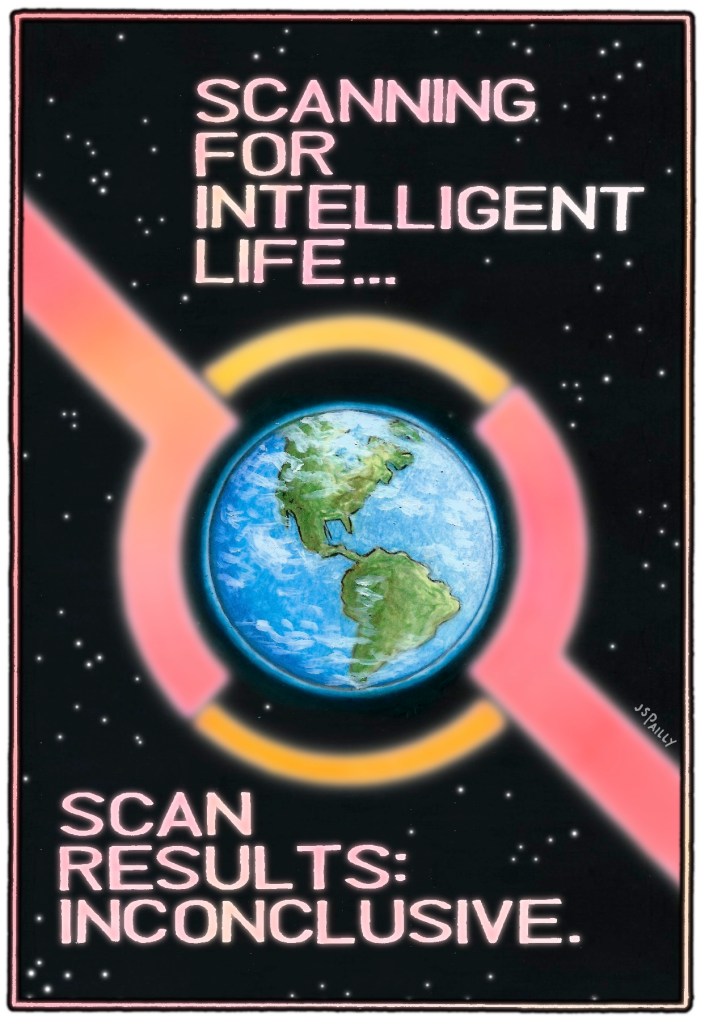
Right now, there’s an interstellar object passing through our Solar System.  Astronomers have named this object 3I/ATLAS, and in my last post I explained how 3I/ATLAS is just a comet and NOT an alien spacecraft.  But let’s pretend for a moment that an alien spaceship were traveling through the Solar System, perhaps on some sort of survey mission.  What would the aliens see when they turn their scientific instruments toward Earth?  How much would they learn about us and our planet?

Much depends on how technologically advanced we imagine these aliens to be, of course, but we humans have been observing Earth from space for decades now.  We know some things are pretty obvious about our planet, even when viewed from a great distance away.  For a start, the aliens would notice that Earth has an abnormally large moon.  They’d also notice that Earth has oceans.  The glint of sunlight reflecting off water would give that away.  And then there’s oxygen.  The spectrographic fingerprints of oxygen are all over Earth’s atmosphere.

Do these aliens breathe oxygen like we do?  Maybe, maybe not.  Either way, Earth’s oxygen-rich atmosphere would make the aliens stop and think, “Huh, that’s weird.”  Most planets don’t have atmospheres like that.  Even weirder, though, the aliens would also detect traces of methane in our atmosphere.  Methane is an easily oxidized chemical, so you’d think all that oxygen would oxidize any atmospheric methane out of existence pretty quick.  Something must keep replenishing the methane as quickly as oxygen destroys it.  Something alive, perhaps?  It’s hard to guess if the aliens would reach that conclusion yet.

As the aliens draw nearer, they’d soon notice this odd green stuff covering much of Earth’s landmasses.  To say that in a more technobabbly way, the extraterrestrials would detect a chemical substance with a strong reflection spectrum in green light (and an even stronger reflection spectrum in infrared).  You and I know what all that green stuff is, but would the aliens figure it out?  Do they have plants back home?  Do their plants contain chlorophyll and perform photosynthesis like ours do?  Hard to say, but Earth’s green stuff would at least make the aliens think, “Huh, that’s also weird.”

A few more things our hypothetical aliens would notice: a substantial ozone layer, continents shaped by recent (or possibly ongoing) tectonic activity, a complex hydrological cycle with water existing as a solid, a liquid, and a gas… oh, and radio emissions.  Lots and lots of narrow-band, amplitude modulated radio emissions, which cannot possibly be a natural phenomenon.

The idea that aliens many lightyears away are watching I Love Lucy, The Brady Bunch, or The Dick Van Dyke Show is probably false.  As radio/television broadcasts propagate through space, those signals grow weaker and eventually blend into the background radiation.  But for the purposes of this blog post, we’re imagining that an alien spaceship is right here in the Solar System with us.  They’re close enough to pick up our broadcasts.  At that point, the aliens wouldn’t just think, “Huh, weird.”  They’d be forced to conclude not only that life exists on Earth but that intelligent life exists on Earth (unless they start watching our news or listening to our talk radio; if they do that, they might second guess the “intelligent” part).

How much more could the aliens learn about us?  Again, it depends on how technologically advanced these aliens are.  Consider the stuff I listed in this blog post to be the bare minimum of what they’d know.

WHAT TO LEARN MORE?

This blog post is based off several research papers, which are listed below.  Detecting life on a planet—even a planet teeming with life, like Earth—is more of a challenge than you might realize.  If that’s a topic you want to learn more about, please check out some of the papers below, especially the first one (the one written by Carl Sagan).

The art in today’s post is my own original work.  I didn’t take it from the Internet or ask an A.I. to generate it.  If you like my art, please consider visiting my store on RedBubble.  Shopping on RedBubble is a great way to support artists (like me!) so that we can keep doing what we do.  Thank you!

3I/ATLAS: It’s Not Aliens

Hello, friends!

You know the expression “If it looks like a duck, swims like a duck, and quacks like a duck, it’s probably just a duck”?  Well, to a certain kind of person, if it looks like a duck and swims like a duck and quacks like a duck, then it must be an extraterrestrial life form that the government has disguised as a duck.  Right now, there’s an interstellar object passing through our Solar System.  It looks like a comet.  It moves like a comet.   It’s grown a tail like a comet.  I think you know where I’m going with this.

Astronomers have named this object 3I/ATLAS.  The “3I” part of the name means this is the 3rd interstellar object we’ve spotted inside our Solar System (the previous two were 1I/Oumuamua and 2I/Borisov).  The “ATLAS” part means this object was first detected by the Asteroid Terrestrial-impact Last Alert System (ATLAS for short).  Ever since the discovery of 3I/ATLAS, there’s been a lot of speculation online, in the news, and even in some corners of the scientific community about how this object might/must be an alien spaceship or alien space probe—or even an alien space weapon!  But this is coming from the same people who cry aliens whenever anything even remotely interesting happens in outer space.

As someone who loves space, I find all this “BuT WhaT iF iT’s ALieNs?” talk annoying and disheartening, because 3I/ATLAS doesn’t need to be aliens in order for it to be interesting.  For example, did you know 3I/ATLAS is insanely old?  By most estimates, it’s approximately 7 billion years old, which makes it 50% older than our entire Solar System.  3I/ATLAS also seems to be composed of unusually high quantities of frozen carbon dioxide (and correspondingly low quantities of frozen H2O).  I’ve read several different possible explanations for this, but the one I find most intriguing is that 3I/ATLAS may come from a star system where water is extremely scarce.

When we learn new things about outer space, ironically, we often end up learning even more about the Earth.  I’ve said before on this blog that our ability to compare and contrast Earth with other planets in the Solar System has taught us a great deal about our home planet.  Now our science has advanced to a point where we can identify interstellar objects as they pass through our Solar System.  We can observe them and study them and use that information to start comparing and contrasting our Solar System with whatever star systems these objects originally came from.  I don’t know what we’ll learn by doing that, but I know we’re going to learn something, and I love that for us!

As for the aliens… someday, I believe we will discover alien life, and that day will be awesome!  If 3I/ATLAS really were an alien spacecraft, that would be awesome, too, but that hypothesis is based more on wishful thinking than actual evidence.  I, for one, think the actual evidence about comet 3I/ATLAS tells a far more interesting story than all the wishful thinking in the world ever could.  How about you?

WANT TO LEARN MORE?

There’s a lot of confusing and conflicting information out there right now about 3I/ATLAS, even without the people crying “it’s aliens!”  That’s because 3I/ATLAS is still under heavy observation at the moment, and new data is coming in at a rapid pace.  That being said, I’m going to recommend these two articles, which I feel give a pretty good synopsis of how much we know so far and how much more we’re hoping to learn.

I also want to recommend this video from Hank Green, titled “Why it’s Never Aliens,” for a more detailed analysis of why, whenever people cry aliens, it never turns out to be aliens.

IWSG: I Promise I Won’t Spread Misinformation

Hello, friends!  Welcome to this month’s meeting of the Insecure Writers’ Support Group, a blog hop created by Alex J. Cavanaugh and co-hosted this month by Jennifer Lane, Jenni Enzor, Renee Scattergood, Rebecca Douglas, Lynn Bradshaw, and Melissa Maygrove.  Are you a writer?  Do you feel insecure?  Well, then this is the support group for you!  Click here to learn more and to see a list of participating blogs.

I have a problem.  I write a blog about space (or rather, I’m supposed to be writing a blog about space).  That requires a lot of research, and I do most of my research here on the Internet.  But it turns out that people tell lies on the Internet, or if they don’t lie outright, they tell half-truths, or quarter-truths, or one-eighth of the truth, or they offer alternative truths, or they misremember things they learned were true in grade school, or they dumb down the truth so much that it no longer resembles the truth.

Misinformation is everywhere.  Misinformation about space, science, and technology?  Check, check, and check.  Early in my blogging journey, I made a promise to myself: I promised that, to the very best of my abilities, I would not make the spread of misinformation worse.  I’m only one blogger, so there’s only so much I can do, but I promised I would not make this problem worse.  Not on my blog, not if I could help it!  So before I’d share a space fact on my blog or on social media, I’d stop and fact check it, and if I came across any space news that sounded super juicy, extra awesome, and extremely clickbait-worthy… I’d fact check that even harder.

But the sea of misinformation is growing deep, and wading through it is becoming increasingly arduous.  Fake research papers are getting harder for me to spot, and sources of information that I used to trust I now find questionable.  I succumbed briefly to the temptation of A.I., until I realized how it was slowly and subtly leading me astray.  I’m at the point now where I’m scared to post anything on my blog, because I’m not sure if my fact checking is enough, and I still don’t want to break my promise.  I still do not want to contribute to the further spread of misinformation.

So what am I going to do?  Fact check everything even harder than ever, I guess.  Do less research online and try to rely, instead, on books, science magazines, and peer-reviewed journals.  If I still have doubts about the topics I write about, I can talk about those doubts, and if I find out later that I made a mistake, I can always correct that mistake—but also, I can call more attention to my own mistakes, to make sure that you, dear reader, get the updated and corrected information.

I still love space.  Despite all the headaches my research process has caused me lately, I still love space, and I still want to share my love of space with others.  I do not want to spread misinformation.  That would be unacceptable.  But to stop writing about space, to stop blogging about space all together, out of fear that I might miss something?  Out of fear that I might make a mistake?  That would be unacceptable, too.

IWSG: Where Do You Get Your Ideas?

Hello, friends!  Welcome to this month’s meeting of the Insecure Writers’ Support Group, a blog hop created by Alex J. Cavanaugh and co-hosted this month by Beth Camp, Crystal Collier, and Cathrina Constantine.  Are you a writer?  Do you feel insecure?  Well, then this is the support group for you!  Click here to learn more and to see a list of participating blogs.

One of the most annoying questions you can ask a writer is “Where do your ideas come from?”  Ideas just happen, and most of them aren’t any good.  However, day after day, week after week, year after year, the average writer has so many ideas that it becomes a statistical impossibility for all of those ideas to be bad.  But if somebody insists on asking me this question—if they insist on asking “Where do you get your ideas?”—I have an easy answer, cocked and loaded.  I write science fiction.  I get my ideas from science.

Does that seem self-evident?  That should seem self-evident.  The tradition of Sci-Fi writers getting story ideas from science dates back to Mary Shelley, the woman widely regarded as the very first science fiction author.  In 1780, Italian biologist Luigi Galvani discovered that applying an electric current to a severed frog leg would cause that leg to twitch.  It was almost as if electricity could imbue life into non-living organic matter.  When Mary Shelley wrote Frankenstein, she’d heard about Galvani’s work.  She may not have known all the details, but she knew enough to jolt her creative brain into action.

Just recently, I learned that you can save computer files to birds.  Step one: convert computer data into music.  Step two: have a bird listen to the music until the bird memorizes the data-encoded music.  You can now retrieve your data from the resulting birdsong.  Does this give me a story idea?  Of course!  Is it a good idea?  Eh… we’ll see.  I also recently learned that Earth once had Saturn-like rings, that mosquitos can smell which viruses are in your blood, and that woolly mammoths still existed when the Pyramids of Giza were built.  Oh, and then there’s the latest news from Mars.  That’s obviously giving me ideas, too.

Having ideas is the easy part of writing.  That’s why we writers get annoyed by the “Where do you get your ideas?” question.  It’s like asking if we know how to chew our own food or tie our own shoes.  Me?  I get most of my ideas from reading and learning about science.  Are they good ideas?  No, they usually aren’t, but the more science facts I’m exposed to day after day, week after week, year after year,  the more Sci-Fi ideas I’m going to have.  Eventually, one of those ideas will be good.  It’s a statistical inevitability.

WANT TO LEARN MORE?

I threw a bunch of science facts at you today.  If any of those science facts gave you a story idea, check out the links below to learn more.

IWSG: Writing is Like Oxygen

Hello, friends!  Welcome to this month’s meeting of the Insecure Writers’ Support Group, a blog hop created by Alex J. Cavanaugh and co-hosted this month by Kim Lajevardi, Natalie Aguirre, Nancy Gideon, and Diedre Knight.  Are you a writer?  Do you feel insecure?  Well, good news!  This is the support group for you!  Click here to learn more and to see a list of participating blogs.

I’m not happy with my writing right now.  I haven’t been doing nearly enough writing.  True, there are a lot of distractions in my life—some good, some not so good—but that’s not important.  No matter what’s going on in my life at any given time, I am still a writer.  Writing is like oxygen to me, and when I go too long without writing I feel like I’m suffocating.

So I have a new plan.  This new plan should help me catch my breath, so to speak, by getting a whole lot more writing done.  Ironically, though, this plan begins with a few things that are not actually writing.

First off, I need to stretch more.  You see, I do almost all of my writing on the floor, lying on my belly, with my feet kicked up in the air like I’m a seven-year-old kid.  But I’m not seven.  I’m forty-two, and lying on the floor like that is not great for my back.  Sitting in a chair for extended periods of time hurts my back even more, so I am not going to change my ways.  But stretching before a writing session, as I would stretch before exercise, does help.

Second, there’s a lot of paper clutter in my house, most of which is concentrated in the room where I do my writing.  Years and years worth of paper, produced by years and years worth of writing, the vast majority of which I have no use for today.  It feels a little sacrilegious to throw away so much writing, but the paper clutter is annoying.  Distracting.  It makes me feel slightly claustrophobic sometimes.  And so it has to go, because old writing cannot be allowed to hamper new writing.

And lastly, I’m not sure if everyone will understand this, but I need to get back in the habit of dressing up nice when I write.  When do you dress up nice?  When you’re doing something important, when you’re doing something special.  Writing is important to me, and also very special, and dressing up nice for writing time reminds me of that fact.

None of these things are new discoveries.  I’ve known for years that I should stretch more.  I’ve known for years that all this paper clutter was a problem.  And I’ve known for years that dressing up helps me get into the mood for writing.  But just because I know these things doesn’t mean I was doing them.

So that’s step one of my plan: do those three things.  I’ll be able to breathe easier (and write easier) if I do those three things.

Now what about you?  What non-writing things do you do to make your writing process easier?

I Love Earth

Hello, friends!

As you know, I love space, and as you might imagine, I socialize with a lot of other people (both online and I.R.L.) who also love space.  But in the last year or so, I’ve noticed a change in the space love community.  It used to be that if you loved space, it naturally followed that you also loved planet Earth.  But that’s not the case anymore.  Not for everybody.  These days, for some people, it seems that love for space equals disdain for Earth.

I’ve seen this disdain for Earth expressed in some of the recent discourse about the Moon and Mars, as well as other proposals for the colonization of outer space: rotating space stations, generation ships to other star systems, far future megastructures encircling our Sun.  Basically, these people say Earth sucks.  Earth is boring.  And Earth’s doomed anyway, so let’s cut our loses and move on from this stupid blue planet.  Let’s all go to Mars, or Proxima Centauri, or anywhere else that might be nominally habitable for humans.

So I want you to know something: when I say I love space, that does not mean I share in this weird disdain for Earth.  As of the time of this writing, astronomers have confirmed the discovery of about 6000 exoplanets (planets orbiting stars other than our Sun), but they have yet to confirm the existence of a single exoEarth.  Not one.  For me, loving space means having the context to understand how extremely rare, extremely special, and extremely precious Earth is.

I love space.  It naturally follows from my love of space that I also feel a deep and profound love for the Earth, too.  How about you?

The art in today’s post is my own original work.  I didn’t take it from the Internet or ask an A.I. to generate it.  If you like my art, please consider visiting my store on RedBubble.  Shopping on RedBubble is a great way to support artists (like me!) so that we can keep doing what we do.  Thank you!

IWSG: Sci-Fi Writers Don’t Need Research… Really?

Hello, friends!  Welcome to this month’s meeting of the Insecure Writers’ Support Group, a blog hop created by Alex J. Cavanaugh and cohosted this month by Ronel Janse van Vuuren, Natalie Aguirre, Sarah – The Faux Fountain Pen, and Olga Godim.  Are you a writer?  Do you feel insecure?  Well, good news!  This is the support group for you!  Click here to learn more and to see a list of participating blogs.

Today, I’d like to tell you a story.  This story is half true, half not true, but I think it’s a good story nonetheless, and maybe some of you will find it relatable.

A long time ago, I was at a party for writers—one of those networking events they say you have to go to if you want to get published.  I ended up sitting at a table with some dude who wrote historical fiction.  He was apparently a big shot in the historical fiction genre, or at least he talked about himself as if he were a big shot in the historical fiction genre.

As the evening wore on, the conversation turned to research.  Mr. Historical Fiction knew a lot about doing research, obviously.  He and his wife had just returned from a trip to Europe, where they’d toured some castle that was going to feature prominently in his next magnum opus.  Anyway, this guy went on and on about how important research is for every writer.  Not just historical fiction writers but every writer, in ever genre.

“Unless you write science fiction,” this guy said, with a gracious nod toward me.  “Sci-Fi and fantasy writers do ‘world building’ where the rest of us do research.”

At this point, I’d run out of patience.  “Well, yeah,” I said.  “Fantasy writers have no need for research.  What would they even do research about?  Horses?  Livestock?  Agriculture?  Blacksmithing?  Swords and armor?  Military strategy?  Medieval architecture?  None of that ever comes up in fantasy.

“And as for Sci-Fi, well… my need for research is even less.  Outer space is a mysterious void that we can fill with pure imagination.  Biology?  Geology?  Chemistry?  Don’t need them.  Newton’s laws?  Not important—not when you’re writing about spaceflight.  As a Sci-Fi author, I will never need to know the difference between an asteroid and a meteor, or between dark matter and dark energy, or between special and general relativity.  It’s a good thing, too, because that relativity stuff is complicated.  Have you seen how much math Einstein put into special and general relativity?

“Nope, I have it easy.  I get to just make stuff up.  Maybe I’ll throw the word ‘quantum’ in there so that I sound smart, but don’t worry!  I don’t need to know what the word quantum actually means.  And when I get my stories published, I can rest easy in the knowledge that my audience—i.e., the nerdy people who read science fiction on a regular basis—will not notice my laziness and will not call me out for my ignorance.”

The room was dead silent now.  I carefully set down my drink.  “My point is,” I said, “we Sci-Fi and fantasy writers do world building on top of our research.  Not instead of research.”

Okay, I lied.  I didn’t say all those things.  That whole rant is the part of this story that’s not true.  But I really wanted to say that stuff.  I really, really wanted to.